Get NSE7_OTS-7.2 Braindumps & NSE7_OTS-7.2 Real Exam Questions
Fortinet NSE7_OTS-7.2 Actual Questions and Braindumps
To become certified in Fortinet NSE7_OTS-7.2, candidates need to have a deep understanding of OT networks and the security challenges they face. NSE7_OTS-7.2 exam covers a wide range of topics, including industrial control systems (ICS), SCADA systems, network segmentation, access control, risk management, and incident response. Candidates also need to have a good understanding of Fortinet's security solutions, including FortiGate, FortiAnalyzer, FortiManager, and FortiSIEM.
NEW QUESTION # 51
Refer to the exhibit.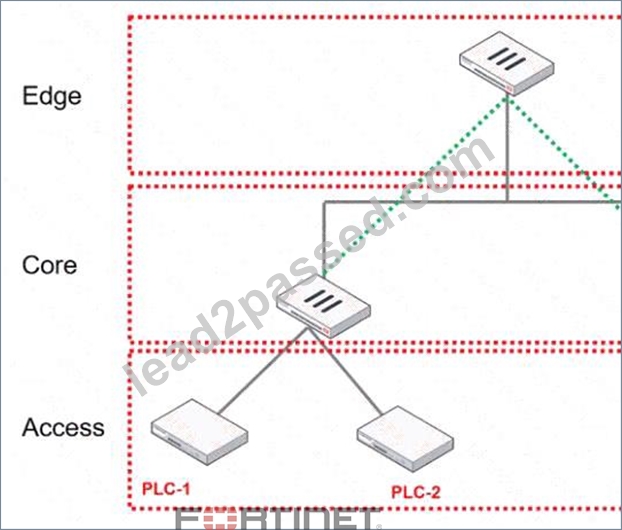
You are assigned to implement a remote authentication server in the OT network.
Which part of the hierarchy should the authentication server be part of?
- A. Edge
- B. Access
- C. Core
- D. Cloud
Answer: A
NEW QUESTION # 52
The operational technology (OT) network analyst runs different levels of reports to investigate threats that exploit the network. The analyst can run these reports on all routers, switches, and firewalls.
Which FortiSIEM reporting method can analysts use to identify threats that exploit image firmware files?
- A. CMDB reports
- B. OT/loT reports
- C. Threat hunting reports
- D. Compliance reports
Answer: C
Explanation:
Threat hunting reports let analysts query events and indicators (like anomalous firmware image access/use) across routers, switches, and firewalls, revealing exploits targeting firmware files.
NEW QUESTION # 53
An OT network architect needs to secure control area zones with a single network access policy to provision devices to any number of different networks. On which device can this be accomplished?
- A. FortiEDR
- B. FortiSwitch
- C. FortiNAC
- D. FortiGate
Answer: D
Explanation:
Network Access Policies are used to dynamically provision access to connecting endpoints, based on the matched user/host profiles associated with the network access configuration.
NEW QUESTION # 54
Refer to the exhibit, which shows a non-protected OT environment.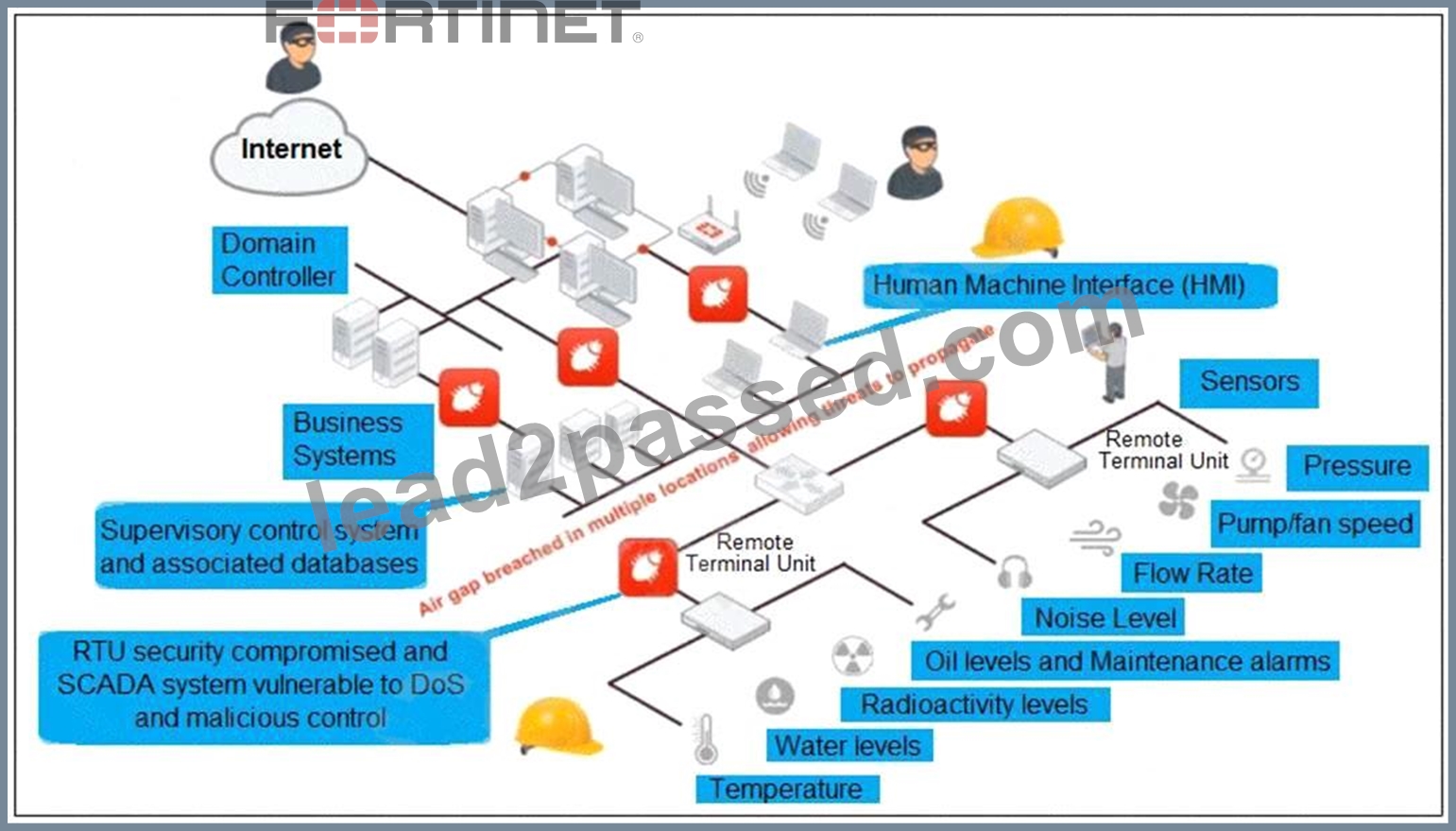
An administrator needs to implement proper protection on the OT network.
Which three steps should an administrator take to protect the OT network? (Choose three.)
- A. Deploy an edge FortiGate between the internet and an OT network as a one-arm sniffer.
- B. Deploy a FortiGate device within each ICS network.
- C. Use segmentation
- D. Configure firewall policies with web filter to protect the different ICS networks.
- E. Configure firewall policies with industrial protocol sensors
Answer: A,D,E
NEW QUESTION # 55
Refer to the exhibits.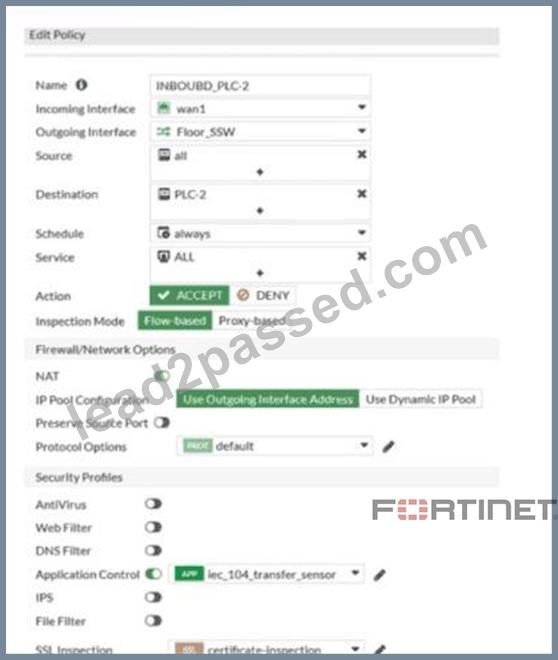
Which statement is true about the traffic passing through to PLC-2?
- A. IEC 104 signatures are all allowed except the C.BO.NA 1 signature.
- B. IPS must be enabled to inspect application signatures.
- C. The application filter overrides the default action of some IEC 104 signatures.
- D. SSL Inspection must be set to deep-inspection to correctly apply application control.
Answer: C
NEW QUESTION # 56
When device profiling rules are enabled, which devices connected on the network are evaluated by the device profiling rules?
- A. Rogue devices, only when they connect for the first time
- B. All connected devices, each time they connect
- C. Known trusted devices, each time they change location
- D. Rogue devices, each time they connect
Answer: A
NEW QUESTION # 57
Refer to the exhibits.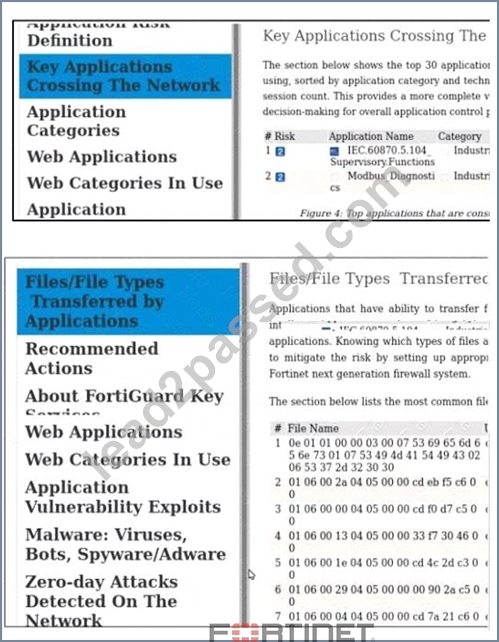
Which statement about some of the generated report elements from FortiAnalyzer is true?
- A. This report is predefined and is not available for customization.
- B. The report confirms Modbus and IEC 104 are the key applications crossing the network.
- C. The file types confirm the infected applications on the PLCs.
- D. FortiGate collects the logs and generates the report to FortiAnalyzer.
Answer: B
NEW QUESTION # 58
Refer to the exhibit.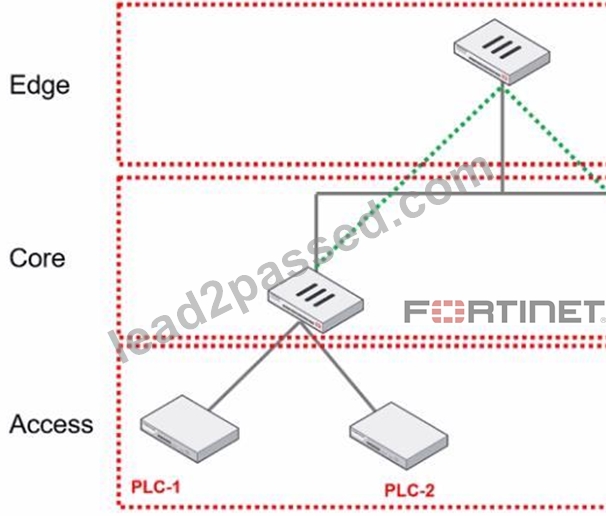
You are assigned to implement a remote authentication server in the OT network.
Which part of the hierarchy should the authentication server be part of?
- A. Edge
- B. Access
- C. Core
- D. Cloud
Answer: A
NEW QUESTION # 59
A FortiGate device is newly deployed as the edge gateway of an OT network security fabric. The downstream FortiGate devices are also newly deployed as Security Fabric leafs to protect the control area zone.
With no additional essential networking devices, and to implement micro-segmentation on this OT network, what configuration must the OT network architect apply to control intra-VLAN traffic?
- A. Enable security profiles on all interfaces connected in the control area zone.
- B. Create a software switch on each downstream FortiGate device.
- C. Enable transparent mode on the edge FortiGate device.
- D. Set up VPN tunnels between downstream and edge FortiGate devices.
Answer: B
NEW QUESTION # 60
When you create a user or host profile, which three criteria can you use? (Choose three.)
- A. Location
- B. Administrative group membership
- C. An existing access control policy
- D. Host or user attributes
- E. Host or user group memberships
Answer: A,D,E
Explanation:
Explanation
https://docs.fortinet.com/document/fortinac/9.2.0/administration-guide/15797/user-host-profiles
NEW QUESTION # 61
Refer to the exhibit, which shows a non-protected OT environment.
An administrator needs to implement proper protection on the OT network. Which three steps should an administrator take to protect the OT network? (Choose three.)
- A. Deploy an edge FortiGate between the internet and an OT network as a one-arm sniffer.
- B. Deploy a FortiGate device within each ICS network.
- C. Use segmentation
- D. Configure firewall policies with web filter to protect the different ICS networks.
- E. Configure firewall policies with industrial protocol sensors
Answer: A,D,E
NEW QUESTION # 62
Which two statements about the Modbus protocol are true? (Choose two.)
- A. Modbus is used to establish communication between intelligent devices.
- B. Modbus uses UDP frames to transport MBAP and function codes.
- C. You can implement Modbus networking settings on internetworking devices.
- D. Most of the PLC brands come with a built-in Modbus module.
Answer: C,D
NEW QUESTION # 63
As an OT administrator, it is important to understand how industrial protocols work in an OT network. Which communication method is used by the Modbus protocol?
- A. It uses OSI Layer 2 and the primary device sends data based on request from secondary device.
- B. It uses OSI Layer 2 and the secondary device sends data based on request from primary device.
- C. It uses OSI Layer 2 and both the primary/secondary devices always send data during the communication.
- D. It uses OSI Layer 2 and both the primary/secondary devices send data based on a matching token ring.
Answer: B
NEW QUESTION # 64
Refer to the exhibit. You are navigating through FortiSIEM in an OT network. How do you view information presented in the exhibit and what does the FortiGate device security status tell you?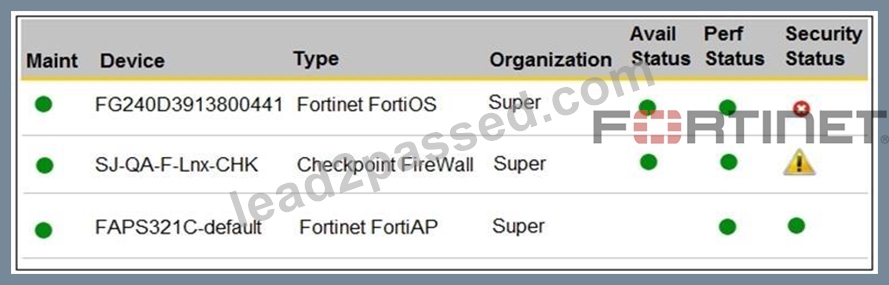
- A. In the PCI logging dashboard and there are one or more high-severity security incidents for the FortiGate device.
- B. In the summary dashboard and there are one or more high-severity security incidents for the FortiGate device.
- C. In the widget dashboard and there are one or more high-severity incidents for the FortiGate device.
- D. In the business service dashboard and there are one or more high-severity security incidents for the FortiGate device.
Answer: B
NEW QUESTION # 65
Refer to the exhibit and analyze the output.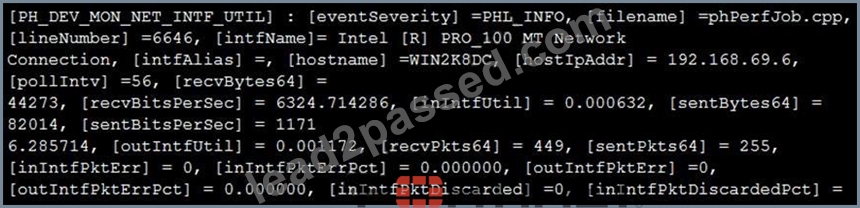
Which statement about the output is true?
- A. This is a sample of FortiGate interface statistics.
- B. This is a sample of a PAM event type.
- C. This is a sample of an SNMP temperature control event log.
- D. This is a sample of a FortiAnalyzer system interface event log.
Answer: B
NEW QUESTION # 66
Refer to the exhibit. The network topology in the exhibit shows FortiGate devices as well as FortiAnalyzer and FortiSIEM for the OT network.
Which two steps must you take to configure logging on the OT network'? (Choose two.)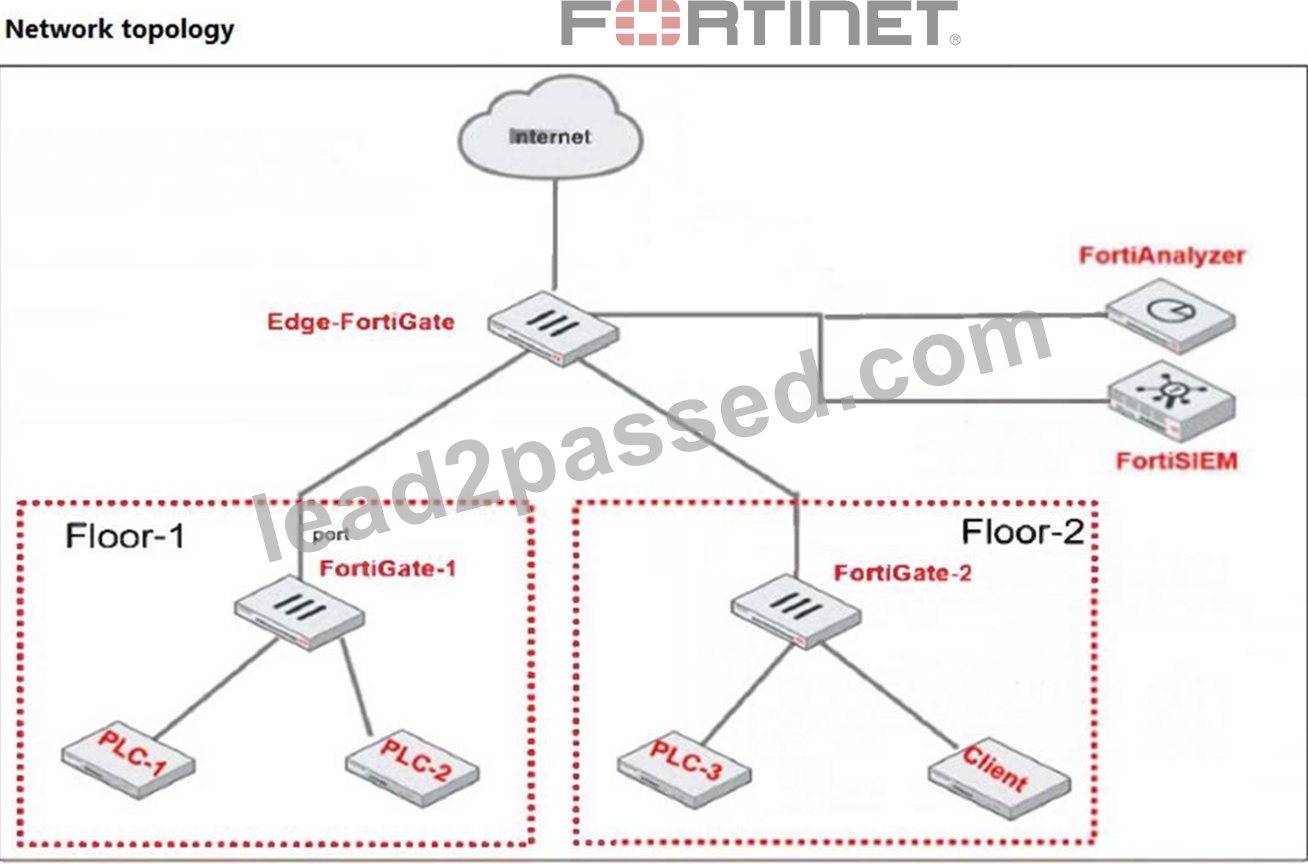
- A. Configure FortiGate to send logs to FortiAnalyzer and FortiSIEM.
- B. Configure FortiAnalyzer to send security events to FortiSIEM.
- C. Configure FortiSIEM to send logs and alerts to FortiAnalyzer.
- D. Configure FortiGate and FortiAnalyzer to send industrial signature patterns to FortiSIEM.
Answer: A,B
Explanation:
FortiGates must forward their logs directly to both FortiAnalyzer and FortiSIEM for storage and correlation. FortiAnalyzer then forwards relevant security events to FortiSIEM, enabling centralized analytics across OT devices.
NEW QUESTION # 67
Refer to the exhibit. The FGT-Edge device is a VPN gateway that allows remote administrators access to the local ICS network. Management hires a third-party company to conduct health and safety on site. The third-party company must have outbound access to external resources.
What is the best scenario to provide external access to the third-party company while continuing to secure the ICS networks?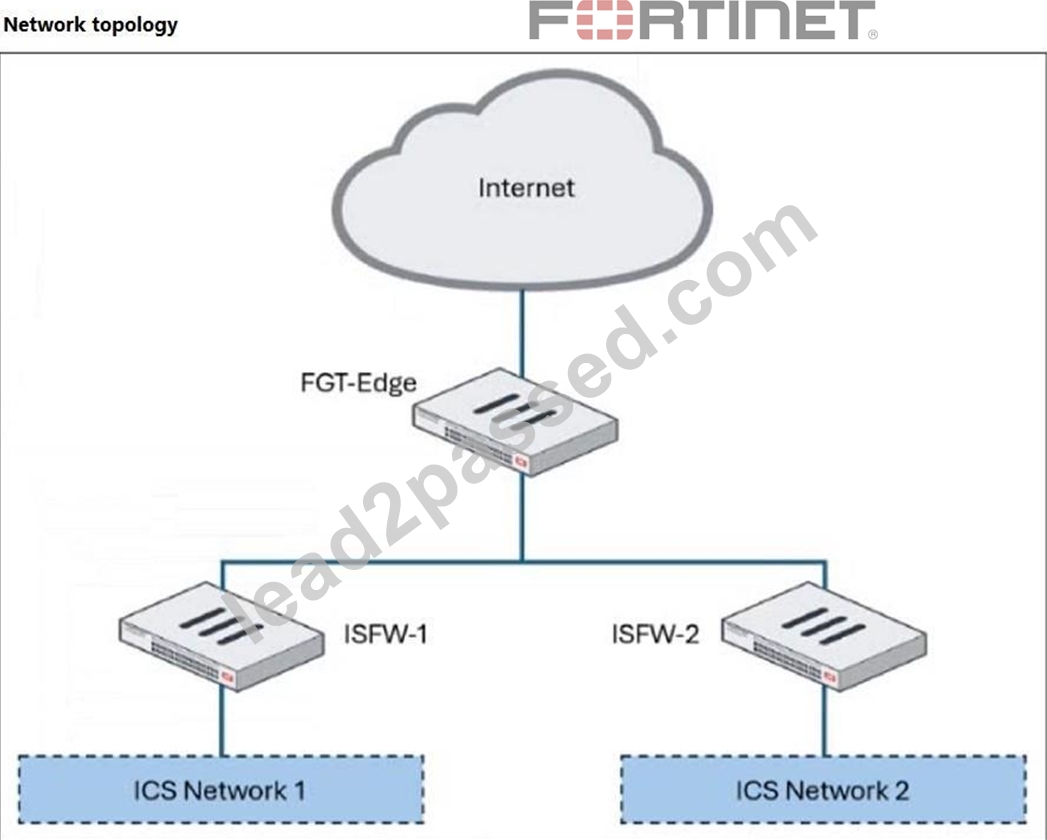
- A. Configure outbound security policies with limited active authentication users of the third-party company.
- B. Split the edge FortiGate device into multiple logical devices to allocate an independent VDOM for the third-party company.
- C. Create VPN tunnels between downstream FortiGate devices and the edge FortiGate to protect ICS network traffic.
- D. Implement an additional firewall using an additional upstream link to the internet.
Answer: B
Explanation:
By splitting the edge FortiGate into VDOMs, you isolate the third-party company in its own virtual firewall. That VDOM can have outbound internet policies without exposing or risking the ICS networks protected by the other VDOMs.
NEW QUESTION # 68
Refer to the exhibit.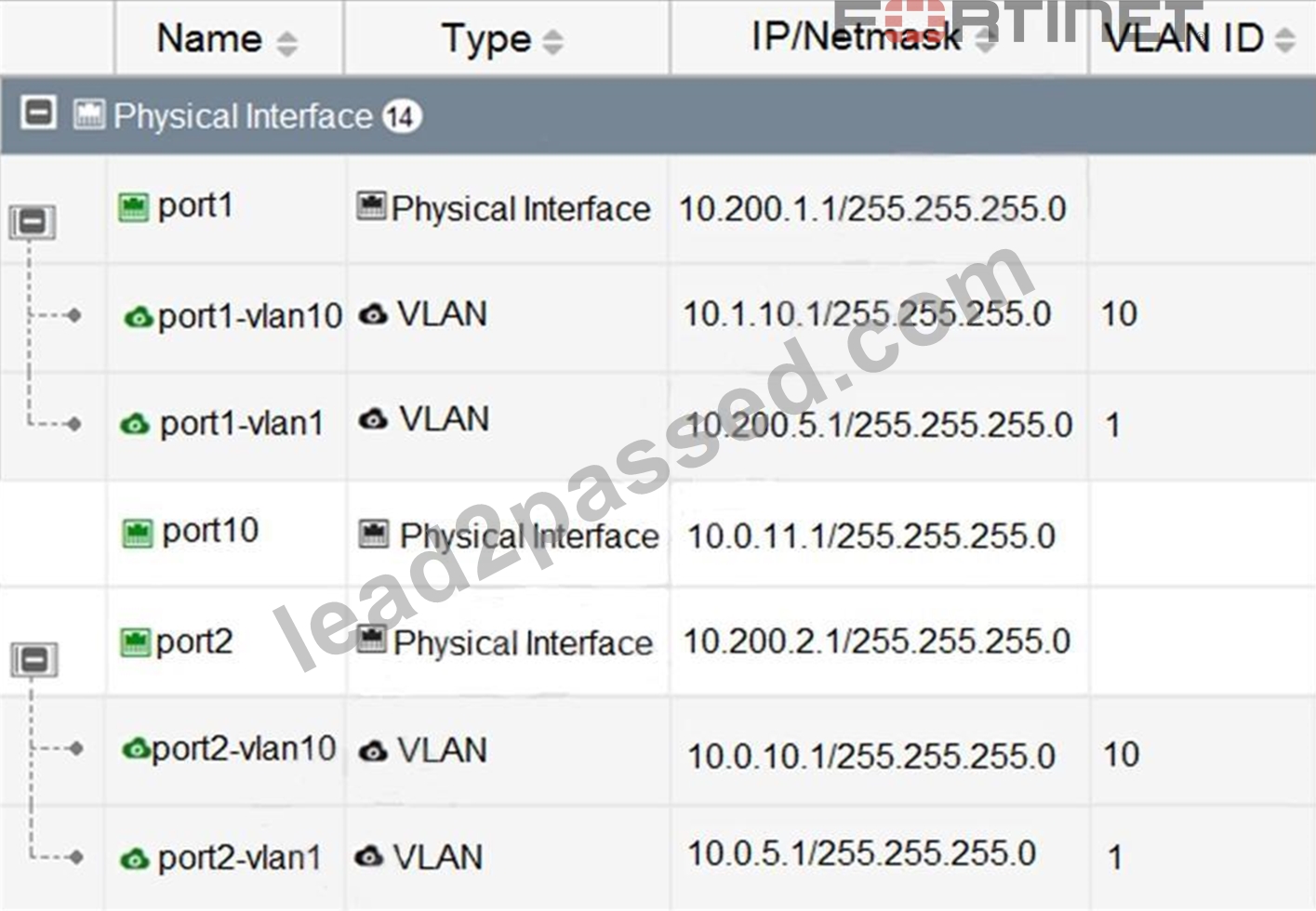
Which statement about the interfaces shown in the exhibit is true?
- A. The VLAN ID of port1-vlan1 can be changed to the VLAN ID 10.
- B. port1-vlan10 and port2-vlan10 are part of the same broadcast domain
- C. port2, port2-vlan10, and port2-vlan1 are part of the software switch interface.
- D. port1, port1-vlan10, and port1-vlan1 are in different broadcast domains
Answer: D
NEW QUESTION # 69
Which statement about how FortiNAC processes matched rogue devices is true?
- A. FortiNAC detects rogue devices by the IP address.
- B. FortiNAC matches the rogue device with only one device profiling rule.
- C. FortiNAC considers rogue devices as known endpoints.
- D. FortiNAC remembers the matching rule of the rogue device.
Answer: D
Explanation:
When FortiNAC detects a rogue device, it applies a device profiling rule and remembers the matching rule. This allows FortiNAC to maintain awareness of the rogue device's characteristics and behavior, enabling consistent monitoring and enforcement of security policies. This memory ensures that appropriate actions are taken when the device is detected again or exhibits suspicious activity.
NEW QUESTION # 70
What are two critical tasks the OT network auditors must perform during OT network risk assessment and management? (Choose two.)
- A. Planning a threat hunting strategy
- B. Creating disaster recovery plans to switch operations to a backup plant
- C. Evaluating what can go wrong before it happens
- D. Implementing strategies to automatically bring PLCs offline
Answer: A,C
Explanation:
Planning a threat hunting strategy is essential for proactively searching for threats and vulnerabilities in the OT environment before they manifest into attacks.
Evaluating what can go wrong before it happens is a core part of risk assessment, involving the identification and analysis of potential risks and their impacts on OT systems.
Implementing strategies to automatically bring PLCs offline is generally not a responsible or safe approach in OT environments because it could disrupt critical industrial processes.
Creating disaster recovery plans is important for overall business continuity but is not primarily a task of auditors during risk assessment-it is more of a broader business continuity or incident response responsibility.
NEW QUESTION # 71
Refer to the exhibit.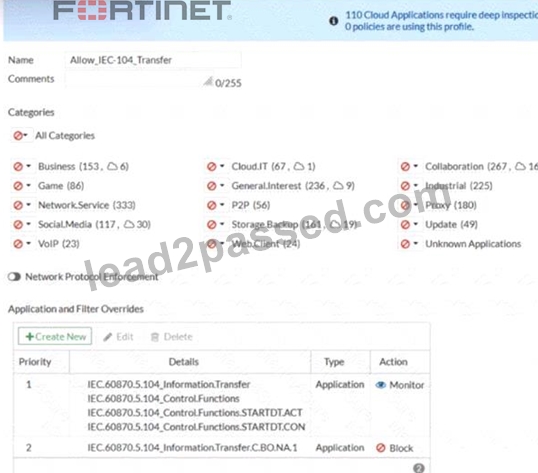
An OT network security audit concluded that the application sensor requires changes to ensure the correct security action is committed against the overrides filters.
Which change must the OT network administrator make?
- A. Remove IEC.60870.5.104 Information.Transfer from the first filter override.
- B. Change the security action of the industrial category to monitor.
- C. Set the priority of the C.BO.NA.1 signature override to 1.
- D. Set all application categories to apply default actions.
Answer: A
Explanation:
According to the Fortinet NSE 7 - OT Security 6.4 exam guide1, the application sensor settings allow you to configure the security action for each application category andnetwork protocol override. The security action determines how the FortiGate unit handles traffic that matches the application category or network protocol override. The security action can be one of the following:
* Allow: The FortiGate unit allows the traffic without any further inspection.
* Monitor: The FortiGate unit allows the traffic and logs it for monitoring purposes.
* Block: The FortiGate unit blocks the traffic and logs it as an attack.
The priority of the network protocol override determines the order in which the FortiGate unit applies the security action to the traffic. The lower the priority number, the higher the priority. For example, a priority of 1 is higher than a priority of 10.
In the exhibit, the application sensor has the following settings:
* The industrial category has a security action of allow, which means that the FortiGate unit will not inspect or log any traffic that belongs to this category.
* The IEC.60870.5.104 Information.Transfer network protocol override has a security action of block, which means that the FortiGate unit will block and log any traffic that matches this protocol.
* The IEC.60870.5.104 Control.Functions network protocol override has a security action of monitor, which means that the FortiGate unit will allow and log any traffic that matches this protocol.
* The IEC.60870.5.104 Start/Stop network protocol override has a security action of allow, which means that the FortiGate unit will not inspect or log any traffic that matches this protocol.
* The IEC.60870.5.104 Transfer.C.BO.NA.1 network protocol override has a security action of block, which means that the FortiGate unit will block and log any traffic that matches this protocol.
The problem with these settings is that the IEC.60870.5.104 Transfer.C.BO.NA.1 network protocol override has a lower priority than the IEC.60870.5.104 Information.Transfer network protocol override. This means that if the traffic matches both protocols, the FortiGate unit will apply the security action of the higher priority override, which is block. However, the IEC.60870.5.104 Transfer.C.BO.NA.1 protocol is used to transfer binary outputs, which are essential for controlling OT devices. Therefore, blocking this protocol could have negative consequences for the OT network.
To fix this issue, the OT network administrator must set the priority of the IEC.60870.5.104 Transfer.C.BO.NA.1 network protocol override to 1, which is higher than the priority of the IEC.60870.5.104 Information.Transfer network protocol override. This way, the FortiGate unit will apply the security action of the lower priority override, which is allow, to the traffic that matches both protocols. This will ensure that the FortiGate unit does not block the traffic that is used to transfer binary outputs, while still blocking the traffic that is used to transfer information.
1: NSE 7 Network Security Architect - Fortinet
NEW QUESTION # 72
Refer to the exhibit. The IPS profile is added on all of the security policies on FortiGate. For an OT network, which statement of the IPS profile is true?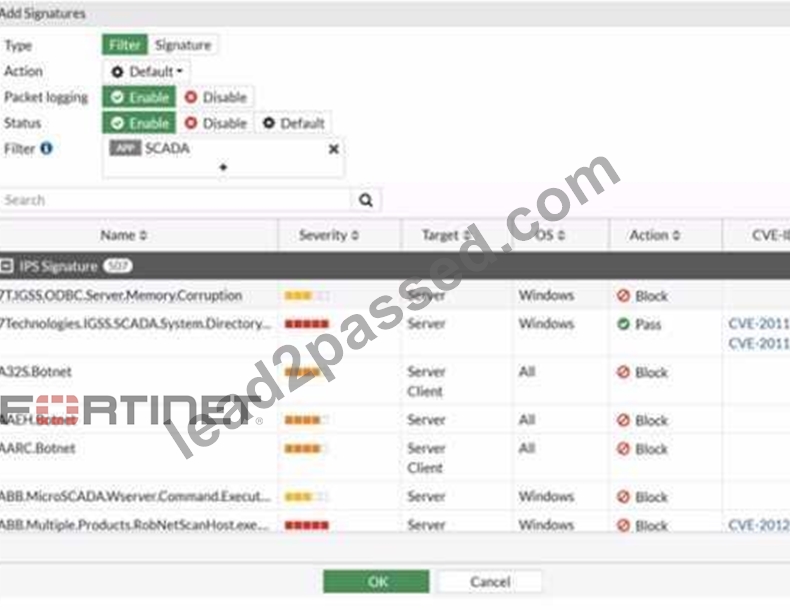
- A. The listed IPS signatures are classified as SCADAapphcat nns
- B. FortiGate has no IPS industrial signature database enabled.
- C. All IPS signatures are overridden and must block traffic match signature patterns.
- D. The IPS profile inspects only traffic originating from SCADA equipment.
Answer: A
NEW QUESTION # 73
Refer to the exhibit.
Based on the topology designed by the OT architect, which two statements about implementing OT security are true? (Choose two.)
- A. Micro-segmentation can be achieved only by replacing FortiGate-3 and FortiGate-4 with a pair of FortiSwitch devices.
- B. Firewall policies should be configured on FortiGate-3 and FortiGate-4 with industrial protocol sensors.
- C. FortiGate-3 and FortiGate-4 devices must be in a transparent mode.
- D. IT and OT networks are separated by segmentation.
Answer: B,D
NEW QUESTION # 74
......
The NSE7_OTS-7.2 exam covers a wide range of topics related to OT security, including network segmentation, risk assessment, threat detection and response, access control, and more. NSE7_OTS-7.2 exam consists of multiple-choice questions and is designed to be challenging, requiring a thorough understanding of the subject matter.
The NSE7_OTS-7.2 certification is highly regarded in the industry and is recognized as a benchmark for OT security professionals. Fortinet NSE 7 - OT Security 7.2 certification demonstrates that the candidate has the skills and knowledge required to design, implement, and manage secure OT networks and systems using Fortinet solutions. Fortinet NSE 7 - OT Security 7.2 certification is valid for two years and requires candidates to renew their certification by passing a recertification exam or earning continuing education credits.
NSE7_OTS-7.2 Dumps To Pass Fortinet Exam in 24 Hours - Lead2Passed: https://www.lead2passed.com/Fortinet/NSE7_OTS-7.2-practice-exam-dumps.html
Buy Latest NSE7_OTS-7.2 Exam Q&A PDF - One Year Free Update: https://drive.google.com/open?id=1--KNFNk2stkWFChaO5nRMJ15czcGK4E1