Among the accreditations an IT engineer can chase in 2026, the IBM Assessment: IBM WebSphere Process Server V7.0, Integration Development is one of the smartest. Lead2Passed backs your chase with 104 practice questions.
IBM A2180-607 Exam Overview:
| Certification Vendor: | IBM |
|---|---|
| Exam Name: | Assessment: IBM WebSphere Process Server V7.0, Integration Development |
| Exam Number: | A2180-607 |
| Related Certifications: | IBM Certified Solution Developer - WebSphere Process Server V7.0 |
| Real Exam Qty: | 60-75 |
| Exam Duration: | 90-120 |
| Available Languages: | English |
| Exam Format: | Scenario-based questions, Multiple choice |
| Sample Questions: | DOWNLOAD DEMO |
| Exam Way: | Proctored online or test center-based exam depending on region |
| Pre Condition: | Recommended experience with IBM WebSphere Application Server and SOA concepts |
| Official Syllabus URL: | https://www.ibm.com/certification |
IBM A2180-607 Exam Syllabus Topics:
| Section | Objectives |
|---|---|
| Service Component Architecture (SCA) Fundamentals | - Business object design
|
| Development and Deployment | - Deployment and administration
|
| Mediation and Integration | - Adapters and connectivity
|
| Security and Transactions | - Transaction management
|
| Business Process Execution Language (BPEL) | - Process modeling
|
IBM Assessment: IBM WebSphere Process Server V7.0, Integration Development Exam — FAQ
90-120, 60-75 questions — that's your time budget. Rehearse it: the Lead2Passed online engine runs simulation tests with automatic settings, so pacing becomes trained, not lucky.
Files arrive first: our system emails your purchase within a minute of successful payment — unlimited installations, and 24/7 support if nothing shows up within 2 hours (check spam). Failure is covered too: take the corresponding A2180-607 exam within 60 days of purchase, and if you don't pass, submit a scanned enrollment slip plus the official Score Report PDF within 2 days of the exam for a full refund, processed within 7 days. Exclusions: exams within 3 days of purchase, candidate names that don't match the payer, and free or expired products. You can also choose a free replacement — two other products of equal value.
Recommended experience with IBM WebSphere Application Server and SOA concepts Eligibility rules change from time to time, so confirm the current requirements on the official page (official A2180-607 exam page) before booking.
The IBM Assessment: IBM WebSphere Process Server V7.0, Integration Development blueprint spans 5 domains — including Mediation and Integration, Development and Deployment, Business Process Execution Language (BPEL). The weightings are your study map: allocate hours where the points are. Every subtopic appears in the outline above.
Yes — download the free A2180-607 demo before buying and assess the quality and reliability yourself; it's the best way to avoid wasting money on bootless material. Purchases include 365 days of free updates, renewable later at half price.
The IBM Assessment: IBM WebSphere Process Server V7.0, Integration Development is IBM's certification exam for WebSphere, at the Professional level. Passing it demonstrates proficiency with specific technologies — a credential employers from small business to enterprise recognize. Related credentials include IBM Certified Solution Developer - WebSphere Process Server V7.0.
IBM Assessment: IBM WebSphere Process Server V7.0, Integration Development Sample Questions:
Refer to the Exhibits.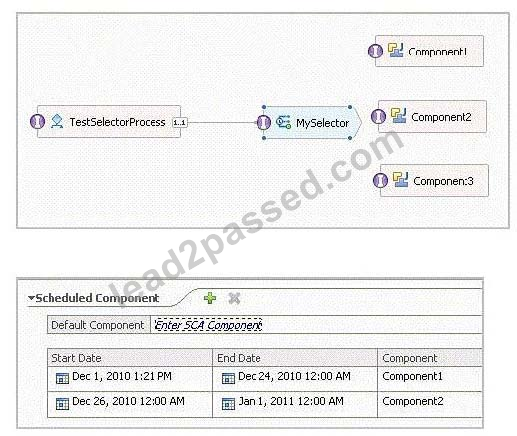
Which of the following statements is TRUE regarding this configuration?
- A. If MySelector is invoked on December 25, 2010, a runtime exception will occur.
- B. Compile errors occur because there is no default component configured.
- C. Component1 and Component2 cannot have different implementation types.
- D. A runtime exception will be thrown if Component2 is implemented as a business rule.
Correct Answer: A 🗳️
Refer to the Exhibit.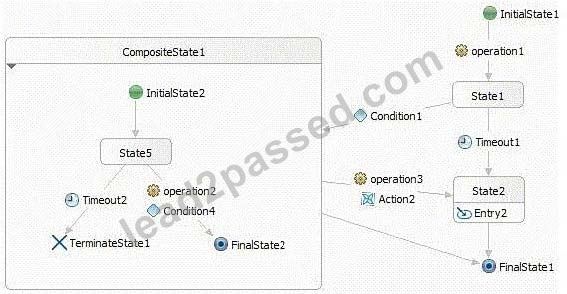
Which of the following statement correctly describes the implementation? If the state machine is waiting in State5, then:
- A. an invocation of operation3 will cause Action2 to execute.
- B. Action2 will never run because there is an unguarded transition leaving the composite state.
- C. if the time expires on Timeout2 before operation2 is invoked, the composite state will terminate and processing will continue.
- D. Condition4 must evaluate to true before operation2 can be invoked.
Correct Answer: A 🗳️
Refer to the Exhibit.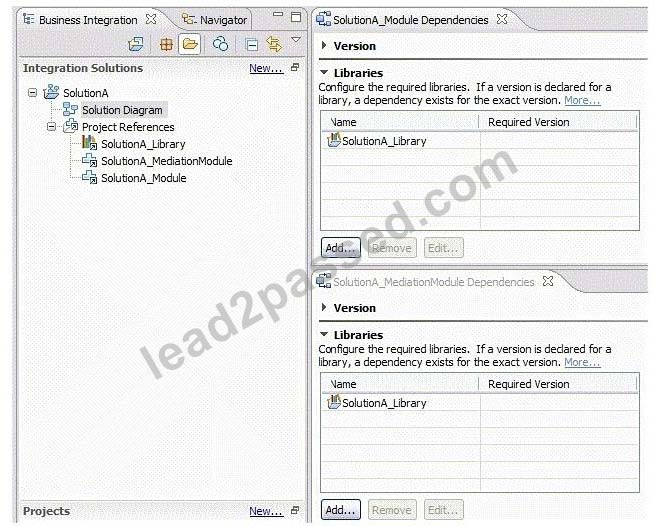
As shown in the Exhibit, both modules of SolutionA reference the library, which is configured to be deployed with the module. If an integration developer exports SolutionA for server deployment, the result is:If an integration developer exports SolutionA for server deployment, the result is:
- A. two enterprise archives, one for each module, each containing the archives for the library.
- B. two enterprise archives, one for each module, and only one contains the archive for the library.
- C. three enterprise archives, one for each module, and one for the library.
- D. one enterprise archive containing the archives for the integration solution, the library, and both modules.
Correct Answer: A 🗳️
Refer to the exhibit.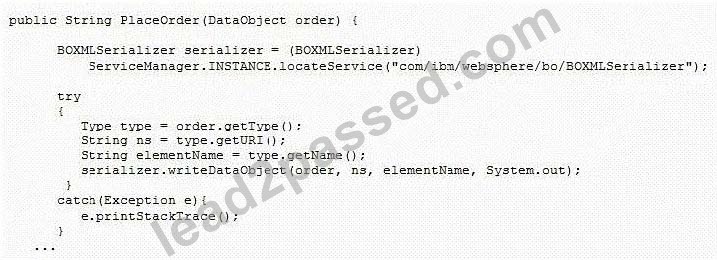
Examine the fragment of Java code implementing PlaceOrder method in the exhibit. The code in the exhibit is intended to:
- A. write the contents of the input data object in the trace.log.
- B. write the contents of the input data object to the SystemErr.log.
- C. serialize and copy the input data object.
- D. write the contents of the input data object in the SystemOut.log.
Correct Answer: D 🗳️
An integration developer has created a single module to hold a parent BPEL process along with multiple child BPEL processes, which are all invoked by the parent process in a large application. The developer is considering reorganizing this application to position himself to better respond to potential changes over the lifetime of the application. What advice should be given to this developer as he decides how to reorganize this project?
- A. Place each BPEL process into its own module, then review the entire project placing all commonly used project artifacts into a separate module to promote their reuse.
- B. Review each module in the application looking for artifacts that can be reused in multiple modules. Use libraries to reorganized the project and avoid leaving reusable artifacts in modules because that would make them private.
- C. Use an integration solution to reorganize the project into smaller modules based on their core functions, and place any commonly used project artifacts into a library.
- D. Review each child BPEL process looking for functionality that is commonly used throughout the application. Place this functionality into a new BPEL process using a library so that it can be shared by the other processes.
Correct Answer: B 🗳️
Viewing page 1 out of 21 pages.
Viewing questions 1-5 out of 104 questions.
 736 Customer Reviews