(2026) MS-102 Exam Dumps, Practice Test Questions BUNDLE PACK
Microsoft 365 Certified Certification MS-102 Sample Questions Reliable
Microsoft MS-102 Exam Syllabus Topics:
| Topic | Details |
|---|---|
| Topic 1 |
|
| Topic 2 |
|
| Topic 3 |
|
| Topic 4 |
|
NEW QUESTION # 221
HOTSPOT
You have a Microsoft 365 subscription that contains a Microsoft 365 group named Group1. Group1 is configured as shown in the following exhibit.
An external user named User1 has an email address of [email protected].
You need to add User1 to Group1.
What should you do first, and which portal should you use? To answer, select the appropriate options in the answer area.
NOTE: Each correct selection is worth one point.
Answer:
Explanation:
Explanation:
Box 1: Invite User1 to collaborate with your organization as a guest.
To manage guest users of a Microsoft 365 tenant via the Admin Center portal, go through the following steps.
Navigate with your Web browser to https://admin.microsoft.com.
On the left pane, click on "Users", then click "Guest Users".
On the "Guest Users" page, to create a new guest user, click on either the "Add a guest user" link on the top of the page or click on "Go to Microsoft Entra ID to add guest users" link at the bottom of the page. Both of these links will take you to the Microsoft Entra ID portal, which is located at https://aad.portal.azure.com.
On the "New user" page in the Microsoft Azure portal, you must choose to either "Create user" or "Invite user". If you choose the "Create user" option, this will create a new user in your organization, which will have a login address with format username@tenantdomain,dot,com. If you choose the "Invite user" option, this will invite a new guest user to collaborate with your organization. The user will be emailed an email invitation which they can accept in order to begin collaborating. For the purpose of creating a guest user, you must choose the "Invite user" option.
Box 2: The Microsoft Entra admin center
Microsoft Entra admin center unites Microsoft Entra ID with family of identity and access products Microsoft Entra admin center gives customers an entire toolset to secure access for everyone and everything in multicloud and multiplatform environments. The entire Microsoft Entra product family is available at this new admin center, including Microsoft Entra ID (Microsoft Entra ID) and Microsoft Entra Permissions Management, formerly known as CloudKnox.
Starting this month, waves of customers will begin to be automatically directed to entra.microsoft.com from Microsoft 365 in place of the Microsoft Entra admin center (aad.portal.azure.com).
Reference:
https://stefanos.cloud/kb/how-to-manage-microsoft-365-guest-users
https://m365admin.handsontek.net/microsoft-entra-admin-center-unites-azure-ad-with-family-of-identity-and- access-products
NEW QUESTION # 222
You have three devices enrolled in Microsoft Endpoint Manager as shown in the following table.
The device compliance policies in Endpoint Manager are configured as shown in the following table.
The device compliance policies have the assignments shown in the following table.
For each of the following statements, select Yes if the statement is true. Otherwise, select No. NOTE: Each correct selection is worth one point.
Answer:
Explanation:
Explanation:
NEW QUESTION # 223
You have a Microsoft 365 E5 subscription that contains two security groups named Group1 and Group2. You need to recommend an authentication solution that meets the following requirements:
* Members of Group1 must be able to authenticate by using a hardware token.
* Members of Group2 must be able to authenticate by using a public key infrastructure (PKI).
Which authentication method should you recommend for each group? To answer, drag the appropriate methods to the correct groups. Each method may be used once, more than once, or not at all. You may need to drag the split bar between panes or scroll to view content.
NOTE: Each correct selection is worth one point.
Answer:
Explanation:
Explanation:
NEW QUESTION # 224
You have a Microsoft 365 E5 subscription.
You need to create a Conditional Access policy that will require the use of FID02 security keys only when users join their Windows devices to Microsoft Entra ID.
How should you configure the policy? To answer, select the appropriate options in the answer area.
NOTE Each correct selection is worth one point.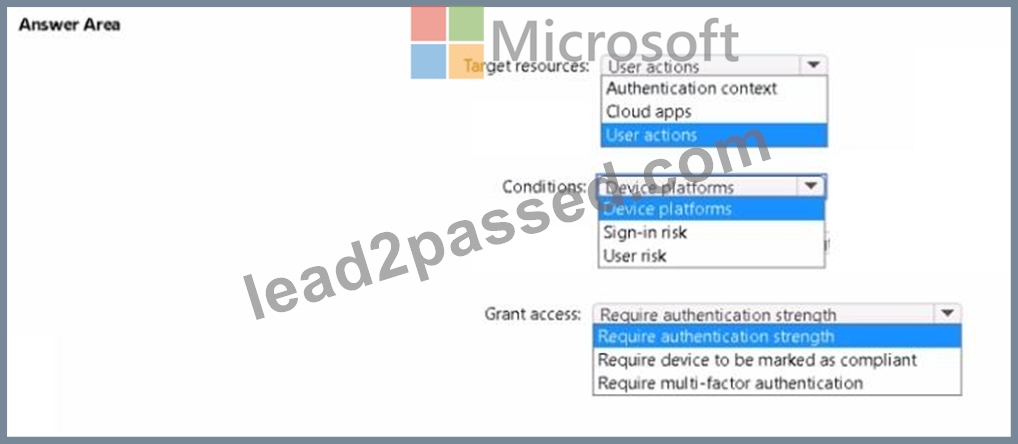
Answer:
Explanation:
NEW QUESTION # 225
HOTSPOT
Your network contains an on-premises Active Directory domain.
You have a Microsoft 365 E5 subscription.
You plan to implement directory synchronization.
You need to identify potential synchronization issues for the domain. The solution must use the principle of least privilege.
What should you use? To answer, select the appropriate options in the answer area.
NOTE: Each correct selection is worth one point.
Answer:
Explanation:
Explanation:
Box 1: IdFix
Query and fix invalid object attributes with the IdFix tool
Microsoft is working to reduce the time required to remediate identity issues when onboarding to Microsoft
365. A portion of this effort is intended to address the time involved in remediating the Windows Server Active Directory (Windows Server AD) errors reported by the directory synchronization tools such as Azure AD Connect and Azure AD Connect cloud sync. The focus of IdFix is to enable you to accomplish this task in a simple, expedient fashion.
The IdFix tool provides you the ability to query, identify, and remediate the majority of object synchronization errors in your Window's Server AD forests in preparation for deployment to Microsoft 365.
The utility does not fix all errors, but it does find and fix the majority. This remediation will then allow you to successfully synchronize users, contacts, and groups from on-premises Active Directory into Microsoft 365.
Note: IdFix might identify errors beyond those that emerge during synchronization. The most common example is compliance with rfc 2822 for smtp addresses. Although invalid attribute values can be synchronized to the cloud, the product group recommends that these errors be corrected.
Incorrect:
* AccessChk
Box 2: Enterprise Admins
IdFix permissions requirements
The user account that you use to run IdFix must have read and write access to the AD DS domain.
If you aren't sure if your user account meets these requirements, and you're not sure how to check, you can still download and run IdFix. If your user account doesn't have the right permissions, IdFix will simply display an error when you try to run it.
* Enterprise Admins
The Enterprise Admins group exists only in the root domain of an Active Directory forest of domains. The group is a Universal group if the domain is in native mode. The group is a Global group if the domain is in mixed mode. Members of this group are authorized to make forest-wide changes in Active Directory, like adding child domains.
Incorrect:
* Domain Admins
Members of the Domain Admins security group are authorized to administer the domain. By default, the Domain Admins group is a member of the Administrators group on all computers that have joined a domain, including the domain controllers. The Domain Admins group is the default owner of any object that ' s created in Active Directory for the domain by any member of the group. If members of the group create other objects, such as files, the default owner is the Administrators group.
* Server Operator
Server Operators can log on to a server interactively; create and delete network shares; start and stop services; back up and restore files; format the hard disk of the computer; and shut down the computer. Any service that accesses the system has the Service identity.
* Domain Users - too few permissions
The Domain Users group includes all user accounts in a domain. When you create a user account in a domain, it ' s automatically added to this group.
Reference:
https://microsoft.github.io/idfix/
https://learn.microsoft.com/en-us/windows-server/identity/ad-ds/manage/understand-security-groups
NEW QUESTION # 226
DRAG DROP
You have a Microsoft 365 E5 subscription that contains two groups named Group1 and Group2.
You need to ensure that each group can perform the tasks shown in the following table.
The solution must use the principle of least privilege.
Which role should you assign to each group? To answer, drag the appropriate roles to the correct groups. Each role may be used once, more than once, or not at all. You may need to drag the split bar between panes or scroll to view content.
NOTE: Each correct selection is worth one point.
Answer:
Explanation:
Explanation:
Box 1: Billing admin
manage service request
Purchase new services
Etc.
Assign the Billing admin role to users who make purchases, manage subscriptions and service requests, and monitor service health.
Box 2: User admin
User admin
Assign the User admin role to users who need to do the following for all users:
- Add users and groups
- Assign licenses
- Manage most users properties
- Create and manage user views
- Update password expiration policies
- Manage service requests
- Monitor service health
Reference:
https://learn.microsoft.com/en-us/microsoft-365/admin/add-users/about-admin-roles
NEW QUESTION # 227
HOTSPOT
You have a Microsoft 365 subscription that contains the users shown in the following table.
You need to configure a dynamic user group that will include the guest users in any department that contains the word Support.
How should you complete the membership rule? To answer, select the appropriate options in the answer area.
NOTE: Each correct selection is worth one point.
Answer:
Explanation:
Explanation:
Box 1: -eq " Guest "
Dynamic membership rules for groups in Microsoft Entra ID
Supported expression operators
The following table lists all the supported operators and their syntax for a single expression. Operators can be used with or without the hyphen (-) prefix. The Contains operator does partial string matches but not item in a collection matches.
* Equals
-eq
* Contains
-contains
* Etc.
Box 2: -contains " Support "
Incorrect:
* -in
If you want to compare the value of a user attribute against multiple values, you can use the -in or -notIn operators.
Reference:
https://learn.microsoft.com/en-us/azure/active-directory/enterprise-users/groups-dynamic-membership
NEW QUESTION # 228
You have a Microsoft 365 E5 subscription that contains the users shown in the following table.
You have a Microsoft Office 365 retention label named Retention1 that is published to Exchange email.
You have a Microsoft Exchange Online retention policy that is applied to all mailboxes. The retention policy contains a retention tag named Retention2.
Which users can assign Retention1 and Retention2 to their emails? To answer, select the appropriate options in the answer area.
NOTE: Each correct selection is worth one point.
Answer:
Explanation:
Explanation:
Reference:
https://docs.microsoft.com/en-us/microsoft-365/compliance/retention-policies-exchange?view=o365- worldwide
NEW QUESTION # 229
You have a Microsoft 365 E5 subscription.
You need to use Microsoft Defender for Cloud Apps to monitor user mailbox activities. What should you do?
- A. Create an activity policy.
- B. Enable mailbox audit logging.
- C. Create an access policy.
- D. Create an app connector for Microsoft 365.
Answer: B
NEW QUESTION # 230
You have a Microsoft 365 subscription.
All users have their email stored in Microsoft Exchange Online.
In the mailbox of a user named User1. you need to preserve a copy of all the email messages that contain the word ProjectX.
What should you do first?
- A. From the Exchange admin center create a mail flow rule.
- B. From Microsoft Defender XDR, start a message trace.
- C. From the Microsoft Purview compliance portal, create a label and a label policy.
- D. From Microsoft Defender for Cloud Apps, create an activity policy.
Answer: C
NEW QUESTION # 231
You have a Microsoft 365 E5 subscription that uses Microsoft intune. The subscription contains the resources shown in the following table.
User1 is the owner of Device1.
You add Microsoft 365 Apps Windows 10 and later app types to Intune as shown in the following table.
On Thursday, you review the results of the app deployments.
For each of the following statements, select Yes if the statement is true. Otherwise, select No.
NOTE: Each correct selection is worth one point.
Answer:
Explanation:
Explanation:
NEW QUESTION # 232
You have a hybrid Azure Active Directory (Azure AD) tenant and a Microsoft Endpoint Configuration Manager deployment.
You have the devices shown in the following table.
You plan to enable co-management.
You need to identify which devices support co-management without requiring the installation of additional software.
Which devices should you identify?
- A. Device2 and Device3 only
- B. Device1 only
- C. Device2 only
- D. Device3 only
- E. Device1, Device2, and Device3
Answer: A
NEW QUESTION # 233
You have a Microsoft 365 subscription.
You plan to implement Microsoft Purview Privileged Access Management.
Which Microsoft Office 365 workloads support privileged access?
- A. Microsoft Teams and SharePoint Online only
- B. Microsoft Exchanqe Online and SharePoint Online only
- C. Microsoft Exchange Online only
- D. Microsoft Teams only
- E. Microsoft Teams, Exchanqe Online, and SharePoint Online
Answer: C
Explanation:
Privileged access management
Having standing access by some users to sensitive information or critical network configuration settings in Microsoft Exchange Online is a potential pathway for compromised accounts or internal threat activities.
Microsoft Purview Privileged Access Management helps protect your organization from breaches and helps to meet compliance best practices by limiting standing access to sensitive data or access to critical configuration settings. Instead of administrators having constant access, just-in-time access rules are implemented for tasks that need elevated permissions. Enabling privileged access management for Exchange Online in Microsoft
365 allows your organization to operate with zero standing privileges and provide a layer of defense against standing administrative access vulnerabilities.
Note: When will privileged access support Office 365 workloads beyond Exchange?
Privileged access management will be available in other Office 365 workloads soon.
Reference:
https://learn.microsoft.com/en-us/microsoft-365/compliance/privileged-access-management-solution-overview
https://learn.microsoft.com/en-us/microsoft-365/compliance/privileged-access-management
NEW QUESTION # 234
Your network contains an on-premises Active Directory Domain Services (AD DS) domain named contoso.
com. The domain contains the users shown in the following table.
You have a Microsoft Entra tenant that syncs with contoso.com by using Microsoft Entra Connect Sync.
Microsoft Entra Connect Sync is configured as shown in the exhibit. (Click the Exhibit tab.)
The Microsoft Entra tenant contains a cloud-only group named Group1 as shown in the following table.
You perform the following tasks at 10 AM:
* In contoso.com, you move User1 to OU2.
* In the Microsoft Entra tenant, you delete User2.
* In contoso.com, you create a computer account named Comp1 in OU1 and update the description of Comp1.
For each of the following statements, select Yes if the statement is true. Otherwise, select No.
NOTE: Each correct selection is worth one point.
Answer:
Explanation:
Explanation:
Statement
Answer
By 11 AM, User1 has become a member of Group1.
No
At 11 AM, User2 is removed from contoso.com.
No
At 11 AM, the description property of Comp1 syncs to the Microsoft Entra tenant.
No
Microsoft Entra Connect Sync OU filtering controls which on-premises objects appear in Microsoft Entra ID.
Microsoft states that when previously synchronized objects are later filtered out, those objects are deleted in Microsoft Entra ID. Since User1 is moved from synced OU1 to unsynced OU2, User1 is no longer in scope and is removed from the active Microsoft Entra sync result, so User1 does not newly become/remain an active Group1 member by 11 AM. Microsoft also states that the sync scheduler runs every 30 minutes by default, so the change can be processed before 11 AM.
User2 is cloud-only in Microsoft Entra ID because on-premises sync is disabled. Deleting that cloud object does not delete the separate on-premises AD DS user. Microsoft Entra Connect's normal direction is on- premises AD DS to Microsoft Entra ID; writeback is limited to specific configured scenarios such as password writeback, not cloud deletion of users back into AD DS.
Comp1 also does not satisfy the statement. Microsoft documents that Windows domain-joined computer
/device synchronization includes only specific device attributes, such as displayName, objectGUID, operatingSystem, operatingSystemVersion, objectSID, and userCertificate. description is not listed as a synchronized device attribute.
NEW QUESTION # 235
Your company purchases a cloud app named App1.
You need to ensure that you can use Microsoft Cloud App Security to block downloads in App1. App1 supports session controls.
Which three actions should you perform in sequence? To answer, move the appropriate actions from the list of actions to the answer area and arrange them in the correct order.
Answer:
Explanation:
Explanation:
Reference:
https://docs.microsoft.com/en-us/cloud-app-security/getting-started-with-cloud-app-security
NEW QUESTION # 236
You need to meet the technical requirement for log analysis.
What is the minimum number of data sources and log collectors you should create from Microsoft Cloud App Security? To answer, select the appropriate options in the answer area.
NOTE: Each correct selection is worth one point.
Answer:
Explanation:
Explanation: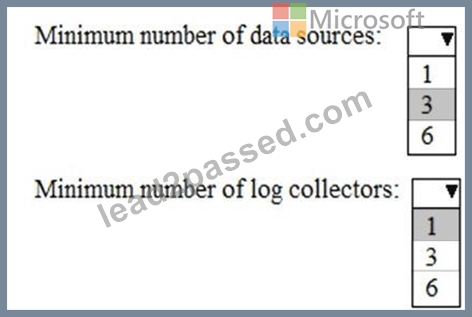
References:
https://docs.microsoft.com/en-us/cloud-app-security/discovery-docker
NEW QUESTION # 237
You have a Microsoft 365 E5 subscription that contains the devices shown in the following table.
All the devices are onboarded To Microsoft Defender for Endpoint
You plan to use Microsoft Defender Vulnerability Management to meet the following requirements:
* Detect operating system vulnerabilities.
Answer:
Explanation:
Explanation:
NEW QUESTION # 238
HOTSPOT
You have a Microsoft 365 E5 subscription.
You need to implement identity protection. The solution must meet the following requirements:
* Identify when a user's credentials are compromised and shared on the dark web.
* Provide users that have compromised credentials with the ability to self-remediate.
What should you do? To answer, select the appropriate options in the answer area.
NOTE: Each correct selection is worth one point.
Answer:
Explanation:
Explanation:
Box 1: A user risk policy
Identify when a user's credentials are compromised and shared on the dark web.
User risk-based Conditional Access policy
Identity Protection analyzes signals about user accounts and calculates a risk score based on the probability that the user has been compromised. If a user has risky sign-in behavior, or their credentials have been leaked, Identity Protection will use these signals to calculate the user risk level. Administrators can configure user risk-based Conditional Access policies to enforce access controls based on user risk, including requirements such as:
Block access
Allow access but require a secure password change.
A secure password change will remediate the user risk and close the risky user event to prevent unnecessary noise for administrators.
Box 2: Require password change
Provide users that have compromised credentials with the ability to self-remediate.
A secure password change will remediate the user risk and close the risky user event to prevent unnecessary noise for administrators Reference:
https://learn.microsoft.com/en-us/azure/active-directory/identity-protection/concept-identity-protection-policies#
NEW QUESTION # 239
You have a Microsoft 365 subscription that contains the users in the following table.
In Microsoft Endpoint Manager, you create two device type restrictions that have the settings shown in the following table.
In Microsoft Endpoint Manager, you create three device limit restrictions that have the settings shown in the following table.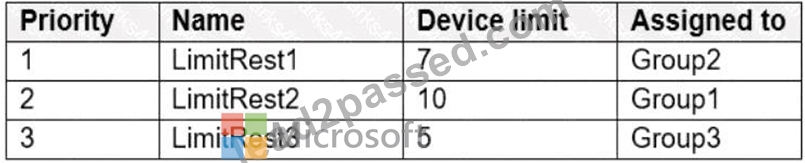
For each of the following statements, select Yes if the statement is true. Otherwise, select No.
NOTE: Each correct selection is worth one point.
Answer:
Explanation:
Explanation:
NEW QUESTION # 240
You have a Microsoft 365 E5 subscription.
You plan to implement identity protection by configuring a sign-in risk policy and a user risk policy. Which type of risk is detected by each policy? To answer, select the appropriate options in the answer area.
NOTE: Each correct selection is worth one point.
Answer:
Explanation:
Explanation:
NEW QUESTION # 241
......
Prepare for the Actual Microsoft 365 Certified MS-102 Exam Practice Materials Collection: https://www.lead2passed.com/Microsoft/MS-102-practice-exam-dumps.html
Microsoft 365 Certified Certified Official Practice Test MS-102: https://drive.google.com/open?id=1ZYcmxhdIpulpI8SjYBWNuDiwjOBHaxi4