4A0-N01 Practice Test Questions Updated 65 Questions
Nokia 4A0-N01 Dumps - Secret To Pass in First Attempt
NEW QUESTION 37
What does VSD stand for?
- A. Virtualized Services Domain
- B. Virtualized Services Description
- C. Virtualized Services Definition
- D. Virtualized Services Directory
Answer: D
Explanation:
Explanation/Reference:
Explanation:
Nuage Virtual Service Directory (VSD)
Reference: https://matscloud.blogspot.com/2017/06/nuage-networks-vsp-deep-dive.html
NEW QUESTION 38
What does VSD stand for?
- A. Virtualized Services Domain
- B. Virtualized Services Description
- C. Virtualized Services Definition
- D. Virtualized Services Directory
Answer: D
Explanation:
Explanation
Nuage Virtual Service Directory (VSD)
NEW QUESTION 39
Which protocol is used for VSC federation?
- A. BGP EVPN
- B. XMPP
- C. Openflow
- D. BGP VPN-IPv4
Answer: C
Explanation:
Explanation
The VSC uses standard protocols to peer with existing networks, allowing it to discover full network topology and reachability. Through Openflow, it distributes relevant switching and routing information to hypervisors within the virtualized datacenter network.
NEW QUESTION 40
Which domain can be extended to a 7750 DCI by GRE tunnels?
- A. A subnet within an L3 domain.
- B. An L3 domain.
- C. A managed L2 domain.
- D. An unmanaged L2 domain.
Answer: B
NEW QUESTION 41
What information is included in the VTEP (virtual tunnel endpoint) forwarding table?
- A. The remote VM MAC addresses, the VXLAN ID (VNI) and the local VTEP.
- B. The remote VM MAC addresses, the VXLAN ID (VNI) and the remote VTEP.
- C. The remote VM IP addresses, the VXLAN ID (VNI) and the local VTEP.
- D. The remote VM IP addresses, the VXLAN ID (VNI) and the remote VTEP.
Answer: D
Explanation:
Explanation
IP address is the remote VTEP IP address or the IP Multicast group address
NEW QUESTION 42
What statement is TRUE regarding service chaining provided by Nuage VCS?
- A. It consists of packets being forwarded by the local VPLS, then through the enterprise VPRN and lastly the backhaul VPLS.
- B. Service chaining only works for virtual appliances.
- C. Service chaining is flow-based traffic redirection.
- D. A virtual firewall is required to perform service chaining.
Answer: B
NEW QUESTION 43
Refer to the diagram.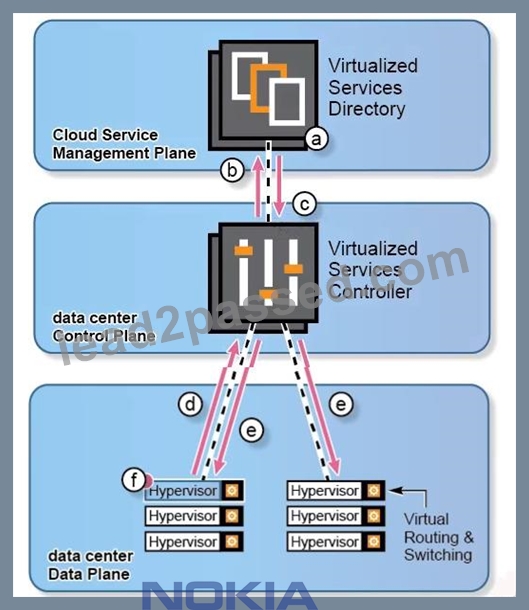
What is the correct sequence of events for a VM to be instantiated, and for its required network connectivity to
be created with the Nuage VCS solution? a. Network domain and policy templates are defined on VSD. b.
VSC queries VSD on network service and policies. c. VSD provides VSC with network service and policies.
d. VRS agent informs VSC of the new VM placement. e. VSC deploys policy to applicable VRS agents. f. VM
instantiated on the hypervisor.
- A. a->b->c->d->e->f
- B. f->d->b->a>c->-e
- C. a->f->d->b->c->-e
- D. a->b->c->f->d->-e
Answer: B
NEW QUESTION 44
Which of the following is a host-centric overlay solution for a modern data center?
- A. VxLAN
- B. TRILL
- C. VPLS
- D. SPBM
Answer: A
Explanation:
Explanation/Reference:
Explanation:
Modern data center, traditional technologies are limiting the speed, flexibility, scalability, and manageability
of application deployments. There is emerging interest in the industry in overlay technologies (such as
MPLS, VXLAN, LISP...)
Reference: https://community.cisco.com/t5/data-center-documents/cisco-data-center-overlays-with-focus-
on-vxlan-slides-from/ta-p/3159545
NEW QUESTION 45
What statement about policy groups is FALSE?
- A. For an ingress security policy, if a hardware endpoint policy group is chosen as the source, the destination must also be hardware endpoints.
- B. One vPort can be associated with multiple policy groups.
- C. Several vPorts ( in the same or different subnets) can be associated with one policy group.
- D. The policy group is the syntactic equivalent of the security group used by cloud management systems.
Answer: C
Explanation:
Explanation/Reference:
NEW QUESTION 46
For a packet transmitted using VXLAN encapsulation, where is the VXLAN header within the packet?
- A. It is added between the Layer 3 IP header and the TCP/UDP transport layer header.
- B. It is added between the Layer 2 header and the Layer 3 IP header.
- C. It is added between the UDP header and the payload.
- D. It is part of the Layer 2 Ethernet header, just like VLAN.
Answer: A
Explanation:
Reference:
https://openct.net/wp-content/uploads/OpenCT-BaaT-Technical-Documentation-2020.pdf
NEW QUESTION 47
What statement about floating public IP addresses in the Nuage Networks environment is CORRECT?
- A. Once a floating IP is configured on the vPort, the VM will stop using its enterprise private IP address.
- B. They are managed by enterprise admin users.
- C. NAT is performed for the traffic leaving the enterprise domain and entering the public network.
- D. There can be more than one floating IP address associated with one vPort.
Answer: D
NEW QUESTION 48
Consider a domain with 3 subnets; each subnet has one virtual machine. Each virtual machine is created on a different HV. How many EVPNs are created on each HV with backhaul VPLS AND without backhaul VPLS?
- A. With backhaul VPLS, there is 1 EVPN; without backhaul VPLS, there are 4 EVPNs on each HV.
- B. With backhaul VPLS, there is 1 EVPN; without backhaul VPLS, there are 3 EVPNs on each HV.
- C. With backhaul VPLS, there are 2 EVPNs; without backhaul VPLS, there are 4 EVPNs on each HV.
- D. With backhaul VPLS, there are 2 EVPNs; without backhaul VPLS, there are 3 EVPNs on each HV.
Answer: B
NEW QUESTION 49
What statement is TRUE regarding the pull and push mode of CMS integration with Nuage Networks VCS?
- A. In the push model, CMS pushes the network configuration to VSC.
- B. In the push model, VSD pushes the network configuration to CMS.
- C. In the pull model, VRS pull the network configuration from CMS.
- D. In the pull model, CMS pulls the network configuration from VSD.
Answer: A
Explanation:
Reference:
https://www.packetcoders.io/what-is-nuage-networks-vcs-virtualized-cloud-services/
NEW QUESTION 50
What statement regarding the VRS-G is FALSE?
- A. The VRS-G is the software VXLAN/VLAN gateway of the Nuage VCS solution.
- B. Virtual machines created on the hypervisor are attached to access ports on VRS-G.
- C. The VRS-G is deployed on a hypervisor, following the same deployment requirements as a regular VRS.
- D. The network ports on VRS-G point towards the Nuage overlay VXLAN network.
Answer: C
Explanation:
Explanation
This permits the bridging of the hypervisor-focused overlay networking and physical devices in the data center.
NEW QUESTION 51
What statement is TRUE regarding multiple virtual IP addresses assigned to a single vPort?
- A. All virtual IP addresses of a vPort must be in the same subnet.
- B. Every virtual IP address must be associated with a virtual MAC, which differs from the VM interface MAC address.
- C. One of the virtual IP addresses can be the same as the VM interface IP address.
- D. The virtual IP addresses can be in a different subnet than the VM interface IP address.
Answer: D
Explanation:
Explanation
If you have only one public IP address available, and you want to host multiple servers, use aVIP.
NEW QUESTION 52
Which statement is TRUE when comparing Virtual Machines and Containers?
- A. All Containers on the same host use the same OS kernel.
- B. All Virtual Machines on the same hypervisor must run the same guest OS.
- C. Virtual Machines are faster to boot.
- D. Contained do not need a CMS.
Answer: A
NEW QUESTION 53
Refer to the diagram.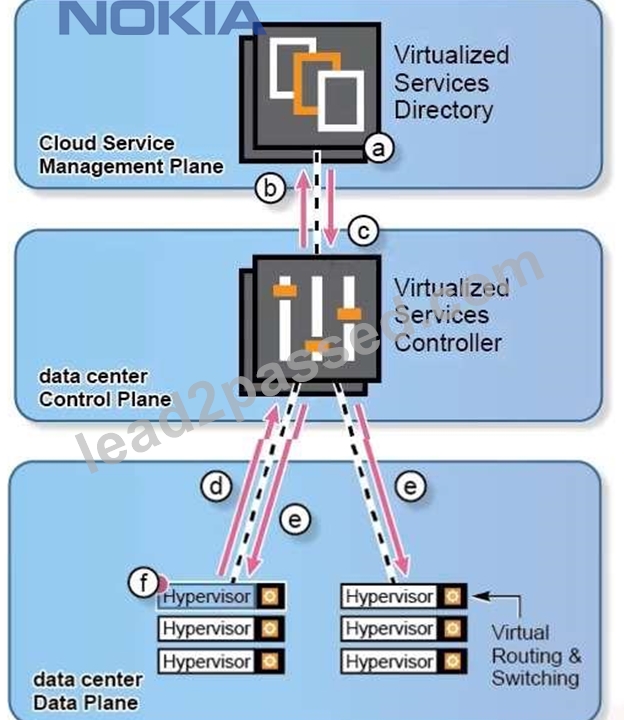
What is the correct sequence of events for a VM to be instantiated, and for its required network connectivity to be created with the Nuage VCS solution? a. Network domain and policy templates are defined on VSD.
b. VSC queries VSD on network service and policies. c. VSD provides VSC with network service and policies. d. VRS agent informs VSC of the new VM placement. e. VSC deploys policy to applicable VRS agents. f. VM instantiated on the hypervisor.
- A. a->b->c->d->e->f
- B. f->d->b->a>c->-e
- C. a->f->d->b->c->-e
- D. a->b->c->f->d->-e
Answer: B
NEW QUESTION 54
Which of the following is NOT Nuage metadata required when creating a virtual machine?
- A. Subnet
- B. Enterprise
- C. VLAN ID
- D. User
Answer: C
NEW QUESTION 55
What is the difference between host vPort and bridge vPort?
- A. A host vPort requires static MAC address configuration, while a bridge vPort learns MAC addresses dynamically.
- B. A host vPort only supports one VLAN, while a bridge vPort can be configured with multiple VLANs.
- C. A host vPort is provisioned on VRS-G, while a bridge vPort is provisioned on VSG.
- D. A host vPort is provisioned for VLAN traffic, while a bridge vPort is for VxLAN traffic.
Answer: C
Explanation:
Explanation
Bridge vPort hosted in Nuage VSG/VSA Gateways
Software, VRS and VRS-G hosted vPort
NEW QUESTION 56
What is NOT a function of the VSC?
- A. CMS integration
- B. XMPP communication with VSD
- C. BGP federation
- D. SDN controller
Answer: D
Explanation:
Reference:
https://www.sdxcentral.com/networking/sdn/definitions/nuage-networks-vsc/
NEW QUESTION 57
......
Nuage Networks 4A0-N01 Exam Certification Details:
| Number of Questions | 40 |
| Passing Score | 80% |
| Sample Questions | Nuage Networks 4A0-N01 Sample Questions |
| Exam Name | Nuage Networks Virtualized Cloud Services (VCS) Fundamentals |
| Exam Price | $125 USD |
Nokia 4A0-N01 Exam Dumps [2022] Practice Valid Exam Dumps Question: https://www.lead2passed.com/Nokia/4A0-N01-practice-exam-dumps.html