FCSS_NST_SE-7.4 Practice Test Questions Answers Updated 42 Questions
FCSS_NST_SE-7.4 dumps & Fortinet Certified Solution Specialist Sure Practice with 42 Questions
NEW QUESTION # 16
Which statement about parallel path processing is correct (PPP)?
- A. PPP chooses froma group of parallel options lo identity the optimal path tor processing a packet.
- B. Only FortiGate hardware configurations affect the path that a packet takes.
- C. Software configuration has no impact on PPP.
- D. PPP does not apply to packets that are part of an already established session.
Answer: A
NEW QUESTION # 17
Exhibit 1.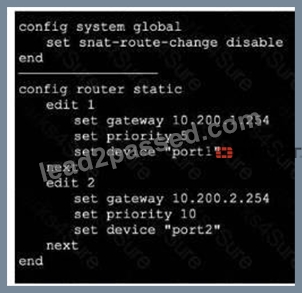
Exhibit 2.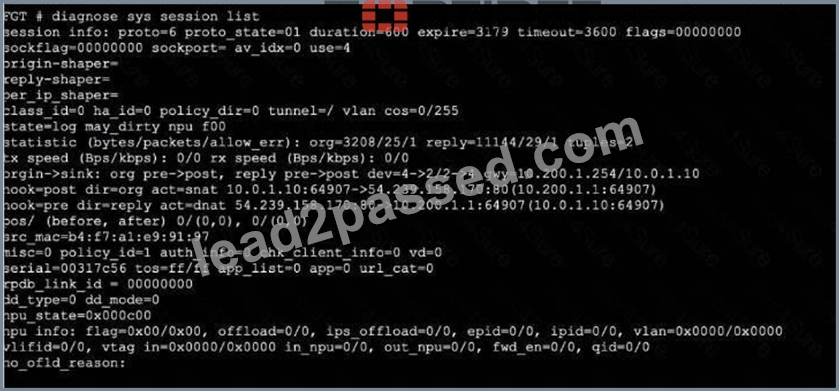
Refer to the exhibits, which show the configuration on FortiGate and partial internet session information from a user on the internal network.
An administrator would like to lest session failover between the two service provider connections.
Which two changes must the administrator make to force this existing session to immediately start using the other interface? (Choose two.)
- A. Change the priority of the port! static route to 11.
- B. Configure setsnat-route-change enable.
- C. Configure unsetsnat-route-change to return it to the default setting.
- D. Change the priority of the port2 static route to 5.
Answer: A,B
NEW QUESTION # 18
Which two statements about Security Fabric communications are true? (Choose two.)
- A. The default port for Neighbor Discovery can be modified.
- B. FortiTelemetry must be manually enabled on the FortiGate interface.
- C. FortiTelemetry and Neighbor Discovery both operate using TCP.
- D. By default, the downstream FortiGate establishes a connection with the upstream FortiGate using TCP port 8013.
Answer: B,D
NEW QUESTION # 19
Exhibit.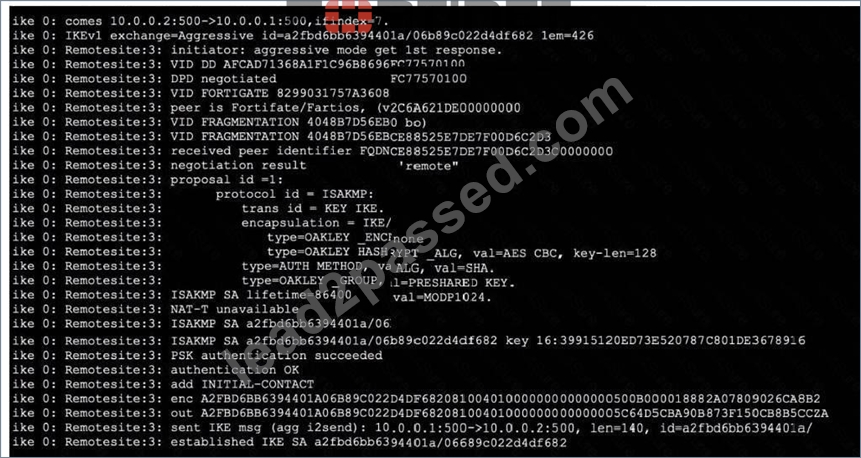
Refer to the exhibit, which contains partial output from an IKE real-time debug.
Which two statements about this debug output are correct? (Choose two.)
- A. It shows a phase 2 negotiation.
- B. The initiator provided remote as its IPsec peer ID.
- C. The local gateway IP address is 10.0.0.1.
- D. Perfect Forward Secrecy (PFS) is enabled in the configuration.
Answer: A,B
NEW QUESTION # 20
Consider the scenario where the server name indication (SNI) does not match either the common name (CN) or any of the subject alternative names (SAN) in the server certificate.
Which action will FortiGate take when using the default settings for SSL certificate inspection?
- A. FortiGate uses the ZN information from the Subject field in the server certificate.
- B. FortiGate uses the first entry listed in the SAN field in the server certificate.
- C. FortiGate closes the connection because this represents an invalid SSL/TLS configuration.
- D. FortiGate uses the SNI from the user's web browser.
Answer: B
NEW QUESTION # 21
In which two slates is a given session categorized as ephemeral? (Choose two.)
- A. A UOP session with packets sent and received
- B. A TCP session waiting for the SYN ACK
- C. A TCP session waiting for FIN ACK
- D. A UDP session with only one packet received
Answer: B,D
NEW QUESTION # 22
Exhibit.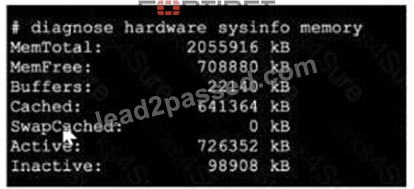
Refer to the exhibit, which shows a partial output of diagnose hardware aysinfo memory.
Which two statements about the output are true? (Choose two.)
- A. The user space has 708880 kB of physical memory that is not used by the system.
- B. The I/O cache, which has 641364 kB of memory allocated to it.
- C. The value indicated next to the inactive heading represents the currently unused cache page.
- D. There are 98908 kB o! memory that will never be used.
Answer: C,D
NEW QUESTION # 23
Which statement about IKEv2 is true?
- A. IKEv1and IKEv2 use same TCP port but run on different UDP ports.
- B. IKEv1and IKEv2 have enough of the header format in common that both versions can run over the same UDP port.
- C. IKEv1and IKEv2 share the concept of phase1and phase2.
- D. Both IKEv1and IKEv2 share the feature of asymmetric authentication.
Answer: B
NEW QUESTION # 24
Which two statements about conserve mode are true? (Choose two.)
- A. FortiGate starts dropping all new sessions when the system memory reaches the configured red threshold.
- B. FortiGate enters conserve mode when the system memory reaches the configured extreme threshold.
- C. FortiGate exits conserve mode when the system memory goes below the configured green threshold.
- D. FortiGate starts taking the configured action for new sessions requiring content inspection when the system memory reaches the configured red threshold.
Answer: C,D
NEW QUESTION # 25
Refer to the exhibits.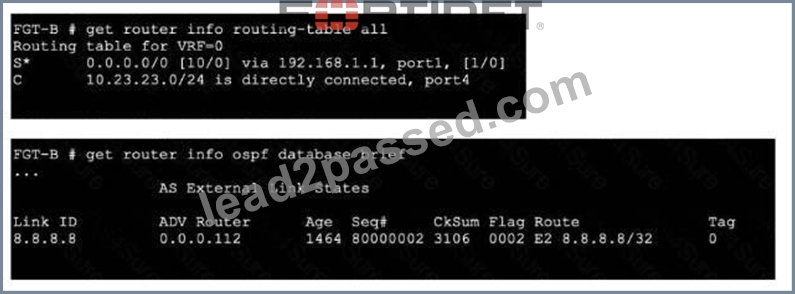
An administrator Is expecting to receive advertised route 8.8.8.8/32 from FGT-A. On FGT-B, they confirm that the route is being advertised and received, however, the route is not being injected into the routing table.
What is the most likely cause of this issue?
- A. The administrator has misconfigured redistribution of routes on FGT-A.
- B. FGT-B is configured with a prefix list denying the 8.8.8.8/32 network to be injected into the routing table.
- C. FGT-8 is configured with a distribution list denying the 8.8.8.8/32 network to be injected into the routing table.
- D. A batter route to the 8.8.8.8/32 network exists in the routing table.
Answer: B
NEW QUESTION # 26
Which two statements are true regarding heartbeat messages sent from an FSSO collector agent to FortiGate?
(Choose two.)
- A. The heartbeat messages can be seen using the command diagnose debug authd fsso list.
- B. The heartbeat messages can be seen in the collector agent logs.
- C. The heartbeat messages can be seen on FortiGate using the real-lime FSSO debug.
- D. The heartbeat messages must be manually enabled on FortiGate.
Answer: B,C
NEW QUESTION # 27
Refer to theexhibit,which shows the output of getrouter info ospf neighbor.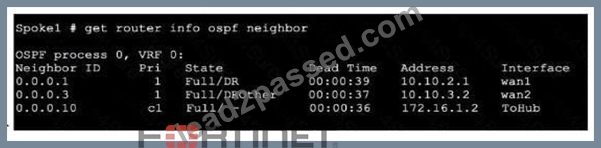
What can you conclude from the command output?
- A. The local FortiGate is not a DROther.
- B. The local FortiGate is the BDR.
- C. All neighbors are in area 0.0.0.0.
- D. The network type connecting the local Fortigate and OSPF neighbor 0.0.0.10 is point-to-point.
Answer: D
NEW QUESTION # 28
Exhibit.
Refer to the exhibit, which shows the output of diagnose automation test.
What can you observe from the output? (Choose two.)
- A. An HA failover occurred.
- B. The test was unsuccessful.
- C. The automation stitch test failed but the HA failover was successful.
- D. The automation stitch test is not being logged.
Answer: B,D
NEW QUESTION # 29
Exhibit.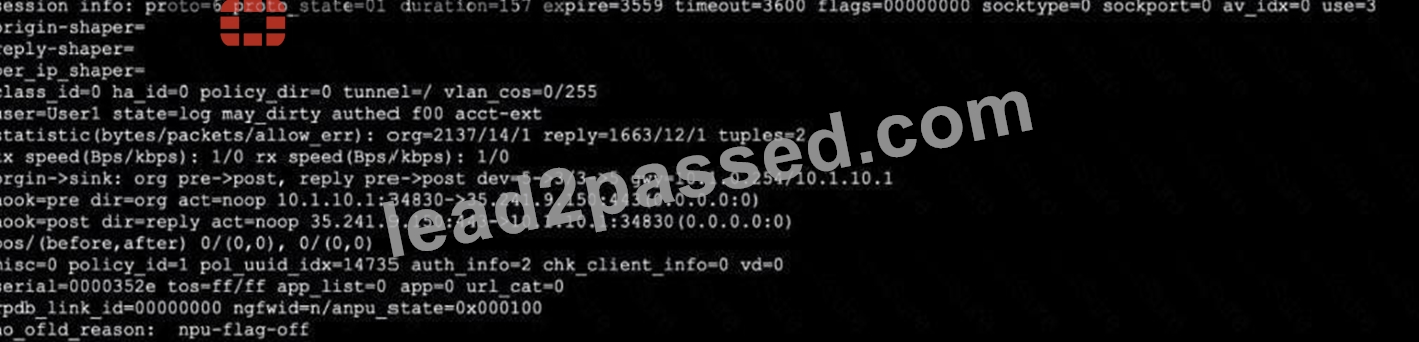
Refer to the exhibit, which shows the output of a session. Which two statements are true? (Choose Iwo.)
- A. The session was initiated from an authenticated user.
- B. The session is being offloaded.
- C. The TCP session has been successfully established.
- D. The session is being inspected using flow inspection.
Answer: A,C
NEW QUESTION # 30
Refer to the exhibit.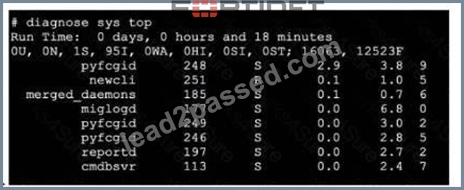
Which three pieces of information does the diagnose sys top command provide? (Choose three.)
- A. The miglogd daemon is running on CPU core ID 0.
- B. If the neweli daemon continues to be in the R state, it will need to be manually restarted.
- C. The miglogd daemon would be on top of the list, if the administrator pressed m on the keyboard.
- D. The cmdbsvr process is occupying 2.4% of the total user memory space.
- E. The diagnose sys top command has been running for 18 minutes.
Answer: A,D,E
NEW QUESTION # 31
Refer to the exhibit, which shows a partial output of the fssod daemon real-time debug command.
What two conclusions can you draw Itom the output? (Choose two.)
- A. The logon event can be seen on the collector agent installed on Windows.
- B. FSSO is using agentless polling mode to detect logon events.
- C. FSSO is using DC agent mode to detect logon events.
- D. The workstation with IP 10.124.2.90 will be polled frequently using TCP port 445 to see if the user is still logged on.
Answer: B,D
NEW QUESTION # 32
......
Fortinet FCSS_NST_SE-7.4 Exam Syllabus Topics:
| Topic | Details |
|---|---|
| Topic 1 |
|
| Topic 2 |
|
| Topic 3 |
|
| Topic 4 |
|
| Topic 5 |
|
New FCSS_NST_SE-7.4 Exam Questions| Real FCSS_NST_SE-7.4 Dumps: https://www.lead2passed.com/Fortinet/FCSS_NST_SE-7.4-practice-exam-dumps.html
Get New FCSS_NST_SE-7.4 Certification – Valid Exam Dumps Questions: https://drive.google.com/open?id=1mXxJDmxyDbNYmL2dYYQt_loO5JO4EzzQ