Fortinet FCSS_NST_SE-7.6 Test Engine Dumps Training With 136 Questions
FCSS_NST_SE-7.6 Questions Pass on Your First Attempt Dumps for Fortinet Certified Solution Specialist Certified
Fortinet FCSS_NST_SE-7.6 Exam Syllabus Topics:
| Topic | Details |
|---|---|
| Topic 1 |
|
| Topic 2 |
|
| Topic 3 |
|
| Topic 4 |
|
| Topic 5 |
|
NEW QUESTION # 79
Refer to the exhibit, which shows partial outputs from two routing debug commands.
Why is the port2 default route not in the second command output?
- A. The port1 default route has a higher priority value than the default route using port2.
- B. The port1 default route has a lower priority value than the default route using port2.
- C. The port2 interface is disabled in the FortiGate configuration.
- D. The port1 default route has a lower distance than the default route using port2.
Answer: D
Explanation:
The correct answer is D .
In the exhibit, get router info routing-table database shows both static default routes:
* 0.0.0.0/0 [20/0] via 100.64.2.254, port2
* 0.0.0.0/0 [10/0] via 100.64.1.254, port1
But get router info routing-table all shows only:
* 0.0.0.0/0 [10/0] via 100.64.1.254, port1
The study guide explains that get router info routing-table all displays the routes that make it to the FIB
- the best active routes . It also says that this command doesn't show standby or inactive routes , which can remain only in the routing table database. It gives the exact rule: "when two static routes to the same destination subnet have different distances, the one with the lower distance is installed in the routing table, and the one with the higher distance is installed in the routing table database." The study guide also shows the route selection process:
* Most specific route
* Lowest distance
* Lowest metric (dynamic routes)
* Lowest priority (static routes)
* ECMP
So the port2 default route is absent from the second output because its distance is 20 , while the port1 default route has distance 10 . The lower-distance route is installed in the active routing table/FIB.
Why the other options are wrong:
* A is wrong because the exhibit does not indicate port2 is down or disabled.
* B and C are wrong because priority is checked only after distance for static routes. Here, the routes already differ by distance , so priority is not the deciding factor.
So the verified answer is: D .
NEW QUESTION # 80
While troubleshooting a FortiGate web filter issue, users report that they cannot access any websites, even though those sites are not explicitly blocked by any web filter profiles that are applied to firewall policies.
What are the three most likely reasons for this behavior? (Choose three answers)
- A. The web filter cache has been cleared causing all websites to take longer to be rated.
- B. The FortiGuard Web Filtering license has expired, causing FortiGate to apply the default block action.
- C. The webfilter-force-off setting has been enabled under config system fortiguard.
- D. The DNS server is unreachable, preventing URL resolution.
- E. The SSL/TLS deep inspection was configured but the browsers do not have the FortiGate certificate installed.
Answer: B,D,E
Explanation:
The reported symptom-users unable to access any websites despite no explicit blocks in the profile-points to systemic connectivity or configuration issues rather than specific URL filtering rules.
* Option B (SSL/TLS Inspection): When Deep Inspection is enabled, the FortiGate acts as a Man-in- the-Middle (MitM) and re-signs server certificates using its own CA. If the clients (browsers) do not trust this CA (i.e., the certificate is not installed in their Trusted Root store), they will reject the connection with certificate errors, effectively preventing access to all HTTPS websites.
* Option D (DNS): Web browsing relies on DNS resolution. If the configured DNS server is unreachable or failing, the FortiGate (or the client) cannot resolve FQDNs to IP addresses.
Consequently, browsers will fail to load any page, resulting in a total loss of web access.
* Option E (License): If the FortiGuard Web Filtering license expires, the FortiGate can no longer query the FortiGuard Distribution Network (FDN) for ratings. By default, or if the allow-when-rating- error setting is disabled (a common security practice), the FortiGate will block all web traffic that it cannot rate, often displaying a "Web Filter Service Error" or invalid license page.
Option A is incorrect because clearing the cache only increases latency, it does not block traffic. Option C is incorrect because webfilter-force-off is typically used to disable the service (often allowing traffic to bypass checks if the service is down), rather than blocking it.
NEW QUESTION # 81
Refer to the exhibit, which shows the partial output of FortiOS kernel slabs.
Which statement is true?
- A. The total slab size of the ip_session slab is 3600 kB and is associated with the user space.
- B. The total slab size of the ip6_session slab is 1300 kB and is associated with the kernel.
- C. The total slab size of the sctp_session slab is 0 kB and is associated with the user space.
- D. The total slab size of the tcp_session slab is 7500 kB and is associated with the kernel.
Answer: D
NEW QUESTION # 82
Refer to the exhibit, which shows a truncated output of a real-time LDAP debug.
What two conclusions can you draw from the output? (Choose two.)
- A. The name of the configured LDAP server is Lab.
- B. The user is authenticating using CN=John Smith.
- C. FortiOS is performing the second step (Search Request) in the LDAP authentication process.
- D. FortiOS is able to locate the user in step 3 (Bind Request) of the LDAP authentication process.
Answer: B,C
Explanation:
According to Fortinet's LDAP authentication workflow as described in the FortiOS Administration Guide and the official LDAP debug log interpretation, each authentication attempt is split into several key steps: Bind Request, Search Request, and then, if successful, a Bind as the found user DN. In the provided debug output, we see "start search_dn-base" with a filter "sAMAccountName=jsmith" and the log line "Going to SEARCH state," confirming that FortiOS is in the second step-the Search Request (Option D). Official documentation highlights this exact phrase "SEARCH state" as indicative of Step 2 within the LDAP process ("Bind # Search # Bind").
Additionally, the last line "Found DN 1: CN=John Smith, CN=Users, DC=TAC, DC=ottawa, DC=fortinet, DC=com" verifies that the system has successfully mapped the username to the Distinguished Name (DN) and this user is "John Smith." The authentication will now proceed using this mapped user (Option B).
Fortinet's logs record the found DN after a successful search, which is a strong confirmation that the user's credentials can be validated against the found DN.
Options A and C are not supported directly by the debug output shown:
The server name "Lab" is referenced as part of the request, but not explicitly as the LDAP server's configured name in this output.
Step 3 (Bind Request) would follow finding the DN, but the log here demonstrates the Search and DN found- per Fortinet, this precedes the actual Bind/validation step.
References:
FortiOS Administration Guide: LDAP Authentication Process and Debug Logs Fortinet Official KB: LDAP Integration Workflow and Log Interpretation
NEW QUESTION # 83
In IKEv2, which exchange establishes the first CHILD_SA?
- A. CREATE_CHILD_SA
- B. INFORMATIONAL
- C. IKE_SA_INIT
- D. IKE_Auth
Answer: C
Explanation:
According to RFC 7296 (IKEv2) and Fortinet's official documentation, the IKE_SA_INIT exchange is responsible for negotiating cryptographic parameters, performing the initial Diffie-Hellman exchange, and implementing the cookie challenge mechanism for DoS protection. When the responder suspects a DoS attack (such as mass requests by the same source), it includes a cookie in the IKE_SA_INIT response. The initiator must return the cookie in its next request to prove that it truly exists at the IP address it claims, thereby mitigating resource exhaustion attacks.
This two-step exchange ensures the responder only allocates resources after successful proof of address, aligning with best security practices. Fortinet documentation confirms that this process occurs strictly in the IKE_SA_INIT phase, not in subsequent IKE_Auth or CHILD_SA exchanges.
References:
RFC 7296: IKEv2, Section 2.6, "Denial of Service Protection"
Fortinet FortiOS VPN Handbook: IKEv2 Exchange Process and DoS Protection Mechanism
NEW QUESTION # 84
Refer to the exhibit, which contains partial output from an IKE real-time debug.
The administrator does not have access to the remote gateway.
Based on the debug output, which configuration change the administrator make to the local gateway to resolve the phase 1 negotiation error?
- A. In the phase 1 network configuration, set the IKE version to 2.
- B. In the phase 1 proposal configuration, add AESCBC-SHA2 to the list of encryption algorithms.
- C. In the phase 1 proposal configuration, add AES128-SHA128 to the list of encryption algorithms.
- D. In the phase 1 proposal configuration, add AES256-SHA256 to the list of encryption algorithms.
Answer: D
NEW QUESTION # 85
Refer to the exhibit.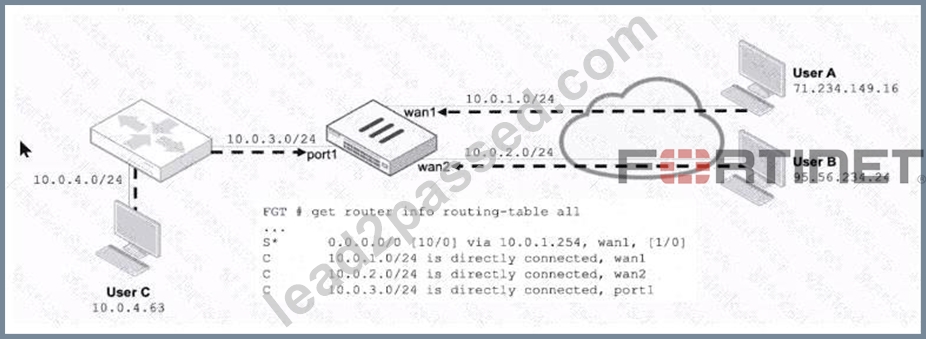
Assuming a default configuration, which three statements are true? (Choose three.)
- A. User B: Fail. There is no route to 95.56.234.24 using wan2 in the routing table.
- B. User A: Pass. The default static route through wan1 passes the RPF check regardless of the source IP address.
- C. User B: Pass. FortiGate will use asymmetric routing using wan1 to reply to traffic for 95.56.234.24.
- D. Strict RPF is enabled by default.
- E. User C: Fail. There is no route to 10.0.4.63 using port1 in the touting table.
Answer: A,C,E
NEW QUESTION # 86
Refer to the exhibit.
Which two observations can you make about the web filter traffic captured using the flow tool? (Choose two.)
- A. The web filter profile is configured with proxy-based inspection mode.
- B. The HTTPS port is mapped to 443 in the SSL/SSH Inspection Profile
- C. The session is offloaded to the NPU.
- D. The firewall policy is configured with proxy-based inspection mode.
Answer: A,D
Explanation:
Analyze the "Send to Application Layer" Message:
The most critical line in the debug output is: id=65308 ... func=av_receive ... msg="send to application layer" Meaning: This message indicates that the FortiGate kernel is handing the packet over to a user-space daemon (specifically the WAD/Proxy process, indicated by av_receive handlers) for deep inspection.
Implication: This behavior is the hallmark of Proxy-based inspection. In Flow-based inspection, the traffic is handled by the IPS engine (often within the kernel or via specific IPS handlers like ips_measure), and you would not typically see a "send to application layer" message for standard web filtering.
Evaluate Option B (Firewall Policy Mode):
Since the traffic is being sent to the application layer proxy, the Firewall Policy controlling this traffic (Policy ID 1, as seen in Allowed by Policy-1) must be configured with Inspection Mode = Proxy. If it were Flow- based, the traffic would stay in the flow path. Thus, Option B is correct.
Evaluate Option C (Web Filter Profile Mode):
In FortiOS, when a firewall policy is set to Proxy-based inspection, the security profiles (like Web Filter) applied to that policy also operate in Proxy-based inspection mode. The presence of the av_receive function confirms that the content inspection (Web Filter/AV) is being performed by the proxy engine. Thus, Option C is correct.
Why Option A is Incorrect (NPU Offload):
The output shows npu_state=0x100. In the context of a flow trace where traffic is being "sent to application layer," this confirms the session is not fully offloaded to the NPU (Network Processor). Offloaded traffic (Fast Path) is handled by the hardware and would not generate these specific CPU-level debug logs for the payload inspection phase. The proxying process requires CPU intervention.
Why Option D is Incorrect (Port Mapping):
While valid protocol mapping is necessary for inspection, the specific debug output shown is a direct result of the Inspection Mode (Proxy vs. Flow). The observation of the traffic moving to the application layer is primarily caused by the policy and profile mode settings, making B and C the direct "observations" derived from the log data.
Reference:
FortiGate Troubleshooting (Debug Flow): "If the debug flow shows msg='send to application layer', it confirms the traffic is being handled by the proxy (WAD) for Proxy-based inspection."
NEW QUESTION # 87
Refer to the exhibit, which shows the output of a policy route table entry.
Which type of policy route does the output show?
- A. An SD-WAN rule
- B. A regular policy route, which is associated with an active static route in the FIB
- C. A regular policy route
- D. An ISDB route
Answer: D
NEW QUESTION # 88
Which two statements about application-layer test commands are true? (Choose two answers)
- A. Some of them display output only after you run the diagnose debug console enable command.
- B. Some of them display statistics and configuration information about a feature or process.
- C. Some of them can be used to restart an application.
- D. Some of them display real-time application debugs.
Answer: B,C
Explanation:
The correct answers are A and D.
The study guide states:
"Application layer test commands do not display information in real time. They display statistics and configuration information about a feature or process. You can also use some of these commands to restart a process or execute a change in its operation." This directly proves:
A is correct because they can display statistics and configuration information D is correct because some of them can restart a process/application Why the other options are wrong:
B is wrong because the study guide explicitly says application-layer test commands do not display information in real time. Real-time output is done with diagnose debug application ... commands instead.
C is wrong because diagnose debug console enable is related to debug output behavior, not a requirement for application-layer test commands to display output. The study guide does not describe test commands that way.
====
NEW QUESTION # 89
Refer to the exhibit.
Partial output of the get vpn ipsec tunnel details command is shown. Based on the output, which two statements are correct? (Choose two.)
- A. The npu_flag for this tunnel is 03.
- B. Different SPI values are a result of auto-negotiation being disabled for phase2 selectors.
- C. Anti-replay is enabled.
- D. The npu_flag for this tunnel is 02.
Answer: A,C
Explanation:
The correct answers are C and D.
The study guide's get vpn ipsec tunnel details example shows:
replay: enabled
inbound and outbound sections with separate SPIs
NPU acceleration: encryption(outbound) decryption(inbound)
and it labels these as "Phase 2 SAs for each direction" and "Hardware acceleration" This directly proves D. Anti-replay is enabled, because the output explicitly says replay: enabled For the NPU status, the study guide explains the exact npu_flag meanings:
npu_flag=00 = both IPsec SAs loaded to the kernel
npu_flag=01 = outbound IPsec SA copied to NPU
npu_flag=02 = inbound IPsec SA copied to NPU
npu_flag=03 = both outbound and inbound IPsec SAs copied to NPU
Because the exhibit shows hardware acceleration in both directions - encryption(outbound) and decryption(inbound) - the matching npu_flag is 03, not 02. That makes C correct and A incorrect.
Why B is wrong:
The same study guide output labels the tunnel as having Phase 2 SAs for each direction, so different inbound and outbound SPIs are normal for the two SAs. Also, the FortiOS administration guide explains that auto-negotiate controls whether phase 2 SA negotiation is initiated automatically, not whether inbound and outbound SPIs are different: "By default the phase 2 security association (SA) is not negotiated until a peer attempts to send data... Auto-negotiate initiates the phase 2 SA negotiation automatically..." So the verified answers are: C, D.
NEW QUESTION # 90
Which statement about parallel path processing is correct (PPP)?
- A. Software configuration has no impact on PPP.
- B. Only FortiGate hardware configurations affect the path that a packet takes.
- C. PPP does not apply to packets that are part of an already established session.
- D. PPP chooses from a group of parallel options lo identity the optimal path tor processing a packet.
Answer: D
NEW QUESTION # 91
What are two reasons you might see iprope_in check () check failed, drop when using the debug How?
(Choose two.)
- A. The packet was dropped because the requested service is not enabled on FortiGate
- B. The packet was dropped because the trusted host list is misconfigured
- C. The packet was dropped because it is not allowed by any firewall policy.
- D. The packet was dropped because there is no route to the source.
Answer: A,B
Explanation:
The debug flow message iprope_in_check() check failed, drop specifically indicates a failure in the Local-In Policy check. The "iprope" (IP ROouting Policy Enforcement) engine handles policy lookups. The _in_check suffix confirms that the decision is regarding traffic destined to the FortiGate itself (Local-In traffic), rather than traffic passing through it.
D). The packet was dropped because the requested service is not enabled on FortiGate:
This is the most common cause. When a packet arrives destined for the FortiGate's interface IP (e.g., an HTTPS or SSH request), the kernel checks if that specific service is enabled in the interface settings (set allowaccess). If the service is not enabled (e.g., trying to Ping an interface where PING access is disabled), the iprope_in_check function fails and drops the packet immediately.
C). The packet was dropped because the trusted host list is misconfigured:
Even if the service (e.g., HTTPS) is enabled on the interface, the FortiGate checks the Administrator settings.
If Trusted Hosts are configured, the source IP of the incoming packet is compared against the allowed list. If the IP is not on the list, the Local-In policy check (iprope_in_check) fails, and the packet is dropped to secure the management plane.
Why other options are incorrect:
A: If traffic is dropped by a standard Firewall Policy (traffic passing through the device from one interface to another), the debug message will typically state denied by policy x or no matching policy. It would generally be a forward check (iprope_fwd_check or similar), not an _in_check.
B: If there is no route to the source, the error is a Reverse Path Forwarding (RPF) failure. The debug flow logs this explicitly as reverse path check fail, drop.
Reference:
FortiGate Troubleshooting Guide (Debug Flow): "The message iprope_in_check() check failed indicates the packet was denied by the Local-In policy. This occurs when traffic destined to the FortiGate is not allowed by the allowaccess configuration or is blocked by Trusted Host settings."
NEW QUESTION # 92
Refer to the exhibit, which shows a partial web filter profile configuration.
The URL www.dropbox.com is categorized as File Sharing and Storage.
Which action does FortiGate take if a user attempts to access www.dropbox.com?
- A. Based on the Web Content filter configuration, access to www.dropbox.com would be exempted.
- B. FortiGate blocks the connection as an invalid URL.
- C. Based on the URL Filter configuration, FortiGate allows the connection.
- D. FortiGate blocks the connection, based on the FortiGuard category-based filter configuration.
Answer: C
NEW QUESTION # 93
Exhibit.
Refer to the exhibit, which shows a FortiGate configuration.
An administrator is troubleshooting a web filter issue on FortiGate. The administrator has configured a web filter profile and applied it to a policy; however the web filter is not inspecting any traffic that is passing through the policy.
What must the administrator do to fix the issue?
- A. Disable webfilter-force-off.
- B. Increase webfilter-timeout.
- C. Change protocol to TCP.
- D. Enable fortiguard-anycast.
Answer: A
NEW QUESTION # 94
Refer to the exhibit.
Which three pieces of information does the diagnose sys top command provide? (Choose three.)
- A. The miglogd daemon is running on CPU core ID 0.
- B. The cmdbsvr process is occupying 2.4% of the total user memory space.
- C. The diagnose sys top command has been running for 18 minutes.
- D. If the neweli daemon continues to be in the R state, it will need to be manually restarted.
- E. The miglogd daemon would be on top of the list, if the administrator pressed m on the keyboard.
Answer: A,B,E
Explanation:
https://community.fortinet.com/t5/FortiGate/Technical-Tip-Using-the-diagnose-sys-top-CLI-command/ta-p
/190238
NEW QUESTION # 95
Which three conditions are required for two FortiGate devices to form an OSPF adjacency? (Choose three answers)
- A. Authentication settings match.
- B. OSPF router IDs are unique.
- C. OSPF interface priority settings are unique.
- D. OSPF link costs match.
- E. OSPF interface network types match.
Answer: A,B,E
Explanation:
The correct answers are C, D, and E .
The study guide lists the exact OSPF adjacency requirements :
* "Interfaces of peers are the same type and in the same OSPF area"
* "Each peer has a unique router ID"
* "OSPF authentication, if enabled, is successful"
These map directly to:
* C. OSPF interface network types match
* D. Authentication settings match
* E. OSPF router IDs are unique
The same study-guide slide also states other requirements such as:
* peers' primary IPs must be in the same subnet with the same mask
* hello and dead intervals must match
* OSPF MTUs must match
Why the other options are wrong:
* A is wrong because link cost matching is not listed as an adjacency requirement . OSPF cost affects path selection, not whether adjacency can form.
* B is wrong because interface priority does not need to be unique . Priority is used for DR/BDR election, where the highest priority wins, and ties are broken by router ID.
So the verified answers are: C, D, E .
NEW QUESTION # 96 
The output of a policy route table entry is shown.
Which type of policy route does the output show?
- A. An SD-WAN rule
- B. A regular policy route, which is associated with an active static route in the FIB
- C. An ISDB route
- D. A regular policy route, which is not associated with an active static route in the FIB
Answer: A
Explanation:
To determine the type of policy route, we must interpret the specific flags and fields visible in the diagnose firewall proute list (or similar kernel table) output provided in the exhibit Identify Key Indicators:
The most critical field in the output is vwl_service=1(test123).
It also lists vwl_mbr_seq=1 5.
Decode the Terminology:
vwl: This stands for Virtual WAN Link. In FortiOS, " Virtual WAN Link " is the legacy internal name for the SD-WAN feature. Even in newer firmware versions (7.x), the kernel and CLI debugs often still refer to SD- WAN objects as vwl.
vwl_service: This specifically refers to an SD-WAN Rule (also known as an SD-WAN Service). The name (test123) is the name given to that specific SD-WAN rule by the administrator.
Evaluate the Options:
A & D (Regular Policy Route): Standard policy routes (configured under config router policy) do not carry the vwl_service tag. They are typically identified by simple gateway or interface instructions without the SD- WAN service abstraction.
B (ISDB Route): While SD-WAN rules can use the Internet Service Database (ISDB) as a destination, the structure of the route entry shown here-specifically defined by a vwl_service ID-classifies it fundamentally as an SD-WAN rule, regardless of the destination object.
C (An SD-WAN rule): The presence of vwl_service and vwl_mbr_seq (SD-WAN member sequence) definitively identifies this entry as a rule generated by the SD-WAN subsystem.
Conclusion: The output shows a route controlled by the SD-WAN engine (vwl), confirming it is an SD-WAN rule.
Reference:
FortiGate Security 7.6 Study Guide (SD-WAN): " In the kernel routing table and debugs, SD-WAN rules are often referenced as vwl (Virtual WAN Link) services. The vwl_service field indicates the specific SD-WAN rule ID and name. "
NEW QUESTION # 97
Refer to the exhibits.
An OSPF peer is advertising route 172.16.52.0/24. The local FortiGate is configured with an inbound distribution list that allows the 172.16.0.0/16 network to be injected into its routing table. However, the 1 '
2.16.52.0/24 subnet cannot be seen in the FIB.
Which two stops can the administrator of the local FortiGate take to ensure that the advertised 172.16. 52.0/24 subnet will be injected into the routing table? (Choose two.)
- A. Change the R- value lo 16.
- B. Modify the default prefix-list behavior from implicit deny to implicit allow.
- C. Add another entry to the prefix list to specifically allow the 172.16.52.0/24 network.
- D. Change the ge value to 17.
Answer: C,D
Explanation:
The issue is caused by the strict matching logic of the configured Prefix List.
Current State: The rule is edit 1 with set prefix 172.16.0.0 255.255.0.0 and both ge (greater than or equal) and le (less than or equal) are unset.
Behavior: When ge and le are unset, FortiOS requires an exact match of the subnet mask. The current rule only matches the exact network 172.16.0.0/16. It denies 172.16.52.0/24 because the mask (/24) does not match the rule ' s mask (/16).
To fix this and inject 172.16.52.0/24, you must modify the list to match the /24 mask:
A). Add another entry to the prefix list to specifically allow the 172.16.52.0/24 network:
Creating a new rule (e.g., edit 2) with set prefix 172.16.52.0 255.255.255.0 will provide an exact match for the incoming route, allowing it to pass the distribute-list.
B). Change the ge value to 17:
By configuring set ge 17 on the existing rule (conceptually 172.16.0.0/16 ge 17), you change the logic from " exact match " to " range match " .
This configuration tells the router to match any prefix starting with 172.16.x.x that has a subnet mask length of 17 or greater.
Since the incoming route is a /24, and 24 is greater than 17, the route will match the prefix list and be accepted.
Why other options are incorrect:
C: The option text appears to read " Change the ... value to 16 " . If this refers to le 16, it would enforce the mask to be exactly /16 or less, which still excludes /24.
D: Changing the default behavior to implicit allow defeats the purpose of a filter (security control) and is not a standard configuration step for fixing a single missing route.
Reference:
FortiGate Security 7.6 Study Guide (Routing): " In prefix-lists, if ge and le are not used, the subnet mask must match exactly. To match subnets within a range, you must define the prefix length boundaries using ge or le. "
NEW QUESTION # 98
Refer to the exhibit showing a debug output.
An administrator deployed FSSO in DC Agent Mode but FSSO is failing on FortiGate. Pinging FortiGate from where the collector agent is deployed is successful.
The administrator then produces the debug output shown in the exhibit.
What could be causing this error message?
- A. The FortiGate cannot resolve the active directory server name.
- B. The FortiGate and the collector agent are using different TCP ports.
- C. The TCP port 445 is blocked between FortiGate and collector agent.
- D. The collector agent preshared password is mismatched.
Answer: B
NEW QUESTION # 99
......
FCSS_NST_SE-7.6 Practice Test Pdf Exam Material: https://www.lead2passed.com/Fortinet/FCSS_NST_SE-7.6-practice-exam-dumps.html
FCSS_NST_SE-7.6 Answers FCSS_NST_SE-7.6 Free Demo Are Based On The Real Exam: https://drive.google.com/open?id=1ZznIuOQWj6A682XRjjZ_HYVTZM669uIu