Free Databricks-Certified-Professional-Data-Engineer Sample Questions and 100% Cover Real Exam Questions (Updated 84 Questions)
Download Real Databricks Databricks-Certified-Professional-Data-Engineer Exam Dumps Test Engine Exam Questions
The DCPDE certification is an excellent way for data professionals to demonstrate their expertise in the Databricks platform. Databricks Certified Professional Data Engineer Exam certification is recognized globally and is highly valued by employers looking for data professionals with expertise in Databricks. The DCPDE certification provides professionals with the opportunity to enhance their career prospects and increase their earning potential.
Databricks Certified Professional Data Engineer (Databricks-Certified-Professional-Data-Engineer) certification exam is designed for professionals who want to demonstrate their expertise in using Databricks to manage big data and create data pipelines. Databricks Certified Professional Data Engineer Exam certification exam is ideal for data engineers, data architects, data scientists, and other professionals who work with big data and want to validate their skills in using Databricks to build data pipelines.
Databricks Certified Professional Data Engineer Exam is a comprehensive exam that covers a wide range of topics related to data engineering. It includes questions on data ingestion, data transformation, data storage, data processing, and data management using Databricks. Databricks-Certified-Professional-Data-Engineer exam also covers topics such as cluster management, security, and performance optimization. Databricks-Certified-Professional-Data-Engineer exam is designed to test the candidate's ability to design, implement, and manage data engineering solutions using Databricks.
NEW QUESTION # 15
A Databricks job has been configured with 3 tasks, each of which is a Databricks notebook. Task A does not depend on other tasks. Tasks B and C run in parallel, with each having a serial dependency on task A.
If tasks A and B complete successfully but task C fails during a scheduled run, which statement describes the resulting state?
- A. All logic expressed in the notebook associated with task A will have been successfully completed; tasks B and C will not commit any changes because of stage failure.
- B. All logic expressed in the notebook associated with tasks A and B will have been successfully completed; any changes made in task C will be rolled back due to task failure.
- C. Because all tasks are managed as a dependency graph, no changes will be committed to the Lakehouse until ail tasks have successfully been completed.
- D. All logic expressed in the notebook associated with tasks A and B will have been successfully completed; some operations in task C may have completed successfully.
- E. Unless all tasks complete successfully, no changes will be committed to the Lakehouse; because task C failed, all commits will be rolled back automatically.
Answer: D
Explanation:
Explanation
The query uses the CREATE TABLE USING DELTA syntax to create a Delta Lake table from an existing Parquet file stored in DBFS. The query also uses the LOCATION keyword to specify the path to the Parquet file as /mnt/finance_eda_bucket/tx_sales.parquet. By using the LOCATION keyword, the query creates an external table, which is a table that is stored outside of the default warehouse directory and whose metadata is not managed by Databricks. An external table can be created from an existing directory in a cloud storage system, such as DBFS or S3, that contains data files in a supported format, such as Parquet or CSV.
The resulting state after running the second command is that an external table will be created in the storage container mounted to /mnt/finance_eda_bucket with the new name prod.sales_by_store. The command will not change any data or move any files in the storage container; it will only update the table reference in the metastore and create a new Delta transaction log for the renamed table. Verified References: [Databricks Certified Data Engineer Professional], under "Delta Lake" section; Databricks Documentation, under "ALTER TABLE RENAME TO" section; Databricks Documentation, under "Create an external table" section.
NEW QUESTION # 16
When writing streaming data, Spark's structured stream supports the below write modes
- A. Append, Delta, Complete
- B. Append, Complete, Update
- C. Append, overwrite, Continuous
- D. Delta, Complete, Continuous
- E. Complete, Incremental, Update
Answer: B
Explanation:
Explanation
The answer is Append, Complete, Update
*Append mode (default) - This is the default mode, where only the new rows added to the Result Table since the last trigger will be outputted to the sink. This is supported for only those queries where rows added to the Result Table is never going to change. Hence, this mode guarantees that each row will be output only once (assuming fault-tolerant sink). For example, queries with only select, where, map, flatMap, filter, join, etc. will support Append mode.
*Complete mode - The whole Result Table will be outputted to the sink after every trigger. This is supported for aggregation queries.
*Update mode - (Available since Spark 2.1.1) Only the rows in the Result Table that were updated since the last trigger will be outputted to the sink. More information to be added in future releases.
NEW QUESTION # 17
Which of the following commands results in the successful creation of a view on top of the delta stream(stream on delta table)?
- A. Spark.readStream.format("delta").table("sales").createOrReplaceTempView("streaming_vw")
- B. Spark.read.format("delta").table("sales").createOrReplaceTempView("streaming_vw")
- C. Spark.read.format("delta").table("sales").mode("stream").createOrReplaceTempView("streaming_vw")
- D. You can not create a view on streaming data source.
- E. Spark.read.format("delta").stream("sales").createOrReplaceTempView("streaming_vw")
- F. Spark.read.format("delta").table("sales").trigger("stream").createOrReplaceTempView("streaming_vw")
Answer: A
Explanation:
Explanation
The answer is
Spark.readStream.table("sales").createOrReplaceTempView("streaming_vw") When you load a Delta table as a stream source and use it in a streaming query, the query processes all of the data present in the table as well as any new data that arrives after the stream is started.
You can load both paths and tables as a stream, you also have the ability to ignore deletes and changes(updates, Merge, overwrites) on the delta table.
Here is more information,
https://docs.databricks.com/delta/delta-streaming.html#delta-table-as-a-source
NEW QUESTION # 18
A data engineer is using a Databricks SQL query to monitor the performance of an ELT job. The ELT job is triggered by a specific number of input records being ready to process. The Databricks SQL query returns the number of minutes since the job's most recent runtime. Which of the following approaches can enable the data engineering team to be notified if the ELT job has not been run in an hour?
- A. They can set up an Alert for the accompanying dashboard to notify them if the returned value is greater than 60.
- B. They can set up an Alert for the accompanying dashboard to notify when it has not re-freshed in 60 minutes.
- C. They can set up an Alert for the query to notify when the ELT job fails.
- D. They can set up an Alert for the query to notify them if the returned value is greater than 60.
- E. This type of alert is not possible in Databricks
Answer: D
Explanation:
Explanation
The answer is, They can set up an Alert for the query to notify them if the returned value is greater than 60.
The important thing to note here is that alert can only be setup on query not on the dashboard, query can return a value, which is used if alert can be triggered.
NEW QUESTION # 19
One of the team members Steve who has the ability to create views, created a new view called re-gional_sales_vw on the existing table called sales which is owned by John, and the second team member Kevin who works with regional sales managers wanted to query the data in region-al_sales_vw, so Steve granted the permission to Kevin using command GRANT VIEW, USAGE ON regional_sales_vw to [email protected] but Kevin is still unable to access the view?
- A. Kevin is not the owner of the sales table
- B. Kevin needs owner access on the view regional_sales_vw
- C. Kevin needs select access on the table sales
- D. Table access control is not enabled on the table and view
- E. Steve is not the owner of the sales table
Answer: E
Explanation:
Explanation
Ownership determines whether or not you can grant privileges on derived objects to other users, since Steve is not the owner of the underlying sales table, he can not grant access to the table or data in the table indirectly.
Only owner(user or group) can grant access to a object
https://docs.microsoft.com/en-us/azure/databricks/security/access-control/table-acls/object-privileges#a-user-has Data object privileges - Azure Databricks | Microsoft Doc
NEW QUESTION # 20
Which of the following results in the creation of an external table?
- A. CREATE EXTERNAL TABLE transactions (id int, desc string)
- B. CREATE TABLE transactions (id int, desc string) TYPE EXTERNAL
- C. CREATE TABLE transactions (id int, desc string) USING DELTA LOCATION EX-TERNAL
- D. CREATE TABLE transactions (id int, desc string) LOCATION '/mnt/delta/transactions'
- E. CREATE TABLE transactions (id int, desc string)
Answer: D
Explanation:
Explanation
Answer is CREATE TABLE transactions (id int, desc string) USING DELTA LOCATION
'/mnt/delta/transactions'
Anytime a table is created using Location it is considered an external table, below is the current syntax.
Syntax
CREATE TABLE table_name ( column column_data_type...) USING format LOCATION "dbfs:/"
NEW QUESTION # 21
You are asked to setup two tasks in a databricks job, the first task runs a notebook to download the data from a remote system, and the second task is a DLT pipeline that can process this data, how do you plan to configure this in Jobs UI
- A. Jobs UI does not support DTL pipeline, setup the first task using jobs UI and setup the DLT to run in continuous mode.
- B. Single job cannot have a notebook task and DLT Pipeline task, use two different jobs with linear dependency.
- C. Add first step in the DLT pipeline and run the DLT pipeline as triggered mode in JOBS UI
- D. Jobs UI does not support DTL pipeline, setup the first task using jobs UI and setup the DLT to run in trigger mode.
- E. Single job can be used to setup both notebook and DLT pipeline, use two different tasks with linear dependency.
Answer: E
Explanation:
Explanation
The answer is Single job can be used to set up both notebook and DLT pipeline, use two different tasks with linear dependency, Here is the JOB UI
1.Create a notebook task
2.Create DLT task
a.add notebook task as dependency
3.Final view
Create the notebook task
Graphical user interface, text, application, email Description automatically generated
DLT task
Graphical user interface, text, application, email Description automatically generated
Final view
Graphical user interface, text, application, PowerPoint Description automatically generated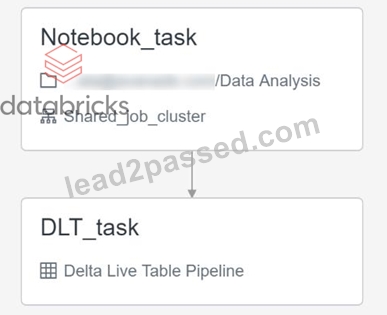
Bottom of Form
Top of Form
NEW QUESTION # 22
The data engineering team has configured a job to process customer requests to be forgotten (have their data deleted). All user data that needs to be deleted is stored in Delta Lake tables using default table settings.
The team has decided to process all deletions from the previous week as a batch job at 1am each Sunday. The total duration of this job is less than one hour. Every Monday at 3am, a batch job executes a series ofVACUUMcommands on all Delta Lake tables throughout the organization.
The compliance officer has recently learned about Delta Lake's time travel functionality. They are concerned that this might allow continued access to deleted data.
Assuming all delete logic is correctly implemented, which statement correctly addresses this concern?
- A. Because the vacuum command permanently deletes all files containing deleted records, deleted records may be accessible with time travel for around 24 hours.
- B. Because Delta Lake time travel provides full access to the entire history of a table, deleted records can always be recreated by users with full admin privileges.
- C. Because the default data retention threshold is 7 days, data files containing deleted records will be retained until the vacuum job is run 8 days later.
- D. Because the default data retention threshold is 24 hours, data files containing deleted records will be retained until the vacuum job is run the following day.
- E. Because Delta Lake's delete statements have ACID guarantees, deleted records will be permanently purged from all storage systems as soon as a delete job completes.
Answer: A
Explanation:
Explanation
This is the correct answer because Delta Lake's delete statements do not physically remove the data files that contain the deleted records, but only mark them as logically deleted in the transaction log. These files are still accessible with time travel until they are permanently deleted by the vacuum command. The default data retention threshold for vacuum is 7 days, but in this case it is overridden by setting it to 24 hours in each vacuum command. Therefore, deleted records may be accessible with time travel for around 24 hours after they are deleted, until they are vacuumed. Verified References: [Databricks Certified Data Engineer Professional], under "Delta Lake" section; [Databricks Documentation], under "Optimizations - Vacuum" section.
NEW QUESTION # 23
The data engineering team is looking to add a new column to the table, but the QA team would like to test the change before implementing in production, which of the below options allow you to quickly copy the table from Prod to the QA environment, modify and run the tests?
- A. ZERO COPY CLONE
- B. METADATA CLONE
- C. SHADOW CLONE
- D. DEEP CLONE
- E. SHALLOW CLONE
Answer: E
Explanation:
Explanation
The answer is SHALLOW CLONE
SHALLOW CLONE If you wish to create a copy of a table quickly to test out applying changes without the risk of modifying the current table, SHALLOW CLONE can be a good option. Shallow clones just copy the Delta transaction logs, meaning that the data doesn't move so it can be very quick.
1.CREATE OR REPLACE TABLE {new_table_name} SHALLOW CLONE
{source_table_name}|[LOCATION path]
DEEP CLONE fully copies data and metadata from a source table to a target. This copy occurs incre-mentally, so executing this command again can sync changes from the source to the target location. It copies all of the data and transaction logs this can take a long time based on the size of the table.
1.CREATE OR REPLACE TABLE {new_table_name} DEEP CLONE {source_table_name}|[LOCATION path]
NEW QUESTION # 24
If you create a database sample_db with the statement CREATE DATABASE sample_db what will be the default location of the database in DBFS?
- A. Statement fails "Unable to create database without location"
- B. Default location, /user/db/
- C. Default location, DBFS:/user/
- D. Default Storage account
- E. Default Location, dbfs:/user/hive/warehouse
Answer: E
Explanation:
Explanation
The Answer is dbfs:/user/hive/warehouse this is the default location where spark stores user data-bases, the default can be changed using spark.sql.warehouse.dir a parameter. You can also provide a custom location using the LOCATION keyword.
Here is how this works,
Graphical user interface, text, application, email Description automatically generated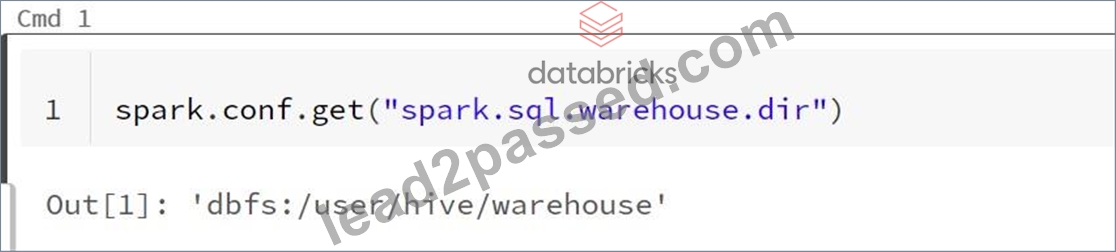
Default location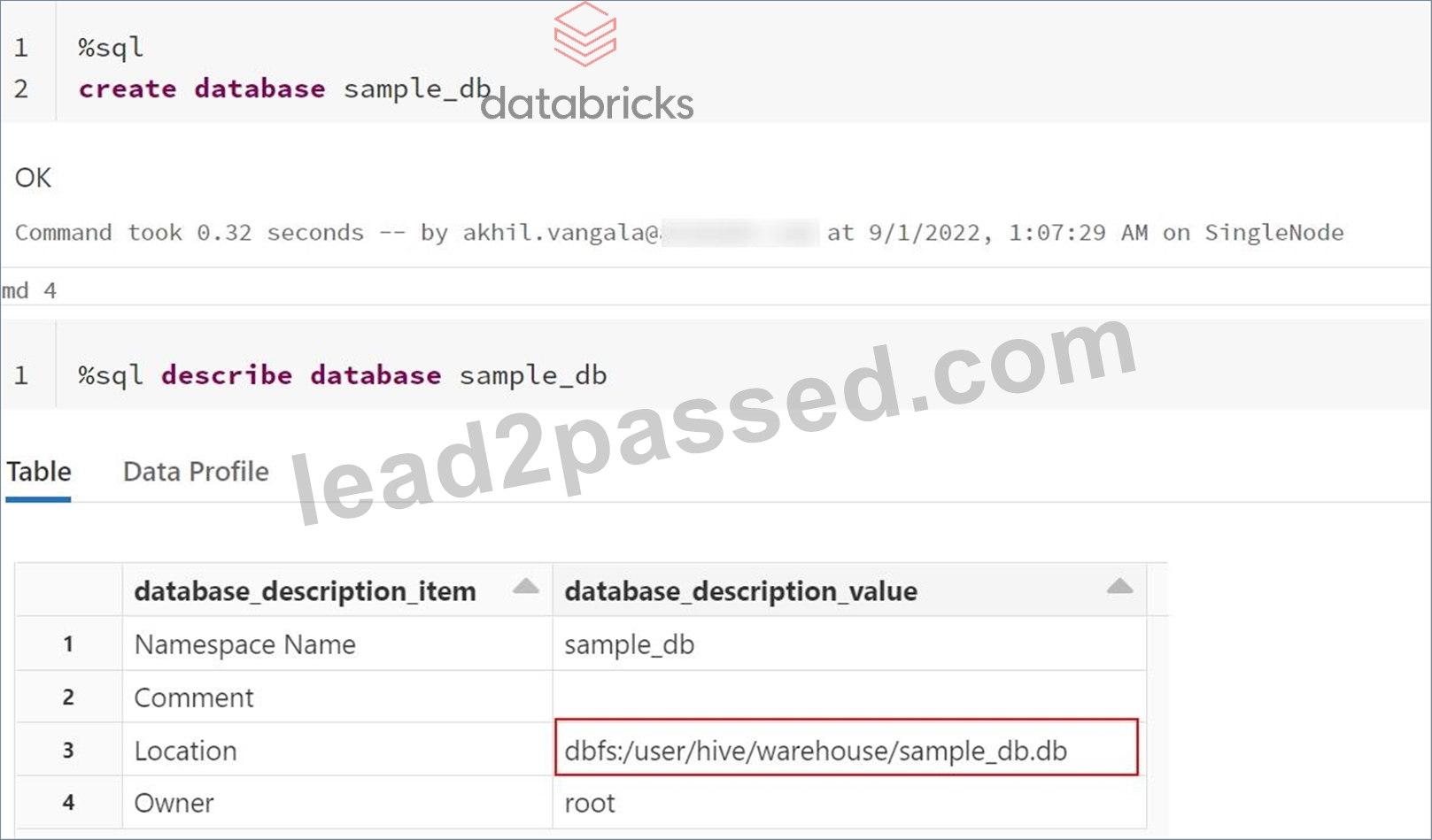
FYI, This can be changed used using cluster spark config or session config.
Modify spark.sql.warehouse.dir location to change the default location
Graphical user interface, text, application Description automatically generated

NEW QUESTION # 25
Drop the customers database and associated tables and data, all of the tables inside the database are managed tables. Which of the following SQL commands will help you accomplish this?
- A. DROP DATABASE customers FORCE
- B. DROP DATABASE customers CASCADE
- C. DROP DELTA DATABSE customers
- D. DROP DATABASE customers INCLUDE
- E. All the tables must be dropped first before dropping database
Answer: D
Explanation:
Explanation
The answer is DROP DATABASE customers CASCADE
Drop database with cascade option drops all the tables, since all of the tables inside the database are managed tables we do not need to perform any additional steps to clean the data in the storage.
NEW QUESTION # 26
A data engineer is designing a data pipeline. The source system generates files in a shared directory that is also
used by other processes. As a result, the files should be kept as is and will accumulate in the directory. The
data engineer needs to identify which files are new since the previous run in the pipeline, and set up the
pipeline to only ingest those new files with each run.
Which of the following tools can the data engineer use to solve this problem?
- A. Auto Loader
- B. Unity Catalog
- C. Data Explorer
- D. Delta Lake
- E. Databricks SQL
Answer: A
NEW QUESTION # 27
A data engineering team has been using a Databricks SQL query to monitor the performance of an ELT job.
The ELT job is triggered by a specific number of input records being ready to process. The Databricks SQL
query returns the number of minutes since the job's most recent runtime.
Which of the following approaches can enable the data engineering team to be notified if the ELT job has not
been run in an hour?
- A. They can set up an Alert for the accompanying dashboard to notify them if the returned value is greater
than 60 - B. They can set up an Alert for the query to notify when the ELT job fails
- C. They can set up an Alert for the query to notify them if the returned value is greater than 60
- D. They can set up an Alert for the accompanying dashboard to notify when it has not re-freshed in 60
minutes - E. This type of alerting is not possible in Databricks
Answer: C
NEW QUESTION # 28
Which of the following is a correct statement on how the data is organized in the storage when when managing a DELTA table?
- A. All of the data is broken down into one or many parquet files, log files are broken down into one or many JSON files, and each transaction creates a new data file(s) and log file.
(Correct) - B. All of the data is broken down into one or many parquet files, but the log file is stored as a single json file, and every transaction creates a new data file(s) and log file gets appended.
- C. All of the data is broken down into one or many parquet files, log file is removed once the transaction is committed.
- D. All of the data is stored into one parquet file, log files are broken down into one or many json files.
- E. All of the data and log are stored in a single parquet file
Answer: A
Explanation:
Explanation
Answer is
All of the data is broken down into one or many parquet files, log files are broken down into one or many json files, and each transaction creates a new data file(s) and log file.
here is sample layout of how DELTA table might look,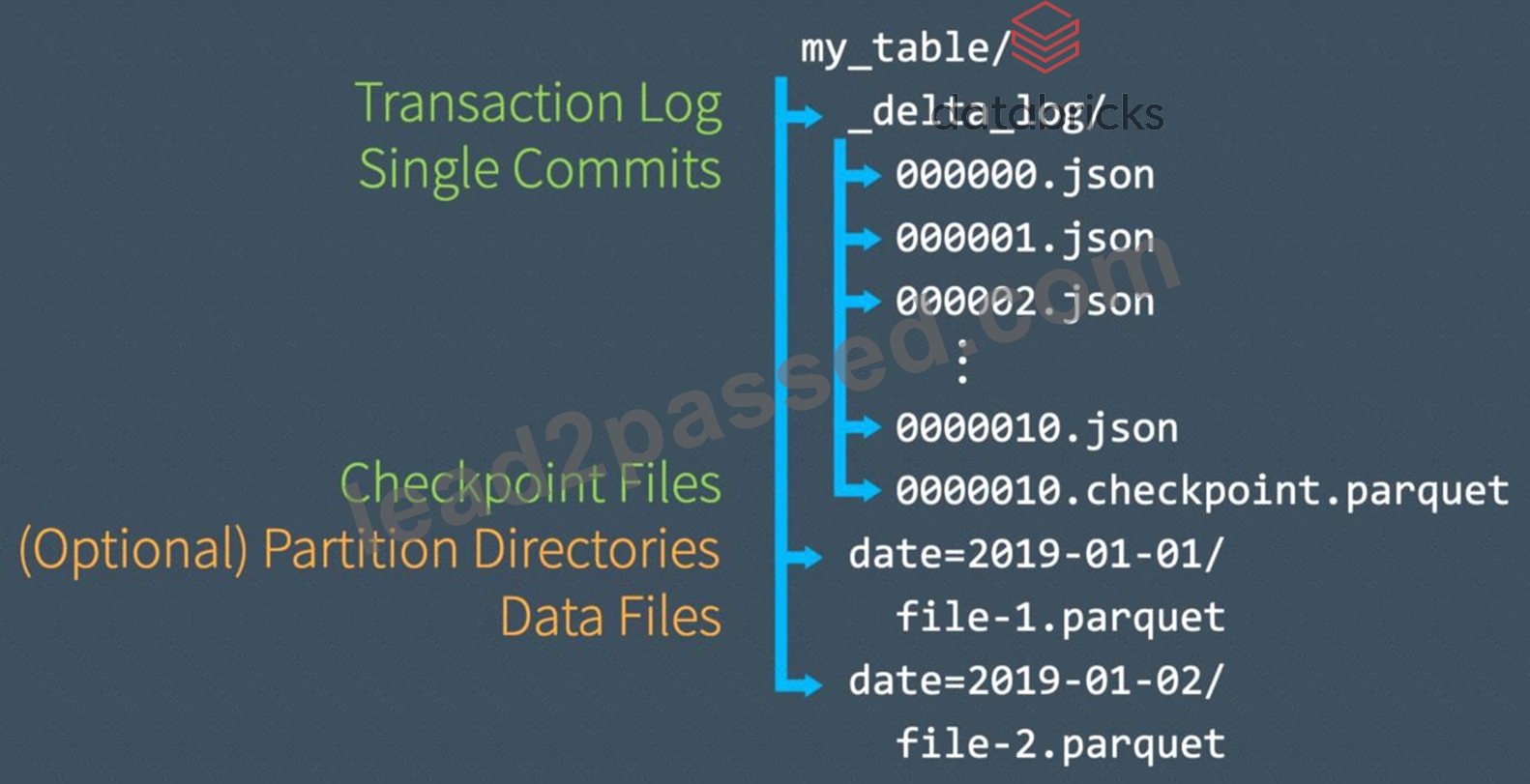
NEW QUESTION # 29
A junior data engineer needs to create a Spark SQL table my_table for which Spark manages both the data and
the metadata. The metadata and data should also be stored in the Databricks Filesystem (DBFS).
Which of the following commands should a senior data engineer share with the junior data engineer to
complete this task?
- A. 1. CREATE TABLE my_table (id STRING, value STRING) USING DBFS;
- B. 1. CREATE TABLE my_table (id STRING, value STRING);
- C. 1. CREATE TABLE my_table (id STRING, value STRING) USING
2. org.apache.spark.sql.parquet OPTIONS (PATH "storage-path") - D. 1. CREATE MANAGED TABLE my_table (id STRING, value STRING) USING
2. org.apache.spark.sql.parquet OPTIONS (PATH "storage-path"); - E. 1. CREATE MANAGED TABLE my_table (id STRING, value STRING);
Answer: B
NEW QUESTION # 30
The Delta Live Tables Pipeline is configured to run in Development mode using the Triggered Pipeline Mode.
what is the expected outcome after clicking Start to update the pipeline?
- A. All datasets will be updated at set intervals until the pipeline is shut down. The compute resources will persist after the pipeline is stopped to allow for additional development and testing
- B. All datasets will be updated continuously and the pipeline will not shut down. The compute resources will persist with the pipeline
- C. All datasets will be updated once and the pipeline will shut down. The compute resources will persist to allow for additional development and testing
- D. All datasets will be updated at set intervals until the pipeline is shut down. The compute resources will be deployed for the update and terminated when the pipeline is stopped
- E. All datasets will be updated once and the pipeline will shut down. The compute resources will be terminated
Answer: B
Explanation:
Explanation
The answer is All datasets will be updated once and the pipeline will shut down. The compute re-sources will persist to allow for additional testing.
DLT pipeline supports two modes Development and Production, you can switch between the two based on the stage of your development and deployment lifecycle.
Development and production modes
When you run your pipeline in development mode, the Delta Live Tables system:
*Reuses a cluster to avoid the overhead of restarts.
*Disables pipeline retries so you can immediately detect and fix errors.
In production mode, the Delta Live Tables system:
*Restarts the cluster for specific recoverable errors, including memory leaks and stale credentials.
*Retries execution in the event of specific errors, for example, a failure to start a cluster.
Use the buttons in the Pipelines UI to switch between develop-ment and production modes. By default, pipelines run in development mode.
Switching between development and production modes only controls cluster and pipeline execution behavior.
Storage locations must be configured as part of pipeline settings and are not affected when switching between modes.
Please review additional DLT concepts using below link
https://docs.databricks.com/data-engineering/delta-live-tables/delta-live-tables-concepts.html#delta-live-tables-c
NEW QUESTION # 31
A data engineering team is in the process of converting their existing data pipeline to utilize Auto Loader for
incremental processing in the ingestion of JSON files. One data engineer comes across the following code
block in the Auto Loader documentation:
1. (streaming_df = spark.readStream.format("cloudFiles")
2. .option("cloudFiles.format", "json")
3. .option("cloudFiles.schemaLocation", schemaLocation)
4. .load(sourcePath))
Assuming that schemaLocation and sourcePath have been set correctly, which of the following changes does
the data engineer need to make to convert this code block to use Auto Loader to ingest the data?
- A. There is no change required. The inclusion of format("cloudFiles") enables the use of Auto Loader
- B. There is no change required. Databricks automatically uses Auto Loader for streaming reads
- C. The data engineer needs to add the .autoLoader line before the .load(sourcePath) line
- D. The data engineer needs to change the format("cloudFiles") line to format("autoLoader")
- E. There is no change required. The data engineer needs to ask their administrator to turn on Auto Loader
Answer: A
NEW QUESTION # 32
Which statement characterizes the general programming model used by Spark Structured Streaming?
- A. Structured Streaming is implemented as a messaging bus and is derived from Apache Kafka.
- B. Structured Streaming relies on a distributed network of nodes that hold incremental state values for cached stages.
- C. Structured Streaming leverages the parallel processing of GPUs to achieve highly parallel data throughput.
- D. Structured Streaming models new data arriving in a data stream as new rows appended to an unbounded table.
- E. Structured Streaming uses specialized hardware and I/O streams to achieve sub-second latency for data transfer.
Answer: D
Explanation:
Explanation
This is the correct answer because it characterizes the general programming model used by Spark Structured Streaming, which is to treat a live data stream as a table that is being continuously appended. This leads to a new stream processing model that is very similar to a batch processing model, where users can express their streaming computation using the same Dataset/DataFrame API as they would use for static data. The Spark SQL engine will take care of running the streaming query incrementally and continuously and updating the final result as streaming data continues to arrive. Verified References: [Databricks Certified Data Engineer Professional], under "Structured Streaming" section; Databricks Documentation, under "Overview" section.
NEW QUESTION # 33
A data engineer wants to create a relational object by pulling data from two tables. The relational object must
be used by other data engineers in other sessions. In order to save on storage costs, the data engineer wants to
avoid copying and storing physical data.
Which of the following relational objects should the data engineer create?
- A. Spark SQL Table
- B. Delta Table
- C. Temporary view
- D. View
- E. Database
Answer: D
NEW QUESTION # 34
A data engineer has written the following query:
1. SELECT *
2. FROM json.`/path/to/json/file.json`;
The data engineer asks a colleague for help to convert this query for use in a Delta Live Tables (DLT)
pipeline. The query should create the first table in the DLT pipeline.
Which of the following describes the change the colleague needs to make to the query?
- A. They need to add a COMMENT line at the beginning of the query
- B. They need to add a CREATE LIVE TABLE table_name AS line at the beginning of the query
- C. They need to add a CREATE DELTA LIVE TABLE table_name AS line at the beginning of the query
- D. They need to add a live. prefix prior to json. in the FROM line
- E. They need to add the cloud_files(...) wrapper to the JSON file path
Answer: B
NEW QUESTION # 35
Two of the most common data locations on Databricks are the DBFS root storage and external object storage mounted with dbutils.fs.mount().
Which of the following statements is correct?
- A. Neither the DBFS root nor mounted storage can be accessed when using %sh in a Databricks notebook.
- B. By default, both the DBFS root and mounted data sources are only accessible to workspace administrators.
- C. DBFS is a file system protocol that allows users to interact with files stored in object storage using syntax and guarantees similar to Unix file systems.
- D. The DBFS root stores files in ephemeral block volumes attached to the driver, while mounted directories will always persist saved data to external storage between sessions.
- E. The DBFS root is the most secure location to store data, because mounted storage volumes must have full public read and write permissions.
Answer: C
Explanation:
Explanation
DBFS is a file system protocol that allows users to interact with files stored in object storage using syntax and guarantees similar to Unix file systems1. DBFS is not a physical file system, but a layer over the object storage that provides a unified view of data across different data sources1. By default, the DBFS root is accessible to all users in the workspace, and the access to mounted data sources depends on the permissions of the storage account or container2. Mounted storage volumes do not need to have full public read and write permissions, but they do require a valid connection string or access key to be provided when mounting3. Both the DBFS root and mounted storage can be accessed when using %sh in a Databricks notebook, as long as the cluster has FUSE enabled4. The DBFS root does not store files in ephemeral block volumes attached to the driver, but in the object storage associated with the workspace1. Mounted directories will persist saved data to external storage between sessions, unless they are unmounted or deleted3. References: DBFS, Work with files on Azure Databricks, Mounting cloud object storage on Azure Databricks, Access DBFS with FUSE
NEW QUESTION # 36
A dataset has been defined using Delta Live Tables and includes an expectations clause: CON-STRAINT valid_timestamp EXPECT (timestamp > '2020-01-01') ON VIOLATION FAIL What is the expected behavior when a batch of data containing data that violates these constraints is processed?
- A. Records that violate the expectation are dropped from the target dataset and loaded into a quarantine table.
- B. Records that violate the expectation are added to the target dataset and flagged as in-valid in a field added to the target dataset.
- C. Records that violate the expectation are dropped from the target dataset and recorded as invalid in the event log.
- D. Records that violate the expectation cause the job to fail
- E. Records that violate the expectation are added to the target dataset and recorded as invalid in the event log.
Answer: D
Explanation:
Explanation
The answer is Records that violate the expectation cause the job to fail.
Delta live tables support three types of expectations to fix bad data in DLT pipelines Review below example code to examine these expectations, Diagram Description automatically generated with medium confidence
Invalid records:
Use the expect operator when you want to keep records that violate the expectation. Records that violate the expectation are added to the target dataset along with valid records:
SQL
CONSTRAINT valid_timestamp EXPECT (timestamp > '2020-01-01')
Drop invalid records:
Use the expect or drop operator to prevent the processing of invalid records. Records that violate the expectation are dropped from the target dataset:
SQL
CONSTRAINT valid_timestamp EXPECT (timestamp > '2020-01-01') ON VIOLATION DROP ROW Fail on invalid records:
When invalid records are unacceptable, use the expect or fail operator to halt execution immediately when a record fails validation. If the operation is a table update, the system atomically rolls back the transaction:
SQL
CONSTRAINT valid_timestamp EXPECT (timestamp > '2020-01-01') ON VIOLATION FAIL UP-DATE
NEW QUESTION # 37
Your team has hundreds of jobs running but it is difficult to track cost of each job run, you are asked to provide a recommendation on how to monitor and track cost across various workloads
- A. Create jobs in different workspaces, so we can track the cost easily
- B. Use a single cluster for all the jobs, so cost can be easily tracked
- C. Use job logs to monitor and track the costs
- D. Use workspace admin reporting
- E. Use Tags, during job creation so cost can be easily tracked
Answer: E
Explanation:
Explanation
The answer is Use Tags, during job creation so cost can be easily tracked Review below link for more details
https://docs.databricks.com/administration-guide/account-settings/usage-detail-tags-aws.html Here is a view how tags get propagated from pools to clusters and clusters without pools, Diagram Description automatically generated
NEW QUESTION # 38
You are working to set up two notebooks to run on a schedule, the second notebook is dependent on the first notebook but both notebooks need different types of compute to run in an optimal fashion, what is the best way to set up these notebooks as jobs?
- A. Each task can use different cluster, add these two notebooks as two tasks in a single job with linear dependency and modify the cluster as needed for each of the tasks
- B. Use a very large cluster to run both the tasks in a single job
- C. A Job can only use single cluster, setup job for each notebook and use job dependency to link both jobs together
- D. Use a single job to setup both notebooks as individual tasks, but use the cluster API to setup the second cluster before the start of second task
- E. Use DELTA LIVE PIPELINES instead of notebook tasks
Answer: A
Explanation:
Explanation
Tasks in Jobs support different clusters for each task in the same job.
NEW QUESTION # 39
......
New Databricks-Certified-Professional-Data-Engineer exam dumps Use Updated Databricks Exam: https://www.lead2passed.com/Databricks/Databricks-Certified-Professional-Data-Engineer-practice-exam-dumps.html