Latest Jun 12, 2024 Real Secret-Sen Exam Dumps Questions Valid Secret-Sen Dumps PDF
CyberArk Secret-Sen Exam Dumps - PDF Questions and Testing Engine
As cybersecurity has become paramount for organizations, the need to protect privileged access is further heightened. Privileged access abuse can lead to severe damage, which can have considerable financial and reputational impact on organizations. As such, CyberArk Secret-Sen exam, also known as CyberArk Sentry - Secrets Manager, has gained prominence in the cybersecurity certification landscape.
NEW QUESTION # 27
Which statement is true for the Conjur Command Line Interface (CLI)?
- A. It is required for working with the Conjur REST API.
- B. It can only be run from the Conjur Leader node.
- C. It does not implement the Conjur REST API for managing Conjur resources.
- D. It is supported on Windows, Red Hat Enterprise Linux, and macOS.
Answer: D
Explanation:
Explanation
This is the correct answer because the Conjur CLI is a tool that allows users to interact with the Conjur REST API from the command line. The Conjur CLI can be run on Windows, Red Hat Enterprise Linux, and macOS operating systems, as well as in Docker containers. The Conjur CLI can be installed using various methods, such as downloading the executable file, using a package manager, or pulling the Docker image. The Conjur CLI supports Conjur Enterprise 12.9 or later versions. This answer is based on the CyberArk Secrets Manager documentation1 and the CyberArk Secrets Manager training course2.
The other options are not true statements for the Conjur CLI. The Conjur CLI can be run from any machine that has network access to the Conjur server, not only from the Conjur Leader node. The Conjur Leader node is the node that performs read/write operations on the Conjur database and policy engine, and hosts the Conjur UI and API endpoints. The Conjur CLI is not required for working with the Conjur REST API, as users can also use other tools, such as curl, Postman, or web browsers, to send HTTP requests to the Conjur REST API.
The Conjur CLI does implement the Conjur REST API for managing Conjur resources, such as roles, policies, secrets, and audit records. The Conjur CLI provides a set of commands that correspond to the Conjur REST API endpoints and allow users to perform various operations on the Conjur resources.
NEW QUESTION # 28
When attempting to configure a Follower, you receive the error: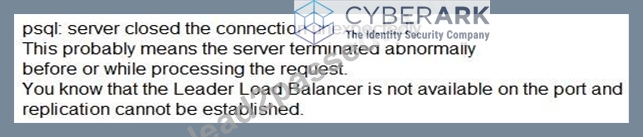
Which port is the problem?
- A. 0
- B. 1
- C. 2
- D. 3
Answer: C
Explanation:
Explanation
The error message "psql: server closed the connection unexpectedly" means that the server terminated abnormally before or while processing the request. This is likely due to the Leader Load Balancer not being available on the port and replication cannot be established. The port that is the problem is 5432, which is the default port for PostgreSQL database connections. The Follower needs to connect to the Leader Load Balancer on this port to receive the replication data from the Leader. If the port is blocked or unreachable, the Follower will fail to sync with the Leader and display the error message. References: [Set up Follower], [Troubleshoot Follower]
NEW QUESTION # 29
During the configuration of Conjur, what is a possible deployment scenario?
- A. The Conjur Leader cluster is deployed outside of a Kubernetes environment; Followers can run inside or outside the environment.
- B. The Conjur Leader cluster and Followers are deployed inside a Kubernetes environment.
- C. The Leader cluster is deployed outside a Kubernetes environment; Followers and Standbys can run inside or outside the environment.
- D. The Leader and Followers are deployed outside of a Kubernetes environment; Slandbys can run inside a Kubernetes environment.
Answer: C
Explanation:
Explanation
Conjur is a secrets management solution that securely stores and manages secrets and credentials used by applications, DevOps tools, and other systems. Conjur can be deployed in different scenarios, depending on the needs and preferences of the organization. One of the possible deployment scenarios is to deploy the Leader cluster outside a Kubernetes environment, and the Followers and Standbys inside or outside the environment.
The Leader cluster is the primary node that handles all write operations and coordinates the replication of data to the Follower and Standby nodes. The Leader cluster consists of one active Leader node and one or more Standby nodes that can be promoted to Leader in case of a failure. The Leader cluster can be deployed outside a Kubernetes environment, such as on a virtual machine or a physical server, using Docker or other installation methods. This can provide more control and flexibility over the configuration and management of the Leader cluster, as well as better performance and security.
The Follower and Standby nodes are read-only replicas of the Leader node that can serve requests from clients and applications that need to retrieve secrets or perform other read-only operations. The Follower and Standby nodes can be deployed inside or outside a Kubernetes environment, depending on the use case and the availability requirements. For example, if the clients and applications are running inside a Kubernetes cluster, it may be convenient and efficient to deploy the Follower and Standby nodes inside the same cluster, using Helm charts or other methods. This can reduce the network latency and complexity, and leverage the Kubernetes features such as service discovery, load balancing, and health checks. Alternatively, if the clients and applications are running outside a Kubernetes cluster, or if there is a need to distribute the Follower and Standby nodes across different regions or availability zones, it may be preferable to deploy the Follower and Standby nodes outside the Kubernetes cluster, using Docker or other methods. This can provide more scalability and resiliency, and avoid the dependency on the Kubernetes cluster.
References = Conjur Deployment Scenarios; Conjur Cluster Installation; Conjur Kubernetes Integration
NEW QUESTION # 30
You are installing a Credential Provider on a Linux host. Arrange the installation steps in the correct sequence.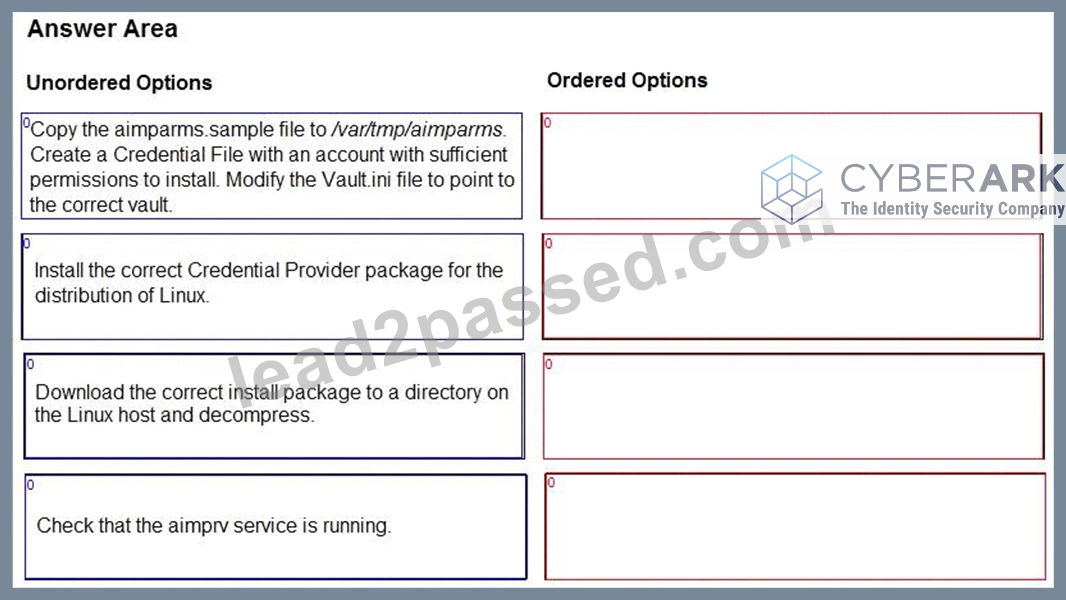
Answer:
Explanation: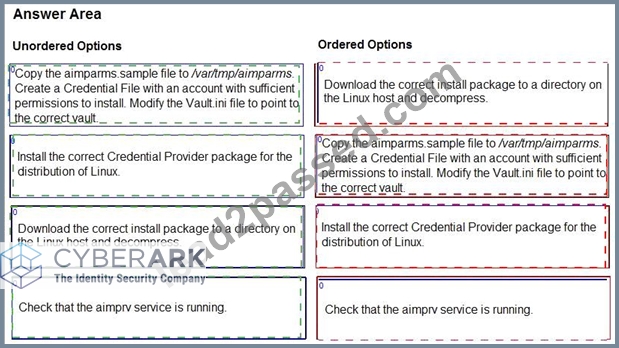
Explanation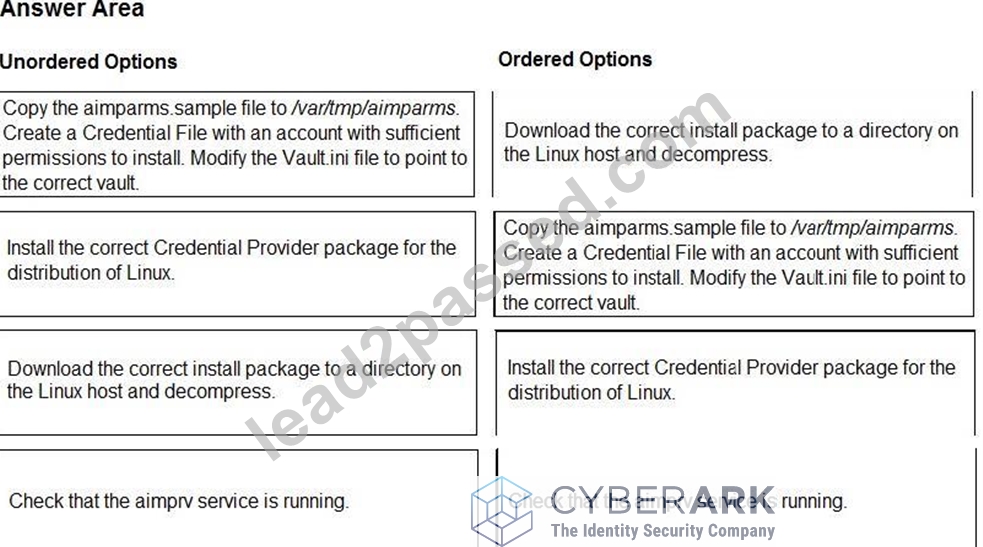
The correct sequence of installation steps for a Credential Provider on a Linux host is as follows:
Download the correct install package to a directory on the Linux host and decompress1.
Copy the aimparms.sample file to /var/tmp/aimparms. Create a Credential File with an account with sufficient permissions to install. Modify the Vault.ini file to point to the correct vault2.
Install the correct Credential Provider package for the distribution of Linux using the command: rpm
-ivh CARKaim-<version+build number>.<distribution>.rpm2.
Check that the aimprv service is running using the command: service aimprv status2.
References: 1: Download the Credential Provider 2: Install Credential Provider on Linux / AIX
NEW QUESTION # 31
When installing the CCP and configuring it for use behind a load balancer, which authentication methods may be affected? (Choose two.)
- A. Path
- B. Allowed Machines authentication
- C. Hash
- D. [Client Certificate authentication
- E. OS User
Answer: B,D
Explanation:
Explanation
The CCP (Central Credential Provider) is a tool that enables applications to securely retrieve credentials from CyberArk Secrets Manager without hard-coding or storing them in files. The CCP can be installed on a single server or on multiple servers behind a load balancer for high availability and scalability. The load balancer is a device or service that distributes the network traffic among the CCP servers based on predefined rules and criteria.
The CCP supports multiple methods to authenticate applications, such as Allowed Machines, Client Certificate, OS User, Path, and Hash. These methods are based on registering information in the Vault with the unique application ID. For more information about the supported authentication methods, see Application authentication methods1.
When installing the CCP and configuring it for use behind a load balancer, some authentication methods may be affected by the load balancer's behavior and settings. Specifically, the following authentication methods may be affected:
Allowed Machines authentication: This method authenticates applications based on their IP address or hostname. If the load balancer replaces the source IP or hostname of the routed packets with its own IP or hostname, the CCP will not be able to authenticate the application that initiated the credential request.
To enable the CCP to resolve the IP or hostname of the application, the load balancer needs to be configured as a transparent proxy or to attach the X-Forwarded-For header to the routed packets. For more information, see Load balance the Central Credential Provider2.
Client Certificate authentication: This method authenticates applications based on their client certificate that is signed by a trusted certificate authority (CA). The client certificate is used to establish a secure and trusted connection between the application and the CCP. If the load balancer terminates the SSL connection before proxying the traffic to the CCP, the CCP will not be able to verify the client certificate of the application. To enable the CCP to validate the client certificate, the load balancer needs to be configured as a pass-through proxy or to forward the client certificate to the CCP. For more information, see Load balance the Central Credential Provider2.
The other authentication methods are not affected by the load balancer, as they do not rely on the IP, hostname, or certificate of the application. For example, the OS User method authenticates applications based on their Windows domain user, the Path method authenticates applications based on their URL path, and the Hash method authenticates applications based on a hash value that is generated from the application ID and a shared secret. These methods do not require any special configuration on the load balancer or the CCP.
NEW QUESTION # 32
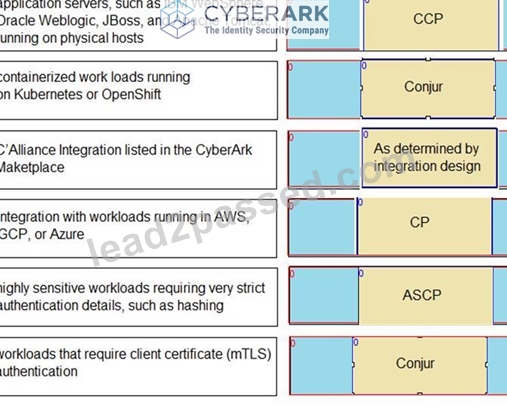
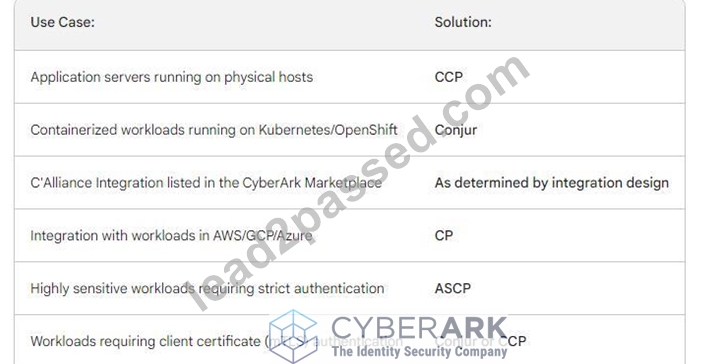
Match each use case to the appropriate Secrets Manager Solution.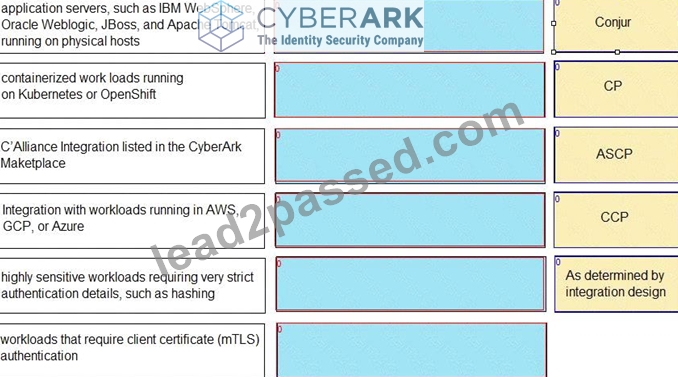
Answer:
Explanation: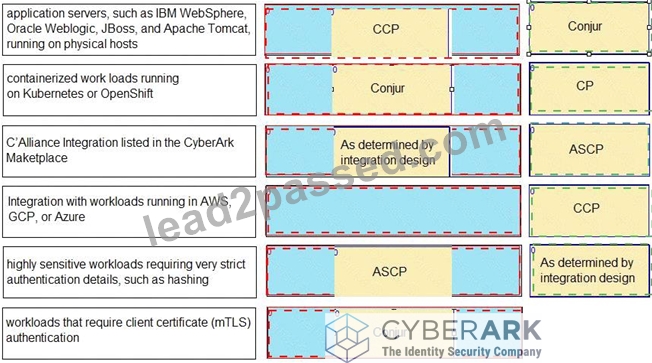
NEW QUESTION # 33
During the configuration of Conjur, what is a possible deployment scenario?
- A. The Conjur Leader cluster is deployed outside of a Kubernetes environment; Followers can run inside or outside the environment.
- B. The Conjur Leader cluster and Followers are deployed inside a Kubernetes environment.
- C. The Leader cluster is deployed outside a Kubernetes environment; Followers and Standbys can run inside or outside the environment.
- D. The Leader and Followers are deployed outside of a Kubernetes environment; Slandbys can run inside a Kubernetes environment.
Answer: C
NEW QUESTION # 34
A customer requires high availability in its AWS cloud infrastructure.
What is the minimally viable Conjur deployment architecture to achieve this?
- A. two Followers in each region, load balanced for the region
- B. two Followers in each AZ. load balanced for the region
- C. one Follower in each AZ. load balancer for the region
- D. two Followers in each region, load balanced across all regions
Answer: C
NEW QUESTION # 35
What does "Line of business (LOB)" represent?
- A. the services that Conjur offers and typically refers to a group of application identities in Conjur
- B. a business group that meets a certain set of Conjur policies for entitlements and policy management
- C. the services that Conjur offers and typically refers to the list of configured and enabled authenticators in Conjur
- D. a business group requiring access to secrets from the Vault/Privilege Claud to facilitate syncing accounts to Conjur
Answer: A
Explanation:
Explanation
Line of business (LOB) is a term used by CyberArk Secrets Manager to describe the services that Conjur offers and typically refers to a group of application identities in Conjur. A LOB can be defined by a Conjur policy that grants permissions and access to secrets for a specific set of applications. For example, a LOB can represent a business unit, a project, a product, or a team within an organization. A LOB can also have sub-LOBs that inherit the permissions and secrets from the parent LOB, but can also have their own specific policies and secrets. A LOB can help organize and manage secrets for different applications in a hierarchical and scalable way. References: CyberArk Secrets Manager - Line of Business; CyberArk Secrets Manager - Policy Management; CyberArk Secrets Manager - Application Identity Management
NEW QUESTION # 36
When working with Credential Providers in a Privileged Cloud setting, what is a special consideration?
- A. If there are installation issues, troubleshooting may need to involve the Privileged Cloud support team.
- B. Debug logging for Credential Providers deployed in a Privileged Cloud setting can inadvertently exhaust available disk space.
- C. Credential Providers are not supported in a Privileged Cloud setting.
- D. The AWS Cloud account number must be defined in the file main appprovider.conf.
<platform>.<version> found in the AppProviderConf Safe.
Answer: A
Explanation:
Explanation
Credential Providers are tools that enable applications to securely retrieve credentials from CyberArk Secrets Manager without hard-coding or storing them in files. Credential Providers can be installed on application servers or on a central server that acts as a proxy for multiple applications. Credential Providers can integrate with Privileged Cloud, which is a cloud-based solution that provides privileged access management as a service. Privileged Cloud integrates with Secrets Manager Credential Providers to manage application credentials as privileged accounts within Privileged Cloud.
When working with Credential Providers in a Privileged Cloud setting, a special consideration is that if there are installation issues, troubleshooting may need to involve the Privileged Cloud support team. This is because the installation of Credential Providers in a Privileged Cloud setting requires some additional steps and configurations that are performed by the Privileged Cloud support team. For example, the Privileged Cloud support team needs to configure the connection between Privileged Cloud and Credential Providers, and provide the necessary certificates and keys for secure communication. Therefore, if there are any problems or errors during the installation process, the Privileged Cloud support team may need to assist with the troubleshooting and resolution.
The other options are not correct. Credential Providers are supported in a Privileged Cloud setting, as described in the Secrets Manager Credential Providers integration documentation1. The AWS Cloud account number does not need to be defined in the file main appprovider.conf.<platform>.<version> found in the AppProviderConf Safe. This file is used to configure the Credential Provider settings, such as the Privileged Cloud URL, the application ID, and the SSL options. The AWS Cloud account number is not relevant for this file. Debug logging for Credential Providers deployed in a Privileged Cloud setting can be enabled or disabled by the Privileged Cloud support team, as described in the Credential Provider installation documentation2.
Debug logging can help with troubleshooting and diagnostics, but it does not necessarily exhaust available disk space, as the log files can be rotated and archived.
References = Secrets Manager Credential Providers integration; Credential Provider installation
NEW QUESTION # 37
When attempting to retrieve a credential, you receive an error 401 - Malformed Authorization Token.
What is the cause of the issue?
- A. The host does not have access to the credential with the current token.
- B. The token you are trying to retrieve does not exist.
- C. The token is not correctly encoded.
- D. The credential has not been initialized.
Answer: C
Explanation:
Explanation
= The cause of the issue is that the token is not correctly encoded. A token is a string of characters that represents a credential or an authorization grant for accessing a resource. A token must be encoded according to a specific format and standard, such as Base64, JSON Web Token (JWT), or OAuth 2.0. If the token is malformed, meaning that it does not follow the expected format or standard, the server will reject the token and return an error 401 - Malformed Authorization Token. This error indicates that the token is invalid or expired, and the request is unauthorized. To resolve the issue, the token must be regenerated or refreshed using the correct encoding method and parameters12. References: = CyberArk Identity: Getting 401 unauthorized Error when using API calls with OAuth2 Client 2, Resolution 1 Troubleshoot CyberArk Vault Synchronizer 1, Error: Forbidden Logon Token is Empty - Cannot logon Unauthorized
NEW QUESTION # 38
If you rename an account or Safe, the Vault Conjur Synchronizer recreates these accounts and safes with their new name and deletes the old accounts or safes.
What does this mean?
- A. Their permissions in Coniur remain the same.
- B. The Vault-Conjur Synchronizer will recreate these accounts and safes with their exact same names.
- C. Their permissions in Coniur must also be recreated to access them.
- D. You can not rename an account or safe.
Answer: C
Explanation:
Explanation
When an account or Safe is renamed in the Vault, the Vault Conjur Synchronizer will create new variables in Conjur with the new name and delete the old variables with the old name. This means that the permissions that were granted to the old variables in Conjur will not apply to the new variables, and they will need to be recreated using delegation policies. Otherwise, the users or hosts that had access to the old variables will not be able to access the new ones. References: Manage Accounts and Safes During Synchronization; Vault Synchronizer full policy guide
NEW QUESTION # 39
Which statement is correct about this message?
Message: "[number-of-deleted-rows] rows has successfully deleted "CEADBR009D Finished vacuum"?
- A. The Vault Conjur Synchronizer successfully deleted the password objects that were marked for deletion in the PVWA.
- B. The user specified for Conjur does not have the appropriate permissions to retrieve the audit database (audit .db).
- C. It notes the number of records deleted from the database and does not require any action.
- D. When audit retention was performed, the query on the Ul audit database (audit.db) generated an error.
Answer: C
Explanation:
Explanation
This is the correct answer because the message indicates that the audit retention process has successfully completed and deleted the specified number of rows from the audit database (audit.db). The audit retention process is a scheduled task that runs periodically to delete old audit records from the audit database based on the retention period configured in the Conjur UI. The audit retention process also performs a vacuum operation to reclaim the disk space and optimize the database performance. The message does not require any action from the user, as it is a normal and expected outcome of the audit retention process. This answer is based on the CyberArk Secrets Manager documentation1 and the CyberArk Secrets Manager training course2.
The other options are not correct statements about the message. The message does not imply that the user specified for Conjur does not have the appropriate permissions to retrieve the audit database, as the message is not an error or a warning, but a confirmation of the audit retention process. The user specified for Conjur is the user that is used to connect to the Conjur server and perform operations on the Conjur resources, such as roles, policies, secrets, and audit records. The user specified for Conjur needs to have the appropriate permissions to access the audit database, but the message does not indicate any problem with the user permissions.
The message does not imply that when audit retention was performed, the query on the UI audit database generated an error, as the message is not an error or a warning, but a confirmation of the audit retention process. The query on the UI audit database is the query that is used to display the audit records in the Conjur UI. The query on the UI audit database is not related to the audit retention process, which is a background task that runs on the Conjur server and deletes the old audit records from the audit database. The message does not indicate any problem with the query on the UI audit database.
The message does not imply that the Vault Conjur Synchronizer successfully deleted the password objects that were marked for deletion in the PVWA, as the message is not related to the Vault Conjur Synchronizer or the password objects. The Vault Conjur Synchronizer is a service that synchronizes secrets from the CyberArk Vault to the Conjur database. The password objects are the accounts in the CyberArk Vault that store the credentials for various platforms and devices. The message is related to the audit retention process, which deletes the old audit records from the audit database. The message does not indicate any problem or action with the Vault Conjur Synchronizer or the password objects.
NEW QUESTION # 40
You modified a Conjur host policy to change its annotations for authentication.
How should you load the policy to make those changes?
- A. Use the "update" method (e.g. conjur policy load - -update <branch> <policy-file>).
- B. Use the "delete" method (e.g. conjur policy load - -delete <branch> <policy-file>).
- C. Use the "replace" method (e.g. conjur policy load - -replace <branch> <policy-file>).
- D. Use the default "append" method (e.g. conjur policy load <branch> <policy-file>).
Answer: C
Explanation:
Explanation
= According to the CyberArk Sentry Secrets Manager documentation, the replace method is used to overwrite an existing policy branch with a new policy file. This method is suitable for making changes to the existing resources, such as modifying their annotations, permissions, or attributes. The replace method preserves the existing data and secrets associated with the resources, but removes any resources that are not defined in the new policy file. Therefore, to change the annotations for authentication of a Conjur host, the replace method is the best option.
The append method is used to add new resources or data to an existing policy branch, without affecting the existing resources. This method is suitable for creating new hosts, groups, variables, or secrets, but not for modifying the existing ones. The append method will ignore any changes to the existing resources, such as annotations, and will only load the new resources or data.
The delete method is used to remove resources or data from an existing policy branch, without affecting the other resources. This method is suitable for deleting hosts, groups, variables, or secrets, but not for modifying them. The delete method will remove any resources or data that are defined in the policy file, and will ignore any resources or data that are not defined in the policy file.
The update method is used to modify the data or secrets associated with existing resources, without affecting the resources themselves. This method is suitable for changing the values of variables or secrets, but not for changing the annotations, permissions, or attributes of the resources. The update method will only load the data or secrets that are defined in the policy file, and will ignore any resources or data that are not defined in the policy file. References: = Annotation reference | CyberArk Docs; Policy load modes | CyberArk Docs; Policy - docs.cyberark.com
NEW QUESTION # 41
You start up a Follower and try to connect to it with a REST call using the server certificate, but you get an SSL connection refused error.
What could be the problem and how should you fix it?
- A. The certificate is unnecessary. Use the command option to suppress SSL certificate checking.
- B. One of the PostgreSQL ports (5432. 1999) is blocked by the firewall Open those ports.
- C. The certificate does not contain the Follower hostname as a Subject Alternative Name (SAN). Generate a new certificate for the Follower.
- D. Port 443 is blocked; open that port.
Answer: C
Explanation:
Explanation
The correct answer is A. The certificate does not contain the Follower hostname as a Subject Alternative Name (SAN). Generate a new certificate for the Follower.
A possible explanation is:
A Follower is a read-only node that replicates data from the Leader node in a Secrets Manager cluster. A Follower can serve requests from clients and applications that need to retrieve secrets or perform other read-only operations. To connect to a Follower with a REST call, the client or application needs to use the server certificate that was generated for the Follower during the installation process. The server certificate is used to establish a secure and trusted connection between the client or application and the Follower.
However, if the server certificate does not contain the Follower hostname as a Subject Alternative Name (SAN), the connection will fail with an SSL connection refused error. This is because the SAN is an extension of the X.509 certificate standard that allows the certificate to specify multiple hostnames or IP addresses that the certificate is valid for. If the Follower hostname is not included in the SAN, the client or application will not be able to verify the identity of the Follower, and will reject the connection.
To fix this problem, a new server certificate needs to be generated for the Follower, with the Follower hostname added to the SAN. The new certificate can be generated using the openssl command or another tool that supports the SAN extension. The new certificate also needs to be signed by the same certificate authority (CA) that signed the original certificate, and the CA certificate needs to be trusted by the client or application.
The new certificate then needs to be copied to the Follower node and configured in the nginx.conf file. The Follower node also needs to be restarted for the changes to take effect.
References = Secrets Manager Cluster Installation; Secrets Manager Cluster Configuration; Subject Alternative Name - Wikipedia
NEW QUESTION # 42
You have a request to protect all the properties around a credential object. When configuring the credential in the Vault, you specified the address, user and password for the credential.
How do you configure the Vault Conjur Synchronizer to properly sync all properties?
- A. In the Conjur UI under Cluster > Synchronizer > Config, change SYNCALLPROPERTIES and update its value to true.
- B. Modify Vault.ini, uncomment SYNCALLPROPERTIES and update its value to true.
- C. Modify VaultConjurSynchronizer.exe.config, uncomment SYNCALLPROPERTIES and update its value to true.
- D. Modify SynchronizerReplication.config, uncomment SYNCALLPROPERTIES and update its value to true.
Answer: D
Explanation:
Explanation
This is the correct answer because the SynchronizerReplication.config file contains the configuration settings for the Vault Conjur Synchronizer service (Synchronizer) to sync secrets from the CyberArk Vault to the Conjur database. The SYNCALLPROPERTIES parameter specifies whether to sync all the properties of the accounts in the Vault or only the password property. By default, the SYNCALLPROPERTIES parameter is set to false, which means that only the password property is synced. To sync all the properties, such as the address and the user, the SYNCALLPROPERTIES parameter needs to be set to true. This answer is based on the CyberArk Secrets Manager documentation1 and the CyberArk Secrets Manager training course2.
The other options are not correct because they do not configure the Synchronizer to properly sync all properties. Modifying VaultConjurSynchronizer.exe.config, uncommenting SYNCALLPROPERTIES and updating its value to true is not a valid option, as this file does not contain the SYNCALLPROPERTIES parameter. The VaultConjurSynchronizer.exe.config file contains the configuration settings for the Synchronizer service, such as the log level, the log path, and the service name. The SYNCALLPROPERTIES parameter is only found in the SynchronizerReplication.config file.
Modifying Vault.ini, uncommenting SYNCALLPROPERTIES and updating its value to true is not a valid option, as this file does not contain the SYNCALLPROPERTIES parameter. The Vault.ini file contains the configuration settings for the CyberArk Central Credential Provider (CCP) to connect to the Vault server and provide credentials to the applications. The SYNCALLPROPERTIES parameter is not related to the CCP configuration or functionality.
In the Conjur UI under Cluster > Synchronizer > Config, changing SYNCALLPROPERTIES and updating its value to true is not a valid option, as this section does not exist in the Conjur UI. The Conjur UI does not have a Cluster, Synchronizer, or Config section. The Conjur UI has a Cluster Config section under Settings, but this section is used to configure the Conjur cluster settings, such as the master IP address, the follower IP address, and the seed fetcher IP address. The SYNCALLPROPERTIES parameter is not related to the Conjur cluster configuration or functionality.
NEW QUESTION # 43
What is the correct process to upgrade the CCP Web Service?
- A. Double-click the AimWebService.msi and select upgrade.
- B. Double-click the Credential Provider installer executable and select upgrade.
- C. Run "sudo yum update aimprv" from the CLI.
- D. Uninstall and reinstall the CCP Web Service.
Answer: D
Explanation:
Explanation
The correct process to upgrade the CCP Web Service is D. Uninstall and reinstall the CCP Web Service. The CCP Web Service is a component of the CyberArk Central Credential Provider (CCP) that enables applications to retrieve secrets from the CyberArk Vault using REST API calls. To upgrade the CCP Web Service, you need to first uninstall the existing CCP Web Service from the Windows Server Manager or the Control Panel, and then reinstall the CCP Web Service using the latest installation package from the CyberArk website. The installation package contains both the Credential Provider and the CCP Web Service components, and you need to run the AimWebService.msi file to install the CCP Web Service. You also need to make sure that the CCP Web Service has the correct configuration and permissions, and that the CyberArk CRL (Certificate Revocation List) is open from the CCP server.
The other options are not correct processes to upgrade the CCP Web Service. Running "sudo yum update aimprv" from the CLI is a command to update the Credential Provider on Linux, not the CCP Web Service on Windows. Double-clicking the Credential Provider installer executable and selecting upgrade is a process to upgrade the Credential Provider on Windows, not the CCP Web Service. Double-clicking the AimWebService.msi and selecting upgrade is not a valid option, as the CCP Web Service does not support an upgrade option, and you need to uninstall it first before reinstalling it. References = Upgrade the Central Credential Provider (CCP) - CyberArk, Section "Upgrade the Central Credential Provider (CCP)" Central Credential Provider web service configuration - CyberArk, Section "Central Credential Provider web service configuration"
NEW QUESTION # 44
How many Windows and Linux servers are required for a minimal Conjur deployment that integrates with an existing CyberArk PAM Vault environment, supports high availability, and is redundant across two geographically disparate regions?
- A. 5 Linux servers, 2 Windows servers
- B. 9 Linux servers, 2 Windows servers
- C. 3 Linux servers, 1 Windows server
- D. 10 Linux servers, 2 Windows server
Answer: B
Explanation:
Explanation
This is the correct answer because a minimal Conjur deployment that integrates with an existing CyberArk PAM Vault environment, supports high availability, and is redundant across two geographically disparate regions requires the following servers:
2 Linux servers for the Conjur master cluster, one in each region. The master cluster consists of a leader and a standby node that can automatically failover in case of a leader failure. The leader node performs read/write operations on the Conjur database and policy engine, while the standby node replicates the leader data and can be promoted to leader if needed. The master cluster also hosts the Conjur UI and API endpoints.
4 Linux servers for the Conjur follower clusters, two in each region. The follower clusters consist of one or more follower nodes that perform read-only operations on the Conjur database and policy engine, such as authentication, authorization, and secret retrieval. The follower clusters are horizontally scalable and can be configured behind a load balancer to handle high volumes of requests from applications and clients. The follower clusters also host the Conjur Synchronizer service, which synchronizes secrets from the CyberArk PAM Vault to the Conjur database.
2 Linux servers for the Conjur seed fetcher service, one in each region. The seed fetcher service is a utility that runs on a separate server and periodically fetches the Conjur seed files from the master cluster and distributes them to the follower clusters. The seed files contain the configuration and encryption keys that are required to join a follower node to the Conjur cluster. The seed fetcher service ensures that the follower clusters are always updated with the latest seed files and can join the Conjur cluster without manual intervention.
2 Windows servers for the CyberArk Central Credential Provider (CCP), one in each region. The CCP is a component that provides secure and centralized credential management for applications and clients that need to access secrets from the CyberArk PAM Vault. The CCP exposes a web service interface that allows applications and clients to request credentials based on their identity and permissions. The CCP integrates with the Conjur Synchronizer service to retrieve the secrets from the Conjur database and cache them locally for faster access.
Therefore, the total number of servers required for this deployment is 9 Linux servers and 2 Windows servers. This deployment architecture is based on the Conjur documentation1 and the Conjur training course2.
NEW QUESTION # 45
When loading policy, you receive a 422 Response from Conjur with a message.
What could cause this issue?
- A. incorrect Vault Conjur Synchronizer URL
- B. incorrect Leader URL
- C. misconfigured Load Balancer health check
- D. malformed Policy file
Answer: D
Explanation:
Explanation
The most likely cause for this issue is A. malformed Policy file. A 422 Response from Conjur indicates that the request was well-formed but was unable to be followed due to semantic errors. A common semantic error when loading policy is having a malformed Policy file, which means that the Policy file does not follow the correct syntax, structure, or logic of the Conjur Policy language. A malformed Policy file can result from typos, missing or extra characters, incorrect indentation, invalid references, or other mistakes that prevent Conjur from parsing and applying the Policy file. The message that accompanies the 422 Response will usually provide more details about the error and the location of the problem in the Policy file.
To resolve this issue, you should review the Policy file and check for any errors or inconsistencies. You can use a YAML validator or a text editor with syntax highlighting to help you identify and correct any syntax errors. You can also use the Conjur Policy Simulator to test and debug your Policy file before loading it to Conjur. The Conjur Policy Simulator is a web-based tool that allows you to upload your Policy file and see how it will affect the Conjur data model, without actually loading it to Conjur. You can also use the Conjur Policy Simulator to compare different versions of your Policy file and see the changes and conflicts between them. For more information, refer to the following resources:
Policy - CyberArk, Section "Policy"
Policy Language - CyberArk, Section "Policy Language"
Conjur Policy Simulator - CyberArk, Section "Conjur Policy Simulator"
NEW QUESTION # 46
A customer requires high availability in its AWS cloud infrastructure.
What is the minimally viable Conjur deployment architecture to achieve this?
- A. two Followers in each region, load balanced for the region
- B. two Followers in each AZ. load balanced for the region
- C. one Follower in each AZ. load balancer for the region
- D. two Followers in each region, load balanced across all regions
Answer: C
Explanation:
Explanation
According to the CyberArk Sentry Secrets Manager documentation, Conjur is a secrets management solution that consists of a leader node and one or more follower nodes. The leader node is responsible for managing the secrets, policies, and audit records, while the follower nodes are read-only replicas that can serve secrets requests from applications. To achieve high availability in AWS cloud infrastructure, the minimally viable Conjur deployment architecture is to have one follower in each availability zone (AZ) and a load balancer for the region. This way, if one AZ fails, the applications can still access secrets from another AZ through the load balancer. Having two followers in each region, load balanced for the region, is not enough to ensure high availability, as a regional outage can affect both followers. Having two followers in each AZ, load balanced for the region, is more than necessary, as one follower per AZ can handle the secrets requests. Having two followers in each region, load balanced across all regions, is not feasible, as Conjur does not support cross-region replication. References: 1: Conjur Architecture 2: Deploying Conjur on AWS
NEW QUESTION # 47
Arrange the steps to configure authenticators in the correct the sequence.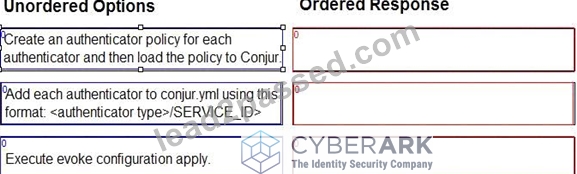
Answer:
Explanation: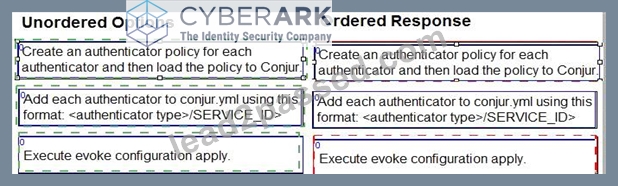
Explanation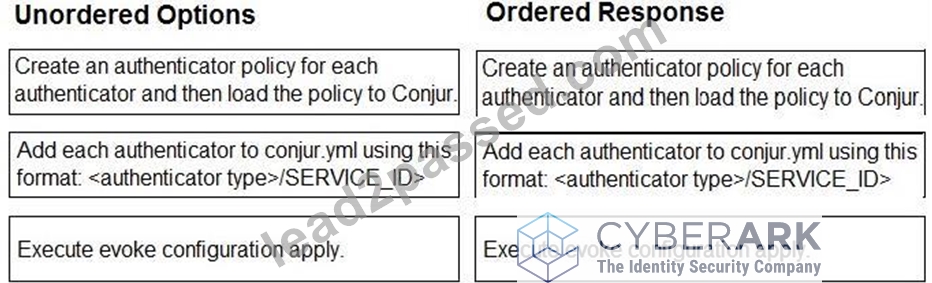
Create an authenticator policy for each authenticator and then load the policy to Conjur.
Add each authenticator to conjur.yml using this format: <authenticator type> <SERVICE_ID>.
Execute evoke configuration apply.
Comprehensive Explanation: Authenticators are plugins that enable Conjur to authenticate requests from different types of clients, such as Kubernetes, Azure, or LDAP. To configure authenticators, you need to follow these steps:
Create an authenticator policy for each authenticator and then load the policy to Conjur. This step defines the authenticator as a resource in Conjur and grants permissions to the users or hosts that can use it. You can use the policy templates provided by Conjur for each authenticator type, or create your own custom policy. For more information, see Define Authenticator Policy.
Add each authenticator to conjur.yml using this format: <authenticator type> <SERVICE_ID>. This step enables the authenticator service on the Conjur server and specifies the service ID that identifies the authenticator instance. The service ID must match the one used in the policy. For more information, see Enable Authenticators.
Execute evoke configuration apply. This step applies the changes made to the conjur.yml file and restarts the Conjur service. This is necessary for the authenticator configuration to take effect. For more information, see Apply Configuration Changes.
References: The steps to configure authenticators are explained in detail in the Configure Authenticators section of the CyberArk Conjur Enterprise documentation. The image in the question is taken from the same source.
NEW QUESTION # 48
You are upgrading an HA Conjur cluster consisting of 1x Leader, 2x Standbys & 1x Follower. You stopped replication on the Standbys and Followers and took a backup of the Leader.
Arrange the steps to accomplish this in the correct sequence.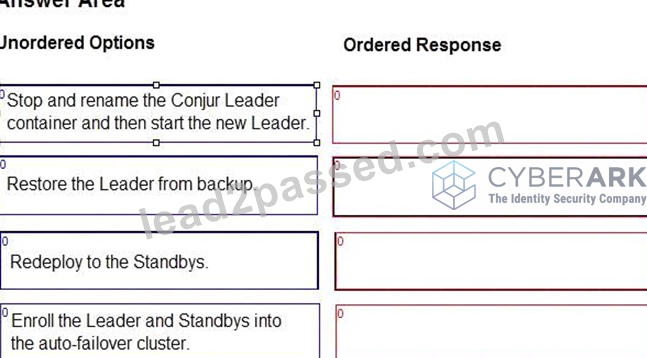
Answer:
Explanation: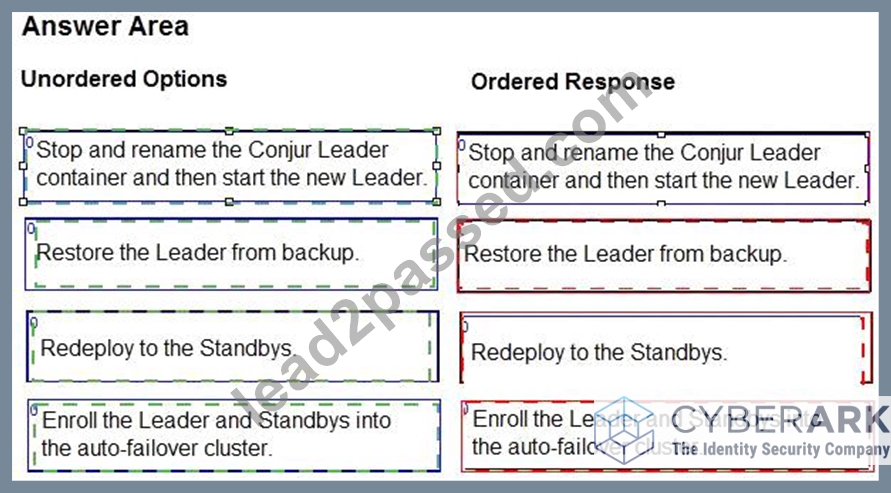
Explanation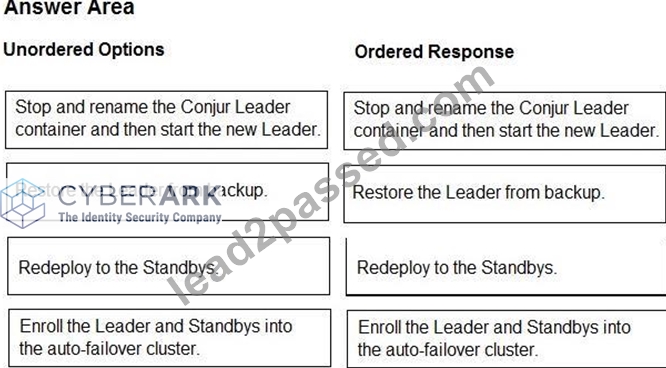
To upgrade an HA Conjur cluster, you need to follow these steps:
Stop and rename the Conjur Leader container and then start the new Leader. This step ensures that you have a backup of the old Leader container in case something goes wrong with the upgrade. You also need to specify the hostname and master-altnames parameters when starting the new Leader container to match the load balancer and the cluster nodes.
Restore the Leader from backup. This step restores the data and configuration from the old Leader to the new Leader. You need to use the evoke restore command with the backup file name and the account name as arguments.
Redeploy to the Standbys. This step upgrades the Standbys to the same version as the Leader. You need to stop and rename the old Standby containers and then start the new Standby containers with the evoke configure standby command. You also need to specify the hostname of the Leader and the Standby as arguments.
Enroll the Leader and Standbys into the auto-failover cluster. This step enables the auto-failover feature for the cluster, which allows the Standbys to automatically take over the role of the Leader in case of a failure. You need to use the evoke cluster enroll command on the Leader and the evoke cluster join command on the Standbys. You also need to provide the hostname and password of the Leader as arguments.
References: You can find more information about the upgrade process in the following resources:
Upgrade Conjur
Configure the Conjur cluster
Conjur architecture and deployment reference
Breathe Easy with a Self-Healing Conjur Cluster
NEW QUESTION # 49
......
CyberArk Secret-Sen is an exam that is designed to test your knowledge of CyberArk Sentry - Secrets Manager. CyberArk Sentry - Secrets Manager is a powerful tool that helps organizations secure their sensitive information and credentials. Secret-Sen exam is designed to test your understanding of the various features of CyberArk Sentry - Secrets Manager, as well as your ability to use the tool effectively.
CyberArk Secret-Sen exam is designed for professionals who work with CyberArk's Secrets Manager solution. This solution is used to manage and secure secrets, such as passwords, SSH keys, and API keys, which are used by applications and systems to access sensitive data. Secret-Sen exam covers a range of topics related to secrets management, including the architecture and components of CyberArk's Secrets Manager, configuring and managing secrets, and integrating Secrets Manager with other CyberArk solutions.
Reliable CyberArk Secrets Manager Secret-Sen Dumps PDF Jun 12, 2024 Recently Updated Questions: https://www.lead2passed.com/CyberArk/Secret-Sen-practice-exam-dumps.html
Latest Secret-Sen Exam Dumps for Pass Guaranteed: https://drive.google.com/open?id=1no6oEE6Bl_mcgALHdanDijuYR-OhtF1F