MCD-Level-2 Exam PDF [2024] Tests Free Updated Today with Correct 62 Questions
MuleSoft MCD-Level-2 Exam Preparation Guide and PDF Download
NEW QUESTION # 15
A Mule application need to invoice an API hosted by an external system to initiate a process. The external API takes anywhere between one minute and 24 hours to compute its process.
Which implementation should be used to get response data from the external API after it completes processing?
- A. Use an HTTP Connector inside Async scope to invoice the API and wait for a response
- B. Use a Scheduler to check for a response every minute
- C. Use an HTTP Connector to invoke the API and wait for a response
- D. Expose an HTTP callback API in Mule and register it with the external system
Answer: D
Explanation:
Explanation
To get response data from the external API after it completes processing, the developer should expose an HTTP callback API in Mule and register it with the external system. This way, the external API can invoke the callback API with the response data when it is ready, instead of making the Mule application wait for a long time or poll for a response repeatedly. References:
https://docs.mulesoft.com/mule-runtime/4.3/http-listener-ref#callback
NEW QUESTION # 16
In a Mule project, Flow-1 contains a flow-ref to Flow-2 depends on data from Flow-1 to execute successfully.
Which action ensures the test suites and test cases written for Flow-1 and Flow-2 will execute successfully?
- A. Use ''Set Event to pass the input that is needed, and keep the test cases for Flow-1 and Flow-2 independent
- B. Chain together the test suites and test cases for Flow-1 and Flow-2
- C. Use ''Before Test Case'' To collect data from Flow-1 test cases before running Flow-2 test cases
- D. Use 'After Test Case' to produce the data needed from Flow-1 test cases to pass to Flow-2 test cases
Answer: A
Explanation:
Explanation
To ensure the test suites and test cases written for Flow-1 and Flow-2 will execute successfully, the developer should use a Set Event processor to pass the input that is needed by Flow-2, and keep the test cases for Flow-1 and Flow-2 independent. This way, the developer can isolate the testing of each flow and avoid coupling them together. References: https://docs.mulesoft.com/munit/2.3/munit-test-flow
NEW QUESTION # 17
Refer to the exhibit.
What is the result if ''Insecure'' selected as part of the HTTP Listener configuration?
- A. The HTTP Listener will trust any certificate presented by the HTTP client
- B. Mutual TLS authentication will be enabled between this HTTP Listener and an HTTP client
- C. The HTTP listener will only accept HTTP requests
- D. The HTTP Lister will accept any unauthenticated request
Answer: C
Explanation:
Explanation
Based on the exhibit below, if 'Insecure' is selected as part of the HTTP Listener configuration, the HTTP listener will only accept HTTP requests. This means that no TLS context will be configured for this listener and no encryption or authentication will be applied to incoming requests. The protocol attribute of this listener will be set to HTTP instead of HTTPS. References:
https://docs.mulesoft.com/http-connector/1.6/http-listener-ref#insecure
NEW QUESTION # 18
In a Mule project, Flow-1 contains a flow-ref to Flow-2 depends on data from Flow-1 to execute successfully.
Which action ensures the test suites and test cases written for Flow-1 and Flow-2 will execute successfully?
- A. Use ''Set Event to pass the input that is needed, and keep the test cases for Flow-1 and Flow-2 independent
- B. Chain together the test suites and test cases for Flow-1 and Flow-2
- C. Use ''Before Test Case'' To collect data from Flow-1 test cases before running Flow-2 test cases
- D. Use 'After Test Case' to produce the data needed from Flow-1 test cases to pass to Flow-2 test cases
Answer: A
Explanation:
Explanation
To ensure the test suites and test cases written for Flow-1 and Flow-2 will execute successfully, the developer should use a Set Event processor to pass the input that is needed by Flow-2, and keep the test cases for Flow-1 and Flow-2 independent. This way, the developer can isolate the testing of each flow and avoid coupling them together. References: https://docs.mulesoft.com/munit/2.3/munit-test-flow
NEW QUESTION # 19
Which statement is true when using XML SDK for creating custom message processors?
- A. An XML SDK provides both inbound and outbound operations
- B. Operations can be reused in recursive calls
- C. All operations are public
- D. Properties are fields defined by an end user of the XML SDK component and serve as a global configuration for the entire Mule project in which they are used
Answer: C
Explanation:
Explanation
When using XML SDK for creating custom message processors, all operations are public by default and can be used by any Mule application that imports them. There is no way to make an operation private or protected in XML SDK. References: https://docs.mulesoft.com/mule-sdk/1.1/xml-sdk#operations
NEW QUESTION # 20
A company with MuleSoft Titanium develops a Salesforce System API using MuleSoft out-of-the-box Salesforce Connector and deploys the API to CloudHub.
Which steps provide the average number of requests and average response time of the Salesforce Connector?
- A. Access Anypoint Monitoring's built-in dashboard
Seclect a resource.
Create a custom dashboard to retrieve the information. - B. Access Anypoint Monitoring's built-in dashboard. Select a resource.
Locate the information under the Connectors tab. - C. Access Anypoint Monitoring built-in dashboard.
Select a resource.
Locate the information under Log Manager < Raw Data. - D. Change the API Implementation to capture the information in the log.
Retrieve the information from the log file.
Answer: B
Explanation:
Explanation
To get the average number of requests and average response time of the Salesforce Connector, the developer should access Anypoint Monitoring's built-in dashboard, select a resource (such as an application or an API), and locate the information under the Connectors tab. The Connectors tab shows metrics for each connector used by the resource, such as average requests per minute, average response time, and failures. References:
https://docs.mulesoft.com/monitoring/built-in-dashboard-reference
NEW QUESTION # 21
The Center for Enablement team published a common application as a reusable module to the central Nexus repository.
How can the common application be included in all API implementations?
- A. Download the common application from Naxus and copy it to the src/main/resources folder in the API
- B. Add a Maven dependency in the POM file with jar as <classifier>
- C. Copy the common application's source XML file and out it in a new flow file in the src/main/mule folder
- D. Add a Maven dependency in the PCM file with multiple-plugin as <classifier>
Answer: B
Explanation:
Explanation
To include a common application as a reusable module in all API implementations, the developer should add a Maven dependency in the POM file with jar as <classifier>. This way, the developer can reuse Mule code from another application by packaging it as a JAR file and adding it as a dependency in the POM file of the API implementation. The classifier element specifies that it is a JAR file. References:
https://docs.mulesoft.com/mule-runtime/4.3/mmp-concept#add-a-maven-dependency-to-the-pom-file
NEW QUESTION # 22
Refer to the exhibit.
A developer generates the base scaffolding for an API in Anypoint Studio.
Which HTTP status code is returned while testing using the API Kit console if no values are entered in client-secret?
- A. HTTP status code:500
- B. HTTP status code:400
- C. HTTP status code:403
- D. HTTP status code:200
Answer: C
Explanation:
Explanation
Based on the code snippet and schema.json file below, when testing using the API Kit console if no values are entered in client-secret, HTTP status code 403 (FORBIDDEN) is returned. This is because client-secret is defined as a required header parameter in schema.json file, which means that it must be present in every request. If no values are entered in client-secret, then it is equivalent to omitting this header parameter, which violates the schema and causes APIKit Router to return HTTP status code 403. References:
https://docs.mulesoft.com/apikit/4.x/apikit-4-headers
NEW QUESTION # 23
A developer is working on a project that requires encrypting all data before sending it to a backend application. To accomplish this, the developer will use PGP encryption in the Mule 4 Cryptography module.
What is required to encrypt the data before sending it to the backend application?
- A. The application needs to configure HTTPS TLS context information to encrypt the data
- B. The application needs the public key from the backend service to encrypt the data
- C. The application needs the private key from the backend service to encrypt the data
- D. The application needs to both the private and public keys to encrypt the data
Answer: B
Explanation:
Explanation
To encrypt the data before sending it to the backend application using PGP encryption, the application needs the public key from the backend service. PGP encryption uses a public-key cryptography system, which means that each party has a pair of keys: a public key and a private key. The public key is used to encrypt data, and the private key is used to decrypt data. Therefore, to encrypt data for a specific recipient (the backend service), the application needs to use the recipient's public key. The recipient can then use its own private key to decrypt the data. References: https://docs.mulesoft.com/mule-runtime/4.3/cryptography-pgp
NEW QUESTION # 24
When registering a client application with an existing API instance or API Group instance, what is required to manually approve or reject request access?
- A. To configure the SLA tier for the application
- B. To configure the SLA tier for the application and have the Exchange Administrator permission
- C. To configure the SLA tier for the application and have the role of Organization Administrator, API Manager Environment Administrator, or the Manage Contacts permission
- D. To only have Exchange Administrator permission
Answer: C
Explanation:
Explanation
To manually approve or reject request access when registering a client application with an existing API instance or API Group instance, it is required to configure the SLA tier for the application and have one of the following roles or permissions: Organization Administrator, API Manager Environment Administrator, or Manage Contracts permission. These roles or permissions allow managing client applications and contracts in API Manager. References:
https://docs.mulesoft.com/api-manager/2.x/client-applications#managing-client-applications-and-contracts
NEW QUESTION # 25
The flow is invoicing a target API. The API's protocol is HTTPS. The TLS configuration in the HTTP Request Configuration global element is set to None. A web client submits a request to
http:localhost:8081/vehicles.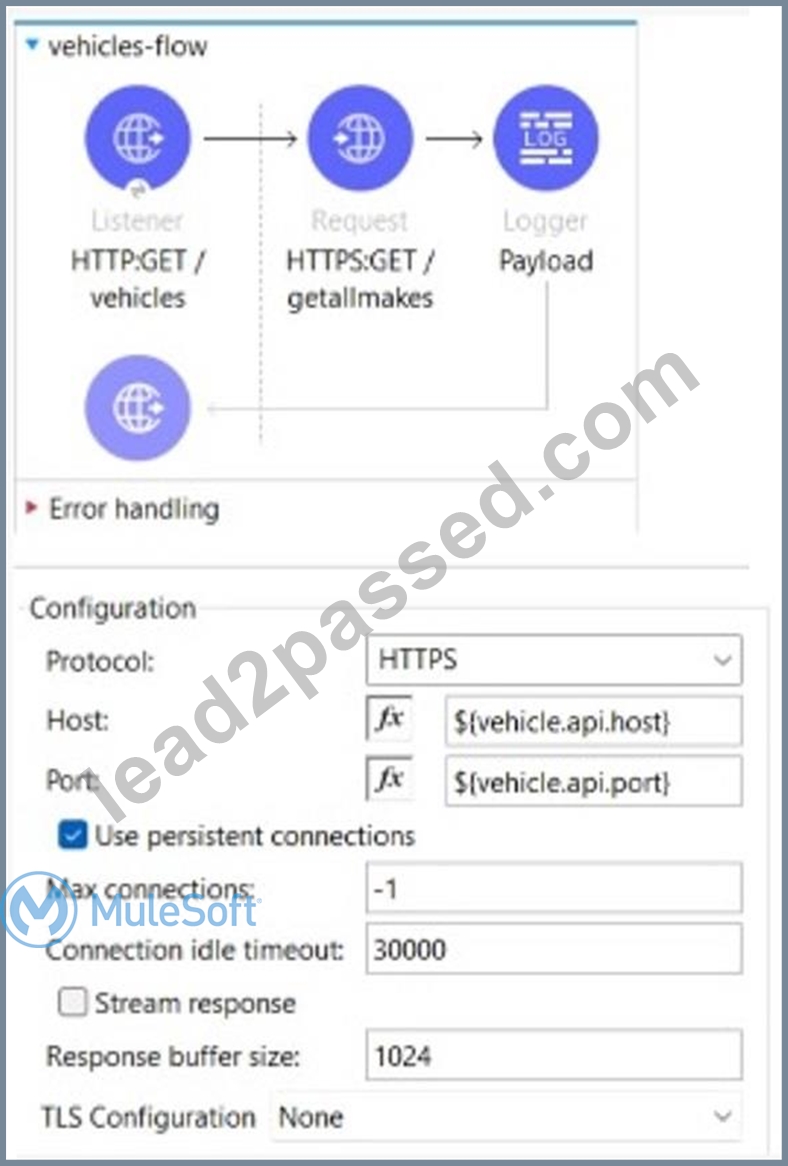
If the certificate of the target API is signed by a certificate authority (CA), what is true about the HTTP Request operation when the flow executes?
- A. The HTTP Request operation will always fail regardless of the CA
- B. The HTTP Request operation will succeed if the CA's certificate is present in the JRE's default truststore.
- C. The HTTP Request operation will succeed if the CA'S certificate is present in the JRE's default keystore
- D. The HTTP Request operation will always succeed regardless of the CA
Answer: B
Explanation:
Explanation
The HTTP Request operation will use the default truststore of the JRE to validate the certificate of the target API. If the CA's certificate is present in the truststore, the operation will succeed. Otherwise, it will fail with a handshake exception. References: https://docs.mulesoft.com/mule-runtime/4.3/tls-configuration#tls-default
NEW QUESTION # 26
A new Mule project has been created in Anypoint Studio with the default settings.
Which file inside the Mule project must be modified before using Maven to successfully deploy the application?
- A. Config.yaml
- B. Pom.xml
- C. Settings.xml
- D. Mule.artificact.json
Answer: B
Explanation:
Explanation
To use Maven to successfully deploy the application, the developer needs to modify the pom.xml file inside the Mule project. The pom.xml file contains the configuration and dependencies of the Mule application, as well as the deployment information such as the CloudHub region, environment, and worker size. The developer needs to specify these properties in the pom.xml file before using Maven to deploy the application.
References: https://docs.mulesoft.com/mule-runtime/4.3/mmp-concept#application-deployment-descriptor
NEW QUESTION # 27
When a client and server are exchanging messages during the mTLS handshake, what is being agreed on during the cipher suite exchange?
- A. An encryption algorithm
- B. The Public key format
- C. The TLS version
- D. A protocol
Answer: A
Explanation:
Explanation
A cipher suite is a set of cryptographic algorithms that are used to secure the communication between a client and a server. A cipher suite consists of four components: a key exchange algorithm, an authentication algorithm, an encryption algorithm, and a message authentication code (MAC) algorithm. During the cipher suite exchange, the client and the server agree on which encryption algorithm to use for encrypting and decrypting the data. References: https://docs.mulesoft.com/mule-runtime/4.3/tls-configuration#cipher-suites
NEW QUESTION # 28
A Mule API receives a JSON payload and updates the target system with the payload. The developer uses JSON schemas to ensure the data is valid.
How can the data be validation before posting to the target system?
- A. Using the DataWeave if Else condition test the values of the payload against the examples included in the schema
- B. Add the JSON module dependency and add the validate-schema operation in the flow, configured to reference the schema
- C. Use a DataWeave 2.09 transform operation, and at the log of the DataWeave script, add:
%dw 2.0
Import.json-moduls - D. Apply the JSON Schema policy in API Manager and reference the correct schema in the policy configuration
Answer: B
Explanation:
Explanation
To validate the data before posting to the target system, the developer should add the JSON module dependency and add the validate-schema operation in the flow, configured to reference the schema. The JSON module provides a validate-schema operation that validates a JSON payload against a JSON schema and throws an error if the payload is invalid. References:
https://docs.mulesoft.com/json-module/1.1/json-validate-schema
NEW QUESTION # 29
A mule application exposes and API for creating payments. An Operations team wants to ensure that the Payment API is up and running at all times in production.
Which approach should be used to test that the payment API is working in production?
- A. Create a health check endpoint that listens on a separate port and uses a separate HTTP Listener configuration from the API
- B. Create a health check endpoint that reuses the same port number and HTTP Listener configuration as the API itself
- C. Configure the application to send health data to an external system
- D. Monitor the Payment API directly sending real customer payment data
Answer: A
Explanation:
Explanation
To test that the payment API is working in production, the developer should create a health check endpoint that listens on a separate port and uses a separate HTTP Listener configuration from the API. This way, the developer can isolate the health check endpoint from the API traffic and avoid affecting the performance or availability of the API. The health check endpoint should return a simple response that indicates the status of the API, such as OK or ERROR. References:
https://docs.mulesoft.com/api-functional-monitoring/afm-create-monitor#create-a-monitor
NEW QUESTION # 30
The HTTP Request operation raises an HTTP CONNECTIVITY error.
Which HTTP status code and body are returned to the web client?
- A. HTTP Status Code:500.
Body 'The HTTP CONNECTIVITY Error description - B. HTTP Status Code:500.
Body 'Error in processing your request - C. HTTP Status Code:200.
Body 'Error in processing your request - D. HTTP Status Code:500.
Body 'Error in processing your request
Answer: D
Explanation:
Explanation
When the HTTP Request operation raises an HTTP CONNECTIVITY error, it triggers an on-error-continue handler that sets a payload with 'Error in processing your request'. Since no status code is explicitly set in this handler, it defaults to 500 (INTERNAL SERVER ERROR). Therefore, the web client receives an HTTP response with status code 500 and body 'Error in processing your request'. References:
https://docs.mulesoft.com/mule-runtime/4.3/error-handling#on-error-continue
NEW QUESTION # 31
......
Verified & Correct MCD-Level-2 Practice Test Reliable Source Jan 04, 2024 Updated: https://www.lead2passed.com/MuleSoft/MCD-Level-2-practice-exam-dumps.html