New 200-201 Test Materials & Valid 200-201 Test Engine
200-201 Updated Exam Dumps [2026] Practice Valid Exam Dumps Question
Cisco 200-201 exam is an important certification for individuals looking to establish themselves in the field of cybersecurity operations. 200-201 exam is designed to test the fundamental knowledge and skills required to identify and respond to security incidents in a network environment. 200-201 exam is intended for those who are new to cybersecurity operations or those who are seeking to expand their knowledge and skills in this field.
Understanding functional and technical aspects of Cisco Cybersecurity Operations Fundamentals v1.0 (200-201 CBROPS) Network Intrusion Analysis
The following will be discussed in CISCO 200-201 exam dumps pdf:
- Map the provided events to source technologies
- Network application control
- ICMP
- IDS/IPS
- True positive
- Client and server port identity
- Compare deep packet inspection with packet filtering and stateful firewall operation
- Payloads
- Destination address
- IP address (source / destination)
- Interpret the fields in protocol headers as related to intrusion analysis
- Extract files from a TCP stream when given a PCAP file and Wireshark
- SMTP/POP3/IMAP
- URI / URL
- False positive
- True negative
- IPv6
- Process (file or registry)
- Benign
- System (API calls)
- Proxy logs
- Compare the characteristics of data obtained from taps or traffic monitoring and transactional data (NetFlow) in the analysis of network traffic
- Transaction data (NetFlow)
- Source address
- Compare inline traffic interrogation and taps or traffic monitoring
- Interpret common artifact elements from an event to identify an alert
- DNS
- Source port
- Protocols
- Firewall
- Interpret basic regular expressions
- Destination port
- ARP
- UDP
Cisco 200-201 certification is recognized globally and is highly valued in the cybersecurity industry. It is an excellent way for individuals to demonstrate their expertise and knowledge in the field of cybersecurity operations, making them more competitive in the job market. Understanding Cisco Cybersecurity Operations Fundamentals certification helps individuals stand out among other candidates and provides them with the necessary skills and knowledge to succeed in their careers.
NEW QUESTION # 14 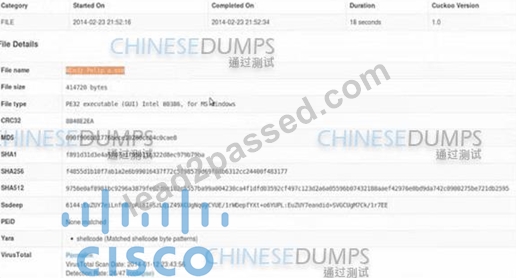
Refer to the exhibit. An employee received an email from an unknown sender with an attachment and reported it as a phishing attempt. An engineer uploaded the file to Cuckoo for further analysis. What should an engineer interpret from the provided Cuckoo report?
- A. Cuckoo cleaned the malicious file and prepared it for usage.
- B. MD5 of the file was not identified as malicious.
- C. The file is clean and does not represent a risk.
- D. Win32.polip.a.exe is an executable file and should be flagged as malicious.
Answer: D
Explanation:
The Cuckoo report indicates that the file is a PE32 executable for MS Windows, which is typically an executable file format. The presence of the watermark "CHINESEDUMPS" and the detection ratio from VirusTotal suggest that the file is recognized by multiple antivirus engines as potentially harmful. This aligns with option A, suggesting that the file, named Win32.polip.a.exe, should be considered malicious and flagged accordingly.
NEW QUESTION # 15
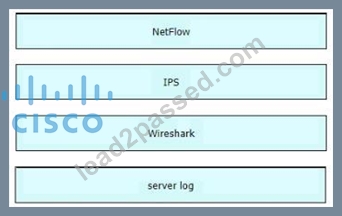
Drag and drop the data source from the left onto the data type on the right.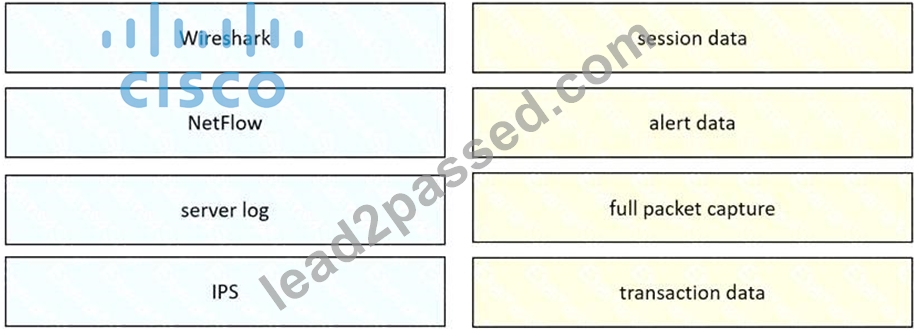
Answer:
Explanation: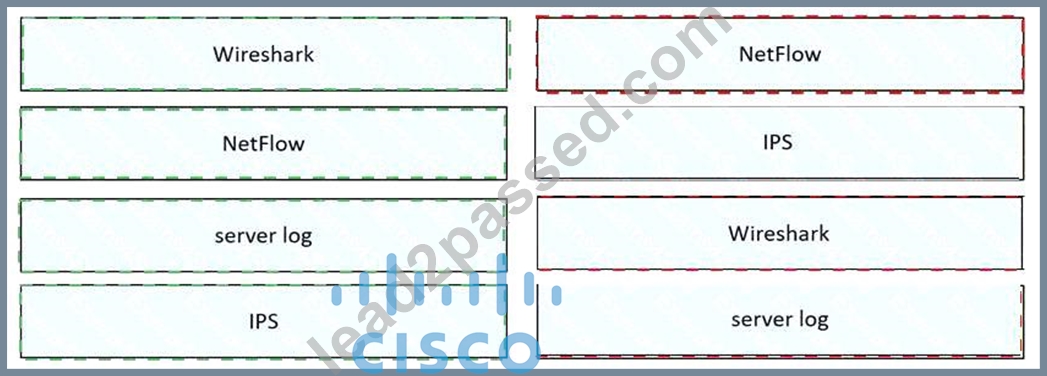
NEW QUESTION # 16
Which security monitoring data type requires the largest storage space?
- A. statistical data
- B. full packet capture
- C. session data
- D. transaction data
Answer: B
Explanation:
Full packet capture data involves storing the entire content of packets that traverse a network. This type of data is comprehensive and allows for detailed analysis but requires a significant amount of storage space compared to other data types like transaction, statistical, or session data. References := Cisco Cybersecurity Operations Fundamentals - Module 3: Network Data and Event Analysis
NEW QUESTION # 17
Refer to the exhibit.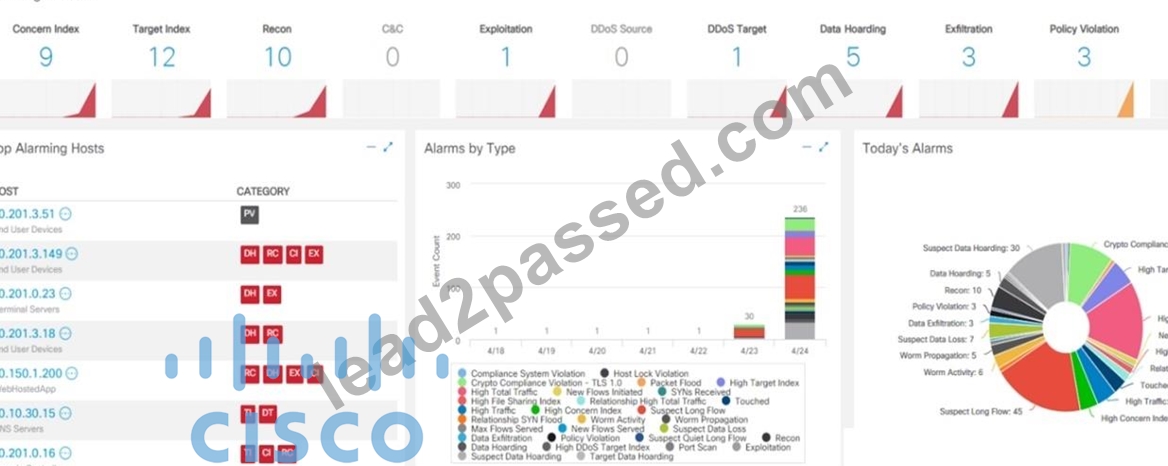
What is the potential threat identified in this Stealthwatch dashboard?
- A. A host on the network is sending a DDoS attack to another inside host.
- B. A policy violation is active for host 10.201.3.149.
- C. There are three active data exfiltration alerts.
- D. A policy violation is active for host 10.10.101.24.
Answer: B
Explanation:
The Stealthwatch dashboard indicates that there is an active policy violation associated with host 10.201.3.149. Stealthwatch is a security analytics tool that uses network telemetry to detect and respond to threats. In this case, the dashboard has flagged a policy violation, which means that activity from this host has been detected that goes against the defined security policies, potentially indicating a security threat or unauthorized access.
NEW QUESTION # 18
An engineer received an alert affecting the degraded performance of a critical server Analysis showed a heavy CPU and memory load. What is the next step the engineer should take to investigate this resource usage?
- A. Run "ps -d" to decrease the priority state of high-load processes to avoid resource exhaustion
- B. Run "ps -ef to understand which processes are taking a high amount of resources
- C. Run "ps -m" to capture the existing state of daemons and map the required processes to find the gap
- D. Run "ps -u" to find out who executed additional processes that caused a high load on a server
Answer: B
Explanation:
When a server is experiencing heavy CPU and memory load, the initial step is to identify the processes consuming the most resources. The command "ps -ef" provides a detailed view of all running processes, including their IDs, CPU, and memory usage, which helps in pinpointing the resource-intensive processes1234. References: This approach is supported by various resources on server management and troubleshooting, which recommend using the "ps -ef" command as a starting point for investigating high resource usage on servers
NEW QUESTION # 19
Which evasion technique is indicated when an intrusion detection system begins receiving an abnormally high volume of scanning from numerous sources?
- A. timing attack
- B. traffic fragmentation
- C. resource exhaustion
- D. tunneling
Answer: C
Explanation:
Resource exhaustion is an evasion technique where an attacker overwhelms a system with a high volume of requests from multiple sources. This can cause the system to become overloaded and unable to process legitimate traffic, potentially allowing the attacker to bypass security measures like intrusion detection systems.
References := The answers are based on the knowledge from the Understanding Cisco Cybersecurity Operations Fundamentals (CBROPS) course material, which covers various cybersecurity concepts, including file identification methods, application control technologies, firewall utilities, and evasion techniques
NEW QUESTION # 20
What describes the defense-m-depth principle?
- A. isolating guest Wi-Fi from the focal network
- B. defining precise guidelines for new workstation installations
- C. categorizing critical assets within the organization
- D. implementing alerts for unexpected asset malfunctions
Answer: D
Explanation:
The defense-in-depth principle is a strategy of applying multiple layers of security controls to protect an asset from threats. It is based on the assumption that no single security measure is sufficient to prevent all attacks, and that each layer adds more protection and reduces the risk of compromise. One example of applying the defense-in-depth principle is implementing alerts for unexpected asset malfunctions, which can indicate a potential security breach or incident. References: Cisco Cybersecurity Operations Fundamentals, Module 1:
Security Concepts, Lesson 1.1: The CIA Triad and Security Concepts, Topic 1.1.4: Defense-in-Depth Principle
NEW QUESTION # 21
Which event artifact is used to identify HTTP GET requests for a specific file?
- A. destination IP address
- B. HTTP status code
- C. TCP ACK
- D. URI
Answer: D
NEW QUESTION # 22
Drag and drop the security concept on the left onto the example of that concept on the right.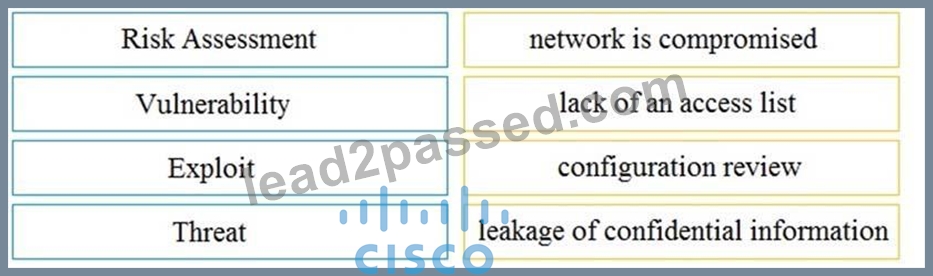
Answer:
Explanation: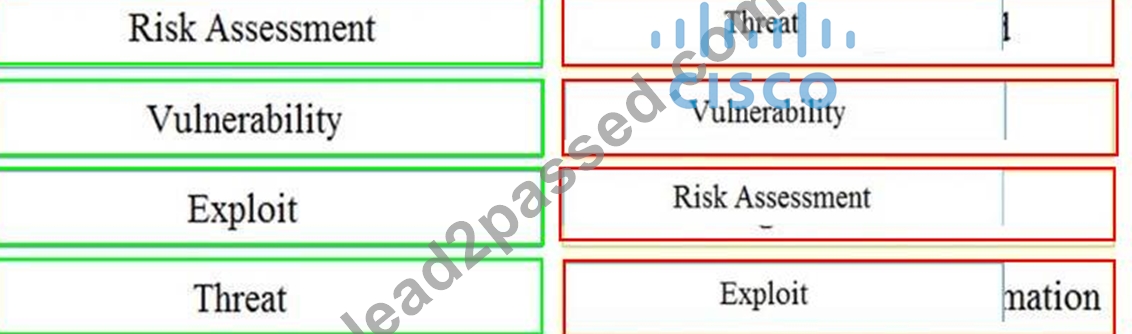
NEW QUESTION # 23
What does cyber attribution identify in an investigation?
- A. cause of an attack
- B. threat actors of an attack
- C. vulnerabilities exploited
- D. exploit of an attack
Answer: B
Explanation:
Cyber attribution identifies the threat actors of an attack in an investigation. Threat actors are the individuals, groups, organizations, or states that are responsible for conducting or sponsoring a cyberattack. Threat actors can have different motives, such as financial gain, espionage, sabotage, activism, or warfare. Cyber attribution can help investigators to determine the identity, location, affiliation, and motivation of the threat actors, as well as to hold them accountable and impose sanctions or legal actions. References := Understanding Cisco Cybersecurity Operations Fundamentals (CBROPS) v1.0, Module 5: Security Policies and Procedures, Lesson
5.2: Incident Response, Topic 5.2.3: Cyber Attribution, page 5-14.
NEW QUESTION # 24
When trying to evade IDS/IPS devices, which mechanism allows the user to make the data incomprehensible without a specific key, certificate, or password?
- A. fragmentation
- B. stenography
- C. pivoting
- D. encryption
Answer: B
NEW QUESTION # 25
What is the impact of false positive alerts on business compared to true positive?
- A. True positives affect security as no alarm is raised when an attack has taken place, while false positives are alerts raised appropriately to detect and further mitigate them.
- B. True-positive alerts are blocked by mistake as potential attacks, while False-positives are actual attacks Identified as harmless.
- C. False positives alerts are manually ignored signatures to avoid warnings that are already acknowledged, while true positives are warnings that are not yet acknowledged.
- D. False-positive alerts are detected by confusion as potential attacks, while true positives are attack attempts identified appropriately.
Answer: D
Explanation:
False-positive alerts are alerts that are triggered by benign or normal network traffic and are mistakenly identified as malicious. False positives can have a negative impact on business as they may consume the resources and time of the security team that need to analyze and verify them. True-positive alerts are alerts that correctly identify malicious traffic or activity and require proper incident response procedures. True positives can help the security team to quickly detect and mitigate threats and minimize the damage to the organization. References := Understanding Cisco Cybersecurity Operations Fundamentals (CBROPS) - Cisco, page 92; [Cisco CyberOps Associate CBROPS 200-201 Official Cert Guide], page 98
NEW QUESTION # 26
What is the role of indicator of compromise in an investigation?
- A. It identifies potentially malicious activity on a system or network.
- B. It is nonforensic data, which is easy to detect.
- C. It helps answer the question of why the attack took place.
- D. It describes what and why something happened.
Answer: A
NEW QUESTION # 27
An analyst is using the SIEM platform and must extract a custom property from a Cisco device and capture the phrase, "File: Clean." Which regex must the analyst import?
- A. ^File: Clean$
- B. File: Clean (.*)
- C. File: Clean
- D. ^Parent File Clean$
Answer: C
Explanation:
A regular expression (regex) is a sequence of characters that defines a search pattern for text. A regex can be used to extract custom properties from log messages or events in a SIEM platform. In this case, the regex that matches the phrase "File: Clean" exactly is ^File: Clean$. The ^ symbol indicates the beginning of the line and the $ symbol indicates the end of the line. The regex ensures that no other characters are before or after the phrase. References:
Understanding Cisco Cybersecurity Operations Fundamentals (CBROPS) - Cisco, Module 5: Security Policies and Procedures, Lesson 5.3: Data and Event Analysis
200-201 CBROPS - Cisco, Exam Topics, 5.0 Security Policies and Procedures, 5.3 Analyze data as part of security monitoring activities Cisco Certified CyberOps Associate Overview - Cisco Learning Network, Videos, 5.3 Analyze data as part of security monitoring activities
NEW QUESTION # 28
Refer to the exhibit.
Which type of log is displayed?
- A. proxy
- B. IDS
- C. NetFlow
- D. sys
Answer: C
NEW QUESTION # 29 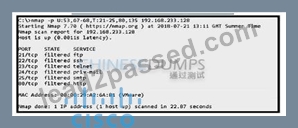
Refer to the exhibit. An attacker scanned the server using Nmap. What did the attacker obtain from this scan?
- A. Gathered a list of Active Directory users
- B. Identified a firewall device preventing the pert state from being returned.
- C. Gathered information on processes running on the server
- D. Identified open SMB ports on the server
Answer: D
Explanation:
The Nmap scan results show that several ports, including ftp (21/tcp), ssh (22/tcp), telnet (23/tcp), smtp (25
/tcp), and http (80/tcp), are listed as "filtered". This typically indicates that a firewall is filtering the traffic to these ports, making it impossible to determine whether they are open without further investigation. However, the question specifically asks about SMB ports, which are not shown in the provided Nmap scan results.
Therefore, based on the information given, we cannot confirm that the attacker identified open SMB ports on the server. The correct answer would require additional evidence not present in the scan results. References := Understanding Cisco Cybersecurity Operations Fundamentals (CBROPS) course materials and official Cisco documentation provide insights into interpreting Nmap scan results and identifying port states. These resources can be found at the Cisco Learning Network Store and Cisco's official training and certifications webpage
NEW QUESTION # 30
Which information must an organization use to understand the threats currently targeting the organization?
- A. threat intelligence
- B. vendor suggestions
- C. risk scores
- D. vulnerability exposure
Answer: A
Explanation:
Threat intelligence is crucial for organizations to understand the threats they are currently facing. It involves collecting, evaluating, and disseminating information about current or potential attacks that could affect an organization. This intelligence can help organizations prioritize their security measures based on the likelihood and potential impact of different threats. By using threat intelligence, organizations can be more proactive in their defense strategies and respond more effectively to cyber threats.
NEW QUESTION # 31
At a company party a guest asks questions about the company's user account format and password complexity. How is this type of conversation classified?
- A. Phishing attack
- B. Piggybacking
- C. Social Engineering
- D. Password Revelation Strategy
Answer: C
Explanation:
Social engineering is the practice of manipulating or deceiving people into performing actions or divulging information that can compromise the security of the organization. Asking questions about the company's user account format and password complexity at a party is an example of social engineering, as the guest may be trying to gather information that can be used to launch a cyberattack. References := Cisco Cybersecurity Operations Fundamentals - Module 6: Security Incident Investigations
NEW QUESTION # 32
Refer to the exhibit.
Which type of evidence is this file?
- A. circumstantial evidence
- B. corroborating evidence
- C. direct evidence
- D. best evidence
Answer: B
NEW QUESTION # 33
Refer to the exhibit.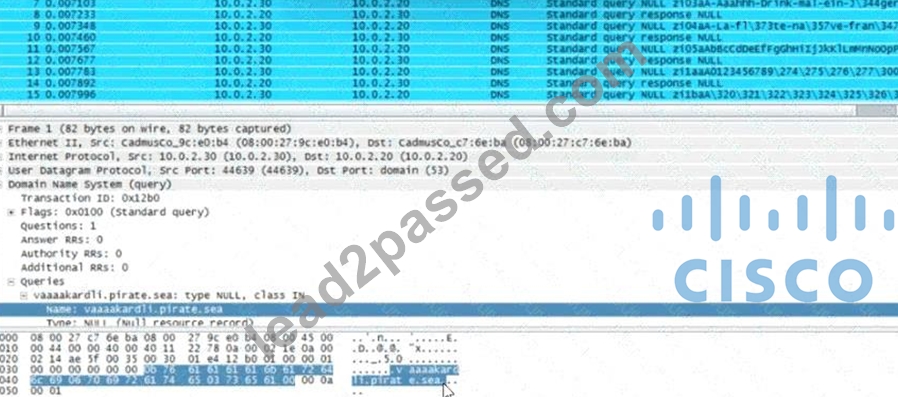
What is occurring?
- A. DNS amplification
- B. DNS tunneling
- C. ARP poisoning
- D. ARP flood
Answer: A
Explanation:
DNS amplification is a type of Distributed Denial of Service (DDoS) attack where an attacker uses publicly accessible open DNS servers to flood a target with DNS response traffic. The goal is to overwhelm the target with traffic, causing a denial of service.
NEW QUESTION # 34
What is the difference between a threat and a risk?
- A. Risk represents the known and identified loss or danger in the system
- B. Threat represents a state of being exposed to an attack or a compromise, either physically or logically.
- C. Threat represents a potential danger that could take advantage of a weakness in a system
- D. Risk represents the nonintentional interaction with uncertainty in the system
Answer: C
Explanation:
A threat is any potential danger to an asset. If a vulnerability exists but has not yet been exploited-or, more importantly, it is not yet publicly known-the threat is latent and not yet realized.
NEW QUESTION # 35
Refer to the exhibit.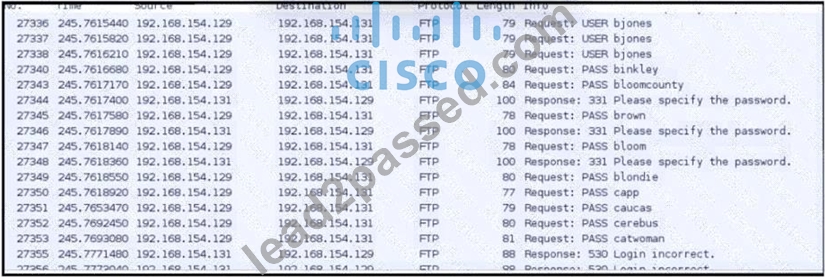
An analyst was given a PCAP file, which is associated with a recent intrusion event in the company FTP server Which display filters should the analyst use to filter the FTP traffic?
- A. dstport = 21
- B. tcpport = FTP
- C. tcp.port==21
- D. dstport == FTP
Answer: C
Explanation:
The correct display filter for analyzing FTP traffic in a PCAP file is "tcp.port==21". This filter will show all TCP packets where the port number is 21, which is the standard port for FTP control messages.
NEW QUESTION # 36 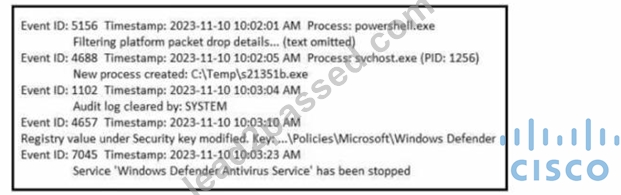
Refer to the exhibit. A SOC analyst is examining the Windows security logs of one of the endpoints. What is the possible reason for this event log?
- A. System maintenance logs
- B. Brute force attack
- C. Windows failed to audit logs
- D. Malware Attack
Answer: D
NEW QUESTION # 37
Refer to the exhibit.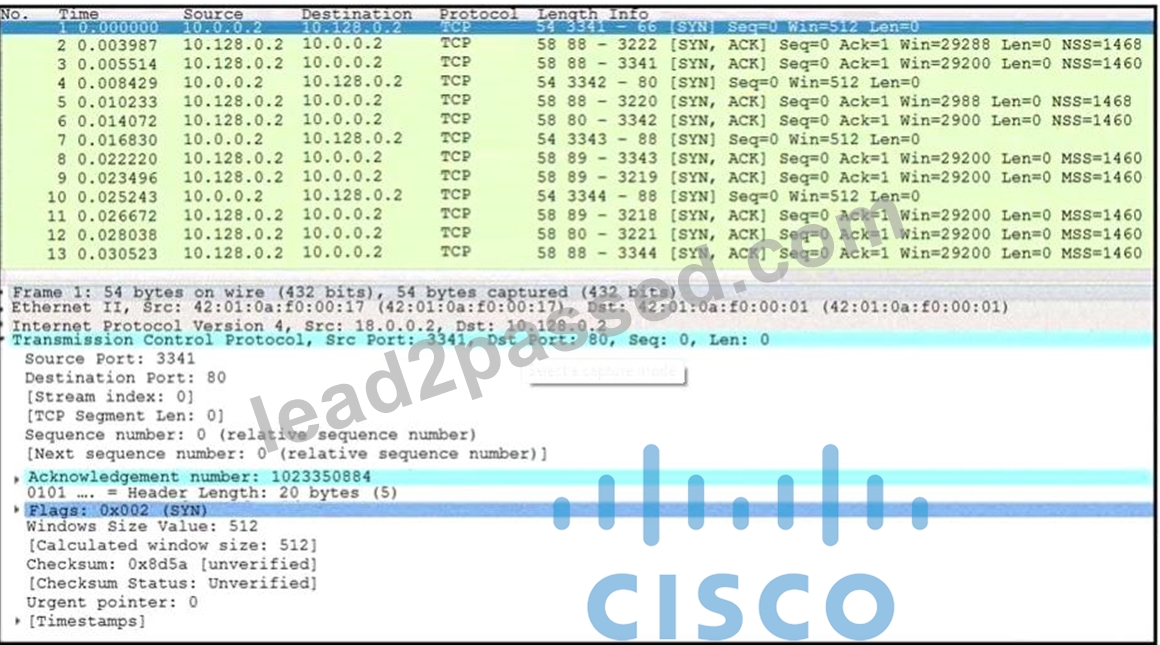
What is occurring in this network traffic?
- A. high rate of SYN packets being sent from a multiple source towards a single destination IP
- B. flood of ACK packets coming from a single source IP to multiple destination IPs
- C. high rate of SYN packets being sent from a single source IP towards multiple destination IPs
- D. flood of SYN packets coming from a single source IP to a single destination IP
Answer: D
NEW QUESTION # 38
......
200-201 Sample with Accurate & Updated Questions: https://www.lead2passed.com/Cisco/200-201-practice-exam-dumps.html
200-201 Exam Info and Free Practice Test | Lead2Passed: https://drive.google.com/open?id=1QqNDprap-iyIIjzSGLhUIve5i8iiqea2