New ACSM 030-444 Dumps & Questions Updated on 2025
Dumps to Pass your 030-444 Exam with 100% Real Questions and Answers
ACSM 030-444 Exam Syllabus Topics:
| Topic | Details |
|---|---|
| Topic 1 |
|
| Topic 2 |
|
| Topic 3 |
|
| Topic 4 |
|
| Topic 5 |
|
NEW QUESTION # 82
A client with angina exhibits symptoms and a 1mm, down-sloping ST- segment depression at a HR of 129 bpm on his exercise test. His peak exercise target HR should be set at
- A. 129 bpm.
- B. 125 to 128 bpm.
- C. 128 bpm.
- D. 109 to 119 bpm.
Answer: D
NEW QUESTION # 83
In the ECG shown on the following page, which of the following conduction abnormalities is indicated?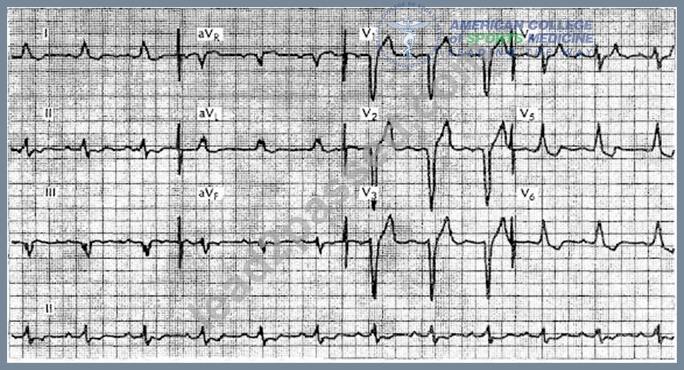
- A. RBBB.
- B. Third-degree AV block.
- C. Mobitz I.
- D. First-degree AV block.
Answer: D
NEW QUESTION # 84
The MINIMAL duration of exercise necessary to achieve improvements in health for deconditioned individuals is
- A. Two sessions of 20 minutes throughout the day.
- B. Multiple sessions of more than 10 minutes in duration throughout the day.
- C. 20 minutes continuously.
- D. 30 minutes continuously.
Answer: B
NEW QUESTION # 85
Treatment for claudication during exercise includes all of the following EXCEPT
- A. Stopping activity at the onset of claudication discomfort to avoid further vascular damage from ischemia.
- B. Intensity of activity to maximal tolerable pain, with intermittent rest periods.
- C. Cardiorespiratory building activities that are nonweight bearing if the plan is to work on longer duration and higher intensity to elicit a cardiorespiratory training effect.
- D. Daily exercise sessions.
Answer: A
NEW QUESTION # 86
Why would a fitness facility be interested in public relations?
- A. To make the staff work harder.
- B. To improve staff morale.
- C. To become involved in local politics.
- D. To increase exposure for the facility and sell its services.
Answer: D
NEW QUESTION # 87
Staff certification is
- A. Important, primarily because it adds a standard of knowledge and credibility to your facility.
- B. Not a good idea, because certified staff will increase your payroll.
- C. Not important, because members do not care.
- D. Important, primarily because it adds spice to marketing materials.
Answer: A
NEW QUESTION # 88
The recommended cardiorespiratory exercise training goal for apparently healthy individuals should be
- A. 15 minutes, six times per week, at 90% of HRR.
- B. 60 minutes, three times per week, at 85% of HRR.
- C. 30 minutes of weight training, three times per week, at 60% of HRR.
- D. 30 minutes, three times per week, at 85% of HRR.
Answer: D
NEW QUESTION # 89
Athletes may have protein needs greater than those of sedentary individuals. What level of protein intake is the recommended UL for athletes?
- A. 1.4 g/kg.
- B. 2.2 g/kg.
- C. 1.7 g/kg.
- D. 0.8 g/kg.
Answer: C
NEW QUESTION # 90
Fiber is a type of carbohydrate that is not digestible (e.g., it will pass through the digestive system without being absorbed). The NCEP ATPIII guidelines recommend that soluble (viscous) fiber be included in the diet for the prevention and treatment of elevated blood lipid concentrations. Sources of soluble (viscous) fibers include
- A. Meat and dairy foods.
- B. Fruits, beans, and oats.
- C. Wheat bran and whole wheat products.
- D. All of the above.
Answer: B
NEW QUESTION # 91
Which the following statements regarding intensity of resistance training is FALSE?
- A. Exercise intensity should be similar for males and females.
- B. Exercise to volitional fatigue is not dangerous from a musculoskeletal standpoint provided that good exercise form is maintained.
- C. The number of repetitions to volitional fatigue will vary inversely with resistance.
- D. It is necessary to determine the 1- RM to establish training intensity.
Answer: D
NEW QUESTION # 92
Which fat-soluble vitamin is important for bone formation?
- A. Vitamin E.
- B. Vitamin D.
- C. Vitamin A.
- D. Vitamin K.
Answer: B
NEW QUESTION # 93
Some of the duties in supervising a fitness staff include scheduling, implementing the policies and procedures, and
- A. Cleaning the equipment.
- B. Marketing and promotions.
- C. Emergency procedures and evaluations.
- D. Managing the fitness billing.
Answer: C
NEW QUESTION # 94
Which of the following statements about injury reporting is NOT correct?
- A. The process to be used and the accompanying forms must be part of the P&P manual.
- B. Injury reporting forms must be kept under lock and key, just like data records.
- C. A process for injury reporting, backed up with a form, should be developed.
- D. A physician should sign every injury report form that is filed.
Answer: D
NEW QUESTION # 95
Which of the following elements is NOT part of an emergency plan for a clinical exercise program?
- A. Emergency plan that constantly refers to national established guidelines (e.g., ACLS) without addressing unique features of the program.
- B. Annual practice sessions involving all staff.
- C. Emergency drills carried out on a regular basis and documented.
- D. Scenarios developed to increase the applicability of the emergency plan practice sessions.
Answer: B
NEW QUESTION # 96
Which of the following waist circumference measurements indicates abdominal obesity?
- A. 43 inches
- B. 0.98.
- C. >29.9
- D. All of the above.
Answer: A
NEW QUESTION # 97
What is the relative Y02 of running on a treadmill at 6.5 mph and a 0% grade?
- A. 34.84 mL . kg-1. min-1
- B. 34.48 mL . kg-1. min-1
- C. 43.83 mL . kg-1. min-1
- D. 38.34 mL . kg-1. min-1
Answer: D
NEW QUESTION # 98
Diets high in saturated fat can lead to elevations in blood ______ concentration, which may increase risk of heart disease. Optimal concentrations of this blood lipoprotein are___
- A. LDL-C, <100 mg/dL.
- B. Very LDL-C, <120 mg/dL.
- C. HDL-C, >30 mg/dL.
- D. LDL-C, <125 mg/dL.
Answer: A
NEW QUESTION # 99
Why would a fitness instructor have an interest in tort laws?
- A. State taxes often are related to profit, which is governed by tort laws.
- B. Tort laws are related to worker's compensation regulations.
- C. Negligence is breaking a tort law and can ruin an instructor's career.
- D. They relate to the Americans with Disabilities Act (ADA)
Answer: C
NEW QUESTION # 100
Differentiation between supraventricular and ventricular rhythm is made on the basis of the
- A. Amplitude of the U wave.
- B. Appearance of the ST segment.
- C. Duration (width) of the QRS complex and the presence or absence of P waves.
- D. Duration of the PR interval.
Answer: C
NEW QUESTION # 101
Which of the following statements regarding warm-up is FALSE?
- A. Between 5 and 10 minutes should be allotted for a warm-up period.
- B. Peripheral vasodilation occurs as a result of warm-up.
- C. Peripheral vasoconstriction occurs as a result of warm-up.
- D. Muscle blood flow is increased as a result of warm-up.
Answer: C
NEW QUESTION # 102
Do fitness instructors need management skills?
- A. Yes, because of the natural progression of advancement into management.
- B. Yes, because as instructors, they manage client programs and manage the floor with the clients.
- C. No, because they will be trained in management if they become managers.
- D. Only if they wish to become floor supervisors or program managers.
Answer: B
NEW QUESTION # 103
......
Updated Exam 030-444 Dumps with New Questions: https://www.lead2passed.com/ACSM/030-444-practice-exam-dumps.html
Today Updated 030-444 Exam Dumps Actual Questions: https://drive.google.com/open?id=1GiLH8xsc9RuMmYuFTJ07o6wCd25dZILy