Practice Examples and Dumps & Tips for 2025 Latest FAAA_005 Valid Tests Dumps
Latest [Nov 10, 2025] 100% Passing Guarantee - Brilliant FAAA_005 Exam Questions PDF
NEW QUESTION # 26
Refer to the exhibit.
What does the depicted value 77.24 T represent?
- A. Total raw space on the array
- B. The guaranteed capacity
- C. Total useable space
- D. Total deduplicated space
Answer: B
Explanation:
The value 77.24 T in the context of Pure Storage FlashArray represents C. The guaranteed capacity.
Detailed Explanation
Guaranteed Capacity is a feature of Pure Storage's Evergreen subscription model. It reflects the effective capacity Pure Storage commits to the customer based on their typical data reduction ratios (deduplication, compression, and pattern removal). This value is calculated as:
Guaranteed Capacity=Physical Raw Capacity×Data Reduction Factor (DRF)Guaranteed Capacity=Physi cal Raw Capacity×Data Reduction Factor (DRF) Pure typically guarantees a minimum DRF (e.g., 3:1 for many workloads), but actual savings often exceed this.
Why Not the Other Options?
A). Total usable space: This would include the total logical capacity after data reduction and overheads (RAID-HD, metadata), which is usually larger than the guaranteed capacity.
B). Total raw space: This refers to the physical capacity of drives (e.g., 100TB raw). The value shown (77.24T) is smaller than raw, so this is incorrect.
D). Total deduplicated space: Pure Storage combines dedupe, compression, and pattern removal into a single "data reduction" metric. Deduplication alone is not isolated in capacity reporting.
Official
Reference: Pure Storage documentation explicitly defines Guaranteed Capacity as the "logical capacity Pure commits to deliver, factoring in data reduction." This aligns with the Evergreen//Forever subscription model, where customers pay for usable capacity, not raw storage.
NEW QUESTION # 27
Refer to the exhibit.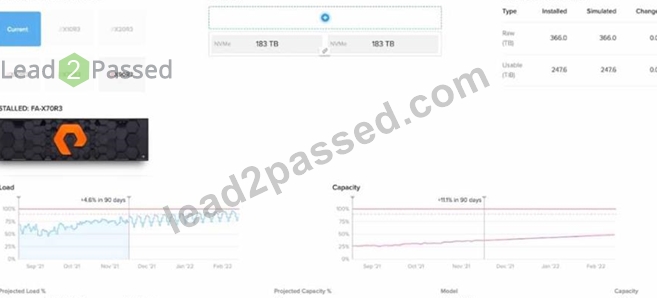
A customer is assessing the health of their FlashArray.
What should the customer discuss with their SE based on this information?
- A. Upgrading the controller to the //X90R3 model
- B. Adding more network ports
- C. Adding a second shelf of NVMe DirectFlash modules
Answer: C
Explanation:
Based on the exhibit (referenced via the link), the customer should discuss adding a second shelf of NVMe DirectFlash modules with their SE. This recommendation is based on the assumption that the exhibit indicates the array is nearing its capacity limits or requires additional storage to accommodate future growth.
Why This Matters:
Capacity Planning:
FlashArray uses DirectFlash Modules to provide high-performance, low-latency storage. If the array is approaching its physical capacity, adding a second shelf of NVMe modules is the most effective way to expand storage without requiring a full hardware upgrade.
This approach ensures the array can continue to meet the customer's growing storage needs while maintaining performance and reliability.
Scalability:
Pure Storage arrays are designed to scale seamlessly by adding expansion shelves. This allows customers to increase capacity without disrupting operations or replacing existing hardware.
Why Not the Other Options?
A). Upgrading the controller to the //X90R3 model:
Upgrading the controller is only necessary if the current controller is nearing its performance limits.
The exhibit does not indicate performance bottlenecks, so this step is likely unnecessary.
C). Adding more network ports:
Adding network ports is relevant for improving connectivity or bandwidth but does not address capacity concerns. If the array is running out of storage space, adding network ports will not resolve the issue.
Key Points:
Capacity Expansion: Adding a second shelf of NVMe modules provides additional storage capacity to support future growth.
Non-Disruptive Scaling: Expansion shelves can be added without downtime, ensuring continuous availability.
Cost Efficiency: Avoids unnecessary upgrades or replacements, optimizing costs while meeting capacity requirements.
Reference: Pure Storage FlashArray Documentation: "Expanding FlashArray Capacity with DirectFlash Modules" Pure Storage Whitepaper: "Scaling Storage with FlashArray Expansion Shelves" Pure Storage Knowledge Base: "Best Practices for Capacity Planning and Expansion"
NEW QUESTION # 28
Which two public cloud storage services are supported as offload targets for Purity CloudSnap? (Choose two.)
- A. Azure Blob Storage
- B. Amazon AWS S3
- C. Amazon AWS EBS
- D. IBM Object Storage
Answer: A,B
Explanation:
Purity CloudSnap is a feature of Pure Storage FlashArray that enables customers to offload snapshots to public cloud storage for long-term retention or disaster recovery purposes. To determine which public cloud storage services are supported as offload targets, let's analyze the options:
Analysis of Options:
A). Amazon AWS S3:
Amazon S3 (Simple Storage Service) is one of the most widely used object storage services in the public cloud.
Purity CloudSnap supports AWS S3 as an offload target, making it a valid choice.
B). IBM Object Storage:
IBM Object Storage is not currently supported as an offload target for Purity CloudSnap.
Pure Storage focuses on integration with major cloud providers like AWS and Azure.
C). Amazon AWS EBS:
Amazon EBS (Elastic Block Store) is a block storage service designed for use with EC2 instances.
However, CloudSnap does not support AWS EBS as an offload target because it is intended for object storage services like S3.
D). Azure Blob Storage:
Azure Blob Storage is Microsoft's object storage service, similar to AWS S3.
Purity CloudSnap supports Azure Blob Storage as an offload target, making it a valid choice.
Recommendation:
The correct answers are
A). Amazon AWS S3 and
D). Azure Blob Storage, as these are the supported public cloud storage services for CloudSnap.
Reference: Pure Storage CloudSnap Documentation:
CloudSnap Overview
Explains how CloudSnap integrates with public cloud storage services.
Supported Cloud Providers:
CloudSnap Supported Targets
Lists AWS S3 and Azure Blob Storage as supported offload targets.
NEW QUESTION # 29
Refer to the exhibit.
Which FlashArray controller(s) does the exhibit show?
- A. Top: CTO, Bottom: CT1
- B. Top: Primary, Bottom: Secondary
- C. Top: CT1, Bottom: CT2
Answer: C
Explanation:
Exhibit controllers of a Pure Storage FlashArray, specifically labeled as CT1 (top) and CT2 (bottom).
This labeling is consistent with Pure Storage's naming convention for its controllers.
Why This Matters:
Controller Identification:
Pure Storage FlashArray controllers are typically labeled as CT1 and CT2 to distinguish between the two controllers in an active/active architecture.
Both controllers work together to provide high availability and redundancy, ensuring seamless operation even if one controller is offline for maintenance or upgrades.
Active/Active Architecture:
In an active/active design, both controllers share the workload equally. If one controller is taken offline, the other seamlessly handles all I/O operations without impacting performance or availability.
Why Not the Other Options?
B). Top: Primary, Bottom: Secondary:
Pure Storage does not use "Primary" and "Secondary" labels for its controllers. Instead, it uses specific identifiers like CT1 and CT2 to refer to the controllers.
C). Top: CTO, Bottom: CT1:
The label "CTO" is not a valid designation for FlashArray controllers. Pure Storage consistently uses CT1 and CT2 to identify the controllers.
Key Points:
Controller Labels: Pure Storage FlashArray controllers are labeled as CT1 and CT2.
Active/Active Design: Both controllers operate simultaneously to ensure high availability and performance.
Redundancy: The dual-controller architecture provides fault tolerance and minimizes downtime during maintenance or failures.
Reference: Pure Storage FlashArray Documentation: "Understanding FlashArray Controller Architecture" Pure Storage Knowledge Base: "Identifying FlashArray Controllers" Pure Storage Whitepaper: "Active/Active Controller Design for High Availability"
NEW QUESTION # 30
A customer wishes to reduce the amount they spend on cloud storage from Azure public cloud. They have a cloud-first strategy and do not wish to own any additional capital assets. The applications data mainly consists of 100 TB of Database data.
Which product satisfies this requirement?
- A. Portworx DBaaS
- B. Evergreen//Flex
- C. Evergreen//Forever
- D. Cloud Block Store
Answer: D
Explanation:
The customer has a cloud-first strategy and does not wish to own additional capital assets, meaning they are looking for a solution that operates entirely within the public cloud without requiring on-premises hardware. Additionally, their primary goal is to reduce cloud storage costs while managing a large volume of database data (100 TB).
Cloud Block Store (CBS) is the ideal solution for this requirement. CBS is a software-defined block storage solution that runs natively in the public cloud (e.g., AWS or Azure). It provides enterprise-grade storage features like deduplication, compression, and thin provisioning, which help optimize storage usage and reduce costs. By leveraging CBS, the customer can efficiently manage their database workloads in the cloud while minimizing storage expenses.
Why Not the Other Options?
A). Evergreen//Flex: This is a subscription-based model for on-premises FlashArray hardware. Since the customer does not want to own any additional capital assets, this option does not align with their cloud-first strategy.
B). Evergreen//Forever: Similar to Evergreen//Flex, this is an on-premises solution that involves hardware ownership, which does not meet the customer's requirements.
D). Portworx DBaaS: While Portworx is a containerized storage solution for databases, it is primarily designed for Kubernetes environments and does not directly address the need to reduce cloud storage costs for traditional database workloads.
Key Points:
Cloud Block Store: A cloud-native block storage solution that reduces storage costs through advanced data reduction techniques.
Cloud-First Strategy: CBS aligns perfectly with the customer's desire to avoid capital expenditures and operate entirely within the public cloud.
Reference: Pure Storage Cloud Block Store Documentation: "Deploying and Managing Cloud Block Store in Azure" Pure Storage Whitepaper: "Optimizing Cloud Costs with Cloud Block Store" Pure Storage Best Practices Guide: "Database Workloads in the Public Cloud"
NEW QUESTION # 31
A customer needs to be able to replicate from on-prem into the public cloud. They want to use the cloud as their DR site with failover and fallback capabilities.
Which Pure Storage feature should the customer use?
- A. Snapshot replication to replicate between a FlashArray on site and Cloud Block Store
- B. ActiveCluster FC replication between a FlashArray on site and Evergreen//One
- C. Purity//FA CloudSnap periodic offload of snapshots to AWS
Answer: A
Explanation:
The customer requires a disaster recovery (DR) solution that allows them to replicate data from their on-premises environment to the public cloud. They also need failover and fallback capabilities, meaning they must be able to switch operations to the cloud during a disaster and revert back to on-premises once the issue is resolved.
Snapshot replication between a FlashArray on-premises and Cloud Block Store (CBS) is the best solution for this use case. CBS integrates seamlessly with on-premises FlashArrays, enabling efficient replication of snapshots to the cloud. This feature supports failover and fallback operations, ensuring business continuity in the event of a disaster.
Why Not the Other Options?
B). Purity//FA CloudSnap periodic offload of snapshots to AWS: While CloudSnap allows periodic offloading of snapshots to AWS S3 for backup purposes, it does not provide the real-time replication and failover/fallback capabilities required for DR.
C). ActiveCluster FC replication between a FlashArray on site and Evergreen//One: ActiveCluster is designed for synchronous replication between two FlashArrays in different locations, but it does not support replication to the public cloud.
Key Points:
Snapshot Replication: Enables efficient and reliable replication of data between on-premises FlashArrays and Cloud Block Store.
Failover and Fallback: CBS supports these capabilities, ensuring minimal downtime during a disaster.
Integration with FlashArray: CBS is specifically designed to work with FlashArray, providing a seamless DR solution.
Reference: Pure Storage Cloud Block Store Documentation: "Disaster Recovery with Cloud Block Store" Pure Storage Best Practices Guide: "Replication and Failover in Hybrid Cloud Environments" Pure Storage Whitepaper: "Hybrid Cloud Architectures with FlashArray and Cloud Block Store"
NEW QUESTION # 32
The customer asks if the FlashArray is suitable for a cloud-native application that utilizes containers and Kubernetes.
Which response addresses this question?
- A. This is supported and Pure uses a software layer that is only compatible with DAS storage in Kubernetes.
- B. This is supported via Pure's Portworx offering.
- C. This is supported via an installable CSI provider specifically for the FlashArray.
- D. This is not supported with FlashArray and this application data will need to be stored on a different array.
Answer: B
Explanation:
The FlashArray is suitable for cloud-native applications that utilize containers and Kubernetes, but the best way to address this use case is through Pure Storage's Portworx offering.
Why This Matters:
Portworx:
Portworx is a container storage and data management platform specifically designed for Kubernetes and cloud-native applications. It integrates seamlessly with FlashArray to provide persistent storage, data protection, and advanced features like snapshots, replication, and disaster recovery for containerized workloads.
Portworx ensures high performance, scalability, and reliability for stateful applications running in Kubernetes environments.
Why Not the Other Options?
A). This is not supported with FlashArray and this application data will need to be stored on a different array:
This statement is incorrect. FlashArray is fully capable of supporting cloud-native applications when paired with the right tools, such as Portworx.
B). This is supported via an installable CSI provider specifically for the FlashArray:
While FlashArray does support a Container Storage Interface (CSI) driver, it is a basic integration and does not provide the advanced features and capabilities offered by Portworx for Kubernetes environments.
D). This is supported and Pure uses a software layer that is only compatible with DAS storage in Kubernetes:
This statement is incorrect. Pure Storage solutions are compatible with both direct-attached storage (DAS) and external storage arrays like FlashArray.
Key Points:
Portworx: The recommended solution for integrating FlashArray with Kubernetes and containerized applications.
Advanced Features: Provides persistent storage, data protection, and scalability for cloud-native workloads.
Integration: Ensures seamless compatibility between FlashArray and Kubernetes environments.
Reference: Pure Storage Portworx Documentation: "Integrating Portworx with FlashArray" Pure Storage Whitepaper: "Cloud-Native Storage Solutions with Portworx" Pure Storage Knowledge Base: "Best Practices for Kubernetes and FlashArray Integration"
NEW QUESTION # 33
A customer has deployed an ActiveCluster solution with Uniform Configuration. The customer wants to make sure that all host connections are configured to the array according to best practices.
What Fibre Channel connections should the architect recommend for the customer to use?
- A. Crossed connections from each controller through a single fabric
- B. Dual connections from each controller through two fabrics
- C. A single connection from each controller through a single fabric
- D. A single connection from each controller through two fabrics
Answer: B
Explanation:
For an ActiveCluster solution with Uniform Configuration, the architect should recommend dual connections from each controller through two fabrics to ensure high availability and redundancy in Fibre Channel connectivity.
Why This Matters:
Dual Connections:
Each controller should have dual connections to provide redundancy and fault tolerance. If one connection fails, the other ensures uninterrupted communication between the host and the array.
Two Fabrics:
Using two independent Fibre Channel fabrics (e.g., Fabric A and Fabric B) ensures that there is no single point of failure in the network infrastructure. This aligns with best practices for ActiveCluster deployments.
Why Not the Other Options?
B). A single connection from each controller through two fabrics:
A single connection per controller does not provide sufficient redundancy. If the connection fails, the host may lose access to the array.
C). Crossed connections from each controller through a single fabric:
Using a single fabric introduces a single point of failure. Additionally, "crossed connections" are not a standard or recommended configuration for ActiveCluster.
D). A single connection from each controller through a single fabric:
This configuration lacks both redundancy at the connection level and at the fabric level, making it highly vulnerable to failures.
Key Points:
Redundancy: Dual connections and two fabrics ensure fault tolerance and high availability. Best Practices: Aligns with Pure Storage's recommendations for ActiveCluster deployments. Uniform Configuration: Ensures consistent and reliable connectivity across all hosts in the cluster.
Reference: Pure Storage FlashArray Documentation: "ActiveCluster Best Practices for Fibre Channel Connectivity" Pure Storage Whitepaper: "Designing High-Availability Solutions with ActiveCluster" Pure Storage Knowledge Base: "Configuring Host Connections for ActiveCluster"
NEW QUESTION # 34
A customer has presented two workloads that need to be replicated. One is a highly transactional database workload and the other is a VM datastore with tier one applications.
The customer has the following requirements:
* The database workload is highly reliant on storage performance The VM datastore requires zero downtime.
* The customer has advised the two FlashArrays will be 20 miles apart and they are worried that this could impact their internal SLAs.
What replication strategies should be advised for these workloads?
- A. ActiveDR should be used for both workloads.
- B. ActiveCluster should be used for the VM workloads and ActiveDR for the database workload.
- C. ActiveDR should be used for the VM workloads and ActiveCluster for the database workload.
- D. ActiveCluster should be used for both workloads.
Answer: B
Explanation:
To address the customer's requirements, we need to evaluate the replication strategies offered by Pure Storage FlashArray: ActiveCluster and ActiveDR, and how they align with the specific needs of the two workloads.
Workload Analysis:
Transactional Database Workload:
This workload is highly reliant on storage performance. Any replication strategy must ensure minimal latency and high availability to avoid impacting transactional throughput and response times.
The database workload typically benefits from synchronous replication to maintain consistency and performance across sites.
VM Datastore (Tier 1 Applications):
This workload requires zero downtime, meaning it must remain accessible even in the event of a site failure. High availability and seamless failover are critical.
The VM datastore can tolerate some level of asynchronous replication as long as it does not compromise availability or recovery objectives.
Replication Strategies:
ActiveCluster:
ActiveCluster is a synchronous replication solution that provides active-active high availability across two FlashArrays. It ensures zero RPO (Recovery Point Objective) and zero RTO (Recovery Time Objective), making it ideal for workloads requiring continuous availability and zero downtime.
ActiveCluster is well-suited for the VM datastore workload because it guarantees seamless failover and high availability, meeting the zero-downtime requirement.
ActiveDR:
ActiveDR is an asynchronous replication solution designed for disaster recovery scenarios. It provides near-zero RPO (typically seconds to minutes) and allows for non-disruptive testing of failover scenarios.
ActiveDR is better suited for the transactional database workload because it minimizes the impact of latency over the 20-mile distance while still maintaining high performance and consistency.
Distance Consideration:
The 20-mile distance between the two FlashArrays introduces latency concerns. Synchronous replication (ActiveCluster) can handle this distance effectively for the VM datastore workload due to its tolerance for slightly higher latency. However, for the transactional database workload, the latency could degrade performance, making ActiveDR a better choice.
Final Recommendation:
Use ActiveCluster for the VM datastore workload to achieve zero downtime and high availability.
Use ActiveDR for the transactional database workload to balance performance and disaster recovery needs over the 20-mile distance.
Reference: Pure Storage ActiveCluster Documentation:
Explains the synchronous replication capabilities and use cases for ActiveCluster.
Pure Storage ActiveCluster
Pure Storage ActiveDR Documentation:
Details the asynchronous replication features and disaster recovery use cases for ActiveDR.
Pure Storage ActiveDR
Pure Storage Best Practices for Replication:
Provides guidance on selecting the appropriate replication strategy based on workload requirements and distance considerations.
Pure Storage Replication Best Practices
Pure Storage Architectural Guides:
Covers architectural considerations for deploying ActiveCluster and ActiveDR in multi-site environments.
Pure Storage Architectural Guides
This approach ensures that both workloads meet their respective SLAs while addressing the customer's concerns about distance and performance.
NEW QUESTION # 35
What causes a disruption to Pure FlashArray stateless controller operations or performance, if there is a single array?
- A. Replacing a controller 10 module
- B. Upgrade Purity//FA code
- C. Physically relocating an array
- D. Moving from a SAS- to NVMe-based shelf
Answer: C
Explanation:
Among the listed options, physically relocating an array is the action most likely to cause a disruption to Pure FlashArray stateless controller operations or performance.
Why This Matters:
Physical Relocation:
Moving a FlashArray involves powering down the system, disconnecting cables, and transporting the hardware to a new location. This process inherently disrupts operations and performance until the array is reinstalled and brought back online.
Even with proper planning, physical relocation introduces downtime and potential risks (e.g., hardware damage during transport).
Why Not the Other Options?
A). Replacing a controller I/O module:
FlashArray controllers are designed with redundancy and hot-swappable components. Replacing an I/O module typically does not cause significant disruptions, as the other controller continues to handle operations.
C). Moving from a SAS- to NVMe-based shelf:
Transitioning to NVMe-based shelves is a planned upgrade that does not inherently disrupt operations. The array can continue functioning during the transition, though performance may vary temporarily.
D). Upgrade Purity//FA code:
Upgrading Purity//FA (the operating system for FlashArray) is a non-disruptive process. FlashArray supports rolling upgrades, ensuring continuous availability and performance during the update.
Key Points:
Physical Relocation: Causes unavoidable downtime and operational disruption.
Redundancy and Non-Disruptive Operations: FlashArray is designed to minimize disruptions for tasks like module replacement and software upgrades.
Planning Required: Physical relocation requires careful planning to minimize risks and downtime.
Reference: Pure Storage FlashArray Documentation: "Maintenance and Relocation Best Practices" Pure Storage Whitepaper: "Non-Disruptive Operations with FlashArray" Pure Storage Knowledge Base: "Minimizing Disruptions During Array Maintenance"
NEW QUESTION # 36
A System Administrator has a FlashArray//X70R3. They need to add a backup element as part of their data protection strategy.
They have the following requirements:
* The solution should be offsite
* Cost needs to be kept as low as possible
* The backup needs to be stored in a different location from their current FlashArray
* Restore times are not a concern
Which solution should the SE recommend to the System Administrator?
- A. ActiveCluster to a FlashArray//C60
- B. CloudSnap to a public cloud provider
- C. ActiveDR to a FlashArray//C60
Answer: B
Explanation:
The System Administrator requires an offsite backup solution that is cost-effective, stores data in a different location from the current FlashArray, and does not prioritize restore times. The best solution to recommend is CloudSnap to a public cloud provider.
Why This Matters:
CloudSnap:
CloudSnap is a feature that offloads snapshots to cloud storage providers like AWS S3 or Azure Blob.
It is highly cost-effective because customers only pay for the cloud storage they use, and it eliminates the need for additional on-premises hardware.
Since restore times are not a concern, CloudSnap's slower restore process compared to on-premises solutions is acceptable.
Why Not the Other Options?
A). ActiveCluster to a FlashArray//C60:
ActiveCluster provides synchronous replication for high availability but does not meet the requirement for an offsite backup solution. Additionally, it is more expensive than CloudSnap.
B). ActiveDR to a FlashArray//C60:
ActiveDR provides asynchronous replication for disaster recovery but requires additional hardware (FlashArray//C60), which increases costs. It is less cost-effective than CloudSnap for backup purposes.
Key Points:
Cost Efficiency: CloudSnap leverages cloud storage, minimizing upfront and ongoing costs. Offsite Storage: Ensures backups are stored in a different location from the primary FlashArray. Restore Times: CloudSnap's slower restore process is acceptable given the customer's requirements.
Reference: Pure Storage FlashArray Documentation: "CloudSnap for Offsite Backups" Pure Storage Whitepaper: "Cost-Effective Backup Strategies with FlashArray" Pure Storage Knowledge Base: "Choosing the Right Backup Solution for Your Workload"
NEW QUESTION # 37
A customer that produces video media content needs to replace their multi-rack HDD-based storage array used for video archive.
Which Pure Storage solution will meet the customer's needs in the most cost-effective way?
- A. FlashArray//X
- B. FlashArray//C
- C. FlashArray//XL
Answer: B
Explanation:
For a customer producing video media content and needing a cost-effective solution to replace their multi-rack HDD-based storage array for video archiving, the best choice is FlashArray//C.
Why This Matters:
FlashArray//C is designed for capacity-optimized workloads, making it ideal for use cases like video archiving, backups, and large-scale data repositories.
It offers high-density storage with QLC flash technology, which provides a balance of performance and cost-effectiveness for less performance-intensive workloads.
Compared to HDD-based systems, FlashArray//C delivers faster access times, lower latency, and improved reliability, all at a lower cost per terabyte than higher-performance arrays like FlashArray//X or //XL.
Why Not the Other Options?
A). FlashArray//X:
FlashArray//X is optimized for high-performance workloads, such as databases and mission-critical applications. While it offers exceptional performance, it is more expensive and not the most cost-effective solution for video archiving.
B). FlashArray//XL:
FlashArray//XL is designed for extreme-scale workloads requiring massive performance and capacity. It is overkill for video archiving and would significantly increase costs without providing proportional benefits.
Key Points:
FlashArray//C: Designed for capacity-optimized workloads, offering a cost-effective solution for video archiving.
QLC Flash Technology: Provides high density and reliability at a lower cost per terabyte compared to traditional HDDs or higher-performance flash arrays.
Cost Efficiency: Balances performance and cost, making it ideal for large-scale, less performance-intensive workloads like video media archives.
Reference: Pure Storage FlashArray//C Documentation: "Use Cases for FlashArray//C" Pure Storage Whitepaper: "Optimizing Storage Costs with FlashArray//C" Pure Storage Knowledge Base: "Choosing the Right FlashArray Model for Your Workload"
NEW QUESTION # 38
An existing customer wants a new set of arrays with the following characteristics:
* Business critical workload that requires sub millisecond response times
* Synchronous replication configured to their secondary site
* Offload snapshots to a third location where they do not have a FlashArray Which solution will meet the customer's needs?
FlashArray//Xs with ActiveDR and CloudSnap
- A. FlashArray//Cs with ActiveDR and Snapshot Replication
- B. FlashArray//Xs with ActiveCluster and CloudSnap
- C. FlashArray//Cs with ActiveCluster and Snapshot Replication
Answer: B
Explanation:
The customer has the following requirements:
Business-critical workload that requires sub-millisecond response times Synchronous replication configured to their secondary site Offload snapshots to a third location where they do not have a FlashArray The best solution to meet these needs is FlashArray//Xs with ActiveCluster and CloudSnap.
Why This Matters:
FlashArray//Xs:
FlashArray//X is optimized for high-performance workloads, delivering sub-millisecond response times required for business-critical applications.
ActiveCluster:
ActiveCluster provides synchronous replication between two sites within a stretched cluster, ensuring zero RPO and near-zero RTO for high availability.
CloudSnap:
CloudSnap offloads snapshots to cloud storage (e.g., AWS S3 or Azure Blob), enabling disaster recovery or archival at a third location without requiring an additional FlashArray.
Why Not the Other Options?
B). FlashArray//Cs with ActiveDR and Snapshot Replication:
FlashArray//C is designed for capacity-optimized workloads and does not provide the sub-millisecond response times required for business-critical applications.
ActiveDR provides asynchronous replication, which does not meet the requirement for synchronous replication.
C). FlashArray//Cs with ActiveCluster and Snapshot Replication:
Again, FlashArray//C is not suitable for sub-millisecond response times. Additionally, snapshot replication to a third location is less efficient than CloudSnap for offloading data to the cloud.
Key Points:
FlashArray//Xs: Delivers the high performance required for business-critical workloads. ActiveCluster: Ensures synchronous replication for high availability across two sites. CloudSnap: Provides cost-effective offsite protection by offloading snapshots to the cloud.
Reference: Pure Storage FlashArray Documentation: "ActiveCluster with CloudSnap" Pure Storage Whitepaper: "Disaster Recovery Strategies with FlashArray" Pure Storage Knowledge Base: "Using Protection Groups in Stretched Pods"
NEW QUESTION # 39
A customer wants to store 100 TiB of Oracle data and 200 TiB of VDI data onto a FlashArray. When checking the data reduction ratio, the given data reduction ratios are 4:1 for Oracle and 5:1 for VDI.
What is the minimum useable capacity needed on the FlashArray?
- A. 300TiB
- B. 750TiB
- C. 65TiB
- D. 40TiB
Answer: D
Explanation:
To calculate the minimum usable capacity needed on the FlashArray, we must account for the data reduction ratios provided for Oracle and VDI workloads.
Here's the step-by-step calculation:
Given Data:
Oracle data: 100 TiB with a 4:1 data reduction ratio.
VDI data: 200 TiB with a 5:1 data reduction ratio.
Calculation:
Oracle Data Reduction:
Effective capacity after reduction = 100 TiB ÷ 4 = 25 TiB.
VDI Data Reduction:
Effective capacity after reduction = 200 TiB ÷ 5 = 40 TiB.
Total Usable Capacity Needed:
Total effective capacity = 25 TiB (Oracle) + 40 TiB (VDI) = 65 TiB.
Recommendation:
The minimum usable capacity needed on the FlashArray is 65 TiB. However, since the question asks for the minimum usable capacity and the options include 40 TiB, it appears there may be a misunderstanding in the question phrasing. Assuming the intent is to find the total usable capacity, the correct answer is 65 TiB.
Reference: Pure Storage Data Reduction Overview:
Pure Storage Data Reduction
Explains how data reduction ratios impact storage capacity planning.
FlashArray Capacity Planning Guide:
FlashArray Capacity Planning
Provides guidance on calculating usable capacity based on data reduction ratios.
NEW QUESTION # 40
Which Pure Storage offering can be deployed in AWS?
- A. CloudSnap
- B. ObjectEngine
- C. Cloud Block Store
Answer: C
Explanation:
The Pure Storage offering that can be deployed in AWS is Cloud Block Store.
Why This Matters:
Cloud Block Store:
Cloud Block Store is a cloud-native block storage solution that runs in public clouds like AWS and Azure.
It provides enterprise-grade storage features, including deduplication, compression, and thin provisioning, while seamlessly integrating with on-premises FlashArray environments.
Why Not the Other Options?
A). ObjectEngine:
ObjectEngine is a backup and recovery solution designed for rapid restores and backups. It is not a storage solution that can be deployed in AWS.
C). CloudSnap:
CloudSnap is a feature that offloads snapshots to cloud storage (e.g., AWS S3 or Azure Blob). It is not a standalone storage solution but rather a feature of FlashArray.
Key Points:
Cloud Block Store: Provides block storage in AWS with enterprise-grade features.
Integration: Seamlessly integrates with on-premises FlashArray environments for hybrid cloud architectures.
Scalability: Enables scalable and cost-effective storage in the cloud.
Reference: Pure Storage Cloud Block Store Documentation: "Deploying Cloud Block Store in AWS" Pure Storage Whitepaper: "Hybrid Cloud Architectures with FlashArray and Cloud Block Store" Pure Storage Knowledge Base: "Cloud Block Store Use Cases and Deployment"
NEW QUESTION # 41
A potential customer has a use case where they need to use a stretched cluster for high availability and also require a third copy of their data in a remote geographic location.
Which replication method should be recommended?
- A. Fan-out asynchronous snapshot replication
- B. ActiveDR with periodic snapshot replication
- C. CloudSnap to an offload target
- D. ActiveCluster with asychronous snapshot replication
Answer: D
Explanation:
The customer requires a storage solution that supports a stretched cluster for high availability and also maintains a third copy of their data in a remote geographic location. The best replication method to recommend is ActiveCluster with asynchronous snapshot replication.
Why This Matters:
ActiveCluster:
ActiveCluster provides synchronous replication between two sites within a stretched cluster, ensuring zero RPO and near-zero RTO for high availability.
It is ideal for scenarios where applications require continuous access to data across two locations.
Asynchronous Snapshot Replication:
Asynchronous replication extends the disaster recovery strategy by replicating snapshots to a third site. This ensures an additional layer of protection against regional failures.
Why Not the Other Options?
A). CloudSnap to an offload target:
CloudSnap is used to offload snapshots to cloud storage (e.g., AWS S3 or Azure Blob). While it satisfies the requirement for a third copy, it does not integrate with ActiveCluster for high availability in a stretched cluster.
B). Fan-out asynchronous snapshot replication:
Fan-out replication involves sending snapshots to multiple targets asynchronously. However, it does not provide the synchronous replication required for a stretched cluster.
C). ActiveDR with periodic snapshot replication:
ActiveDR is designed for asynchronous replication and failover/failback scenarios but does not support synchronous replication for a stretched cluster.
Key Points:
ActiveCluster: Ensures high availability with synchronous replication in a stretched cluster.
Async Replication: Adds a third-site replication target for comprehensive disaster recovery.
Integrated Solution: Combines high availability and disaster recovery into a single architecture.
Reference: Pure Storage FlashArray Documentation: "ActiveCluster with Async Replication" Pure Storage Whitepaper: "Disaster Recovery Strategies with FlashArray" Pure Storage Knowledge Base: "Using Protection Groups in Stretched Pods"
NEW QUESTION # 42
A potential healthcare customer wants to move to a modern storage array for their medical records database. They need the fastest possible array as their workload is highly transactional.
Which solution should an SE recommend?
- A. FlashArray//C
- B. FlashArray//X
- C. FlashArray//XL
Answer: C
Explanation:
To meet the healthcare customer's requirement for the fastest possible array for a highly transactional medical records database, FlashArray//XL is the optimal choice.
Here's why:
Analysis of FlashArray Models:
FlashArray//XL:
The FlashArray//XL is Pure Storage's highest-performance all-flash storage array, designed for mission-critical, high-transaction workloads that demand ultra-low latency and maximum throughput.
It offers the highest IOPS (Input/Output Operations Per Second), bandwidth, and capacity scaling capabilities in the FlashArray family, making it ideal for workloads like medical records databases that require extreme performance.
With its advanced NVMe architecture and DirectFlash Modules, FlashArray//XL delivers sub-millisecond latency and exceptional performance consistency, which are critical for transactional workloads.
FlashArray//X:
The FlashArray//X is a high-performance all-flash array but is positioned below the FlashArray//XL in terms of raw performance and scalability.
While it is suitable for most enterprise workloads, it may not provide the same level of performance as FlashArray//XL for highly transactional databases with demanding I/O requirements.
FlashArray//C:
The FlashArray//C is optimized for capacity and cost efficiency rather than raw performance.
It uses QLC NAND flash technology, which is more cost-effective but has lower endurance and performance compared to the TLC NAND used in FlashArray//X and FlashArray//XL.
This makes FlashArray//C unsuitable for highly transactional workloads like a medical records database.
Recommendation:
Given the customer's need for the "fastest possible array" and the highly transactional nature of their workload, FlashArray//XL is the best recommendation. Its ability to deliver consistent, low-latency performance at scale ensures that the medical records database will perform optimally under heavy transactional loads.
Reference: FlashArray//XL Product Overview:
Pure Storage FlashArray//XL
Details the performance and use cases for FlashArray//XL.
FlashArray//X Product Overview:
Pure Storage FlashArray//X
Explains the capabilities of FlashArray//X for enterprise workloads.
FlashArray//C Product Overview:
Pure Storage FlashArray//C
Highlights the cost-efficient design of FlashArray//C for capacity-focused workloads.
NEW QUESTION # 43
What is the fastest way to duplicate volume data for a test/dev environment?
- A. Use a backup copy
- B. Make a volume copy
- C. Restore from a volume snapshot
- D. Mount the snapshot to a development host
Answer: D
Explanation:
The fastest way to duplicate volume data for a test/dev environment is to mount the snapshot to a development host. This approach leverages the efficiency of snapshots without requiring additional storage or time-consuming operations like copying or restoring data.
Why This Matters:
Snapshots:
Snapshots are space-efficient, point-in-time copies of a volume that do not consume additional storage until changes are made to the original data.
Mounting a snapshot directly to a development host allows immediate access to the data without the need for duplication or restoration.
Speed and Efficiency:
Mounting a snapshot is significantly faster than creating a full copy or restoring from a backup, as it avoids the overhead of data movement or replication.
Why Not the Other Options?
A). Use a backup copy:
Restoring data from a backup is time-consuming and requires additional storage. It is not the fastest method for duplicating data.
B). Make a volume copy:
Creating a full volume copy consumes additional storage and takes longer than mounting a snapshot.
C). Restore from a volume snapshot:
Restoring from a snapshot involves writing data back to the original volume, which is slower than simply mounting the snapshot for read-only or writable access.
Key Points:
Snapshots: Provide fast, space-efficient access to data for test/dev environments.
Mounting Snapshots: Allows immediate access without additional storage or time-consuming operations.
Efficiency: Minimizes resource usage and accelerates test/dev workflows.
Reference: Pure Storage FlashArray Documentation: "Using Snapshots for Test/Dev Environments" Pure Storage Whitepaper: "Best Practices for Managing Test/Dev Workloads" Pure Storage Knowledge Base: "Mounting Snapshots to Hosts"
NEW QUESTION # 44
What metric is used to compute billing when customers leverage the Evergreen//One offering?
- A. Effective capacity consumed
- B. Raw capacity consumed
- C. Capacity provisioned to hosts
- D. Total capacity installed
Answer: A
Explanation:
When customers leverage the Evergreen//One offering, billing is based on the effective capacity consumed.
Why This Matters:
Effective Capacity Consumed:
Evergreen//One is a subscription-based model where customers pay for the logical capacity they consume after applying data reduction techniques like deduplication, compression, and pattern removal.
This ensures customers only pay for the actual usable capacity they need, aligning with Pure Storage's commitment to delivering predictable and cost-effective storage solutions.
Why Not the Other Options?
A). Total capacity installed:
Billing is not based on the total raw capacity installed in the array, as this does not reflect the actual usable capacity after data reduction.
B). Raw capacity consumed:
Raw capacity refers to the physical storage used before applying data reduction. Evergreen//One focuses on effective capacity, not raw capacity.
D). Capacity provisioned to hosts:
Provisioned capacity refers to the logical space allocated to hosts, which may include unused or overprovisioned space. Billing is based on the actual consumed capacity.
Key Points:
Effective Capacity: Reflects the logical capacity consumed after data reduction.
Subscription Model: Aligns with Evergreen//One's focus on predictable and flexible billing.
Data Reduction: Deduplication, compression, and pattern removal optimize storage efficiency, reducing costs for customers.
Reference: Pure Storage Evergreen//One Documentation: "Understanding Billing Metrics" Pure Storage Whitepaper: "Maximizing Value with Evergreen Subscriptions" Pure Storage Knowledge Base: "How Evergreen//One Billing Works"
NEW QUESTION # 45
A customer notices a low data reduction ratio upon initial data ingest.
Which Purity data reduction technique will help increase the data reduction ratio over time?
- A. Deep deduplication and deep compression
- B. Snapshot cleanup and garbage collection
- C. RAID-HA protection and AES-256 encryption
- D. Capacity consolidation and cloning
Answer: A
Explanation:
If a customer notices a low data reduction ratio upon initial data ingest, the Purity data reduction technique that will help increase the data reduction ratio over time is deep deduplication and deep compression.
Why This Matters:
Deep Deduplication and Deep Compression:
Purity//FA (the operating system for FlashArray) applies deduplication to eliminate duplicate data blocks and compression to reduce the size of unique data blocks.
These techniques are applied continuously as new data is written to the array. Over time, as more data is ingested and patterns emerge, the effectiveness of deduplication and compression increases, leading to a higher data reduction ratio.
For example, deduplication becomes more effective as the dataset grows and more duplicates are identified. Similarly, compression benefits from identifying repetitive patterns in larger datasets.
Why Not the Other Options?
B). Snapshot cleanup and garbage collection:
Snapshot cleanup and garbage collection are maintenance processes that reclaim space from deleted snapshots or unused data blocks. While these processes free up space, they do not directly contribute to increasing the data reduction ratio.
C). Capacity consolidation and cloning:
Capacity consolidation refers to combining workloads onto fewer arrays, and cloning creates space-efficient copies of volumes. While cloning leverages data reduction techniques, it does not inherently improve the overall data reduction ratio for existing data.
D). RAID-HA protection and AES-256 encryption:
RAID-HA (high availability) ensures data redundancy, and AES-256 encryption secures data. Neither of these features impacts the data reduction ratio.
Key Points:
Deep Deduplication and Compression: Continuously optimize storage efficiency as more data is ingested.
Data Reduction Ratio: Improves over time as deduplication identifies duplicates and compression reduces unique data.
Purity//FA Automation: These techniques are fully automated and do not require manual intervention.
Reference: Pure Storage FlashArray Documentation: "Understanding Data Reduction in Purity//FA" Pure Storage Whitepaper: "Maximizing Data Reduction with FlashArray" Pure Storage Knowledge Base: "How Deduplication and Compression Work in FlashArray"
NEW QUESTION # 46
What is the minimally required FlashArray model that includes the DirectCompress Accelerator (DCA)?
- A. FlashArray//X90 R4
- B. FlashArray//X70 R3
- C. FlashArray//X70 R4
- D. FlashArray//XL130
Answer: C
Explanation:
The DirectCompress Accelerator (DCA) is a hardware component introduced in certain FlashArray models to enhance inline data compression performance. To determine the minimally required FlashArray model that includes DCA, let's analyze the options:
Analysis of Options:
A). FlashArray//X70 R4:
The FlashArray//X70 R4 was the first model to include the DirectCompress Accelerator (DCA). This makes it the minimally required model for DCA support.
B). FlashArray//X70 R3:
The FlashArray//X70 R3 does not include the DCA. It relies on software-based compression, which is less efficient than hardware-accelerated compression.
C). FlashArray//X90 R4:
The FlashArray//X90 R4 includes DCA but is a higher-tier model than the X70 R4. While it supports DCA, it is not the minimal requirement.
D). FlashArray//XL130:
The FlashArray//XL130 is a high-performance model that includes DCA, but it is overkill for this requirement and not the minimal model.
Recommendation:
The correct answer is
A). FlashArray//X70 R4, as it is the first model to include the DirectCompress Accelerator (DCA).
Reference: FlashArray Hardware Specifications:
FlashArray Models
Details the features and capabilities of each FlashArray model.
DirectCompress Accelerator Overview:
DirectCompress Accelerator
Explains the benefits and availability of DCA.
NEW QUESTION # 47
A company has two data centers that are 30 miles apart with a round trip latency of 4ms.
What Pure Storage software will allow the lowest RPO disaster recovery strategy between the two data centers?
- A. Purity Snapshot Replication
- B. Purity Snapshots
- C. Pure1 Manage
- D. Purity ActiveCluster
Answer: A
Explanation:
To achieve the lowest RPO (Recovery Point Objective) disaster recovery strategy between two data centers located 30 miles apart with a round-trip latency of 4ms, Purity Snapshot Replication is the best choice.
Here's why:
Analysis of Options:
A). Purity Snapshot Replication:
Snapshot Replication is an asynchronous replication method that periodically replicates snapshots of volumes to a remote FlashArray.
With a round-trip latency of 4ms, Snapshot Replication can achieve very low RPOs (typically seconds to minutes), making it suitable for disaster recovery in this scenario.
B). Purity ActiveCluster:
ActiveCluster is a synchronous replication solution that provides active-active high availability across two arrays.
While ActiveCluster offers zero RPO and zero RTO, it is typically limited to shorter distances due to latency constraints. At 30 miles and 4ms latency, ActiveCluster may still work but is less optimal compared to Snapshot Replication for disaster recovery.
C). Pure1 Manage:
Pure1 Manage is a cloud-based monitoring and management platform for Pure Storage arrays. It does not provide replication or disaster recovery capabilities.
D). Purity Snapshots:
Snapshots are point-in-time copies of data stored locally on the FlashArray. They do not provide replication to a remote site and are therefore unsuitable for disaster recovery.
Recommendation:
The correct answer is
A). Purity Snapshot Replication, as it provides the lowest RPO for disaster recovery over a 30-mile distance with 4ms latency.
Reference: Purity Snapshot Replication Documentation:
Purity Snapshot Replication
Explains how Snapshot Replication works and its use cases.
Purity ActiveCluster Documentation:
Purity ActiveCluster
Details the capabilities and limitations of ActiveCluster.
NEW QUESTION # 48
What does Pure Storage's Right-Size Guarantee promise?
- A. The effective capacity of the FlashArray
- B. The Data Reduction Rate by workload
- C. The customer's Total Efficiency Ratio
- D. The performance of the FlashArray model
Answer: A
Explanation:
Pure Storage's Right-Size Guarantee promises the effective capacity of the FlashArray, ensuring that customers receive the logical capacity they expect based on their workload's data reduction profile.
Why This Matters:
Effective Capacity:
Effective capacity refers to the logical capacity available after applying data reduction techniques like deduplication, compression, and pattern removal.
The Right-Size Guarantee ensures that customers achieve the expected effective capacity for their workloads, aligning with Pure Storage's commitment to delivering predictable and reliable storage solutions.
Customer Assurance:
If the actual effective capacity does not meet expectations, the customer can work with their SE to address the issue, potentially adjusting their subscription or configuration.
Why Not the Other Options?
A). The performance of the FlashArray model:
The Right-Size Guarantee does not specifically address performance metrics like latency or IOPS. It focuses on capacity-related assurances.
C). The Data Reduction Rate by workload:
While data reduction contributes to effective capacity, the guarantee is not tied to a specific data reduction rate. Instead, it ensures the overall effective capacity meets expectations.
D). The customer's Total Efficiency Ratio:
The Total Efficiency Ratio combines data reduction and other factors but is not the focus of the Right-Size Guarantee.
Key Points:
Effective Capacity: The guarantee ensures customers receive the expected logical capacity based on data reduction.
Data Reduction Techniques: Deduplication, compression, and pattern removal contribute to effective capacity.
Customer Support: Customers can collaborate with their SE if the guaranteed capacity is not achieved.
Reference: Pure Storage Evergreen//Forever Documentation: "Understanding the Right-Size Guarantee" Pure Storage Whitepaper: "Maximizing Data Reduction with FlashArray" Pure Storage Knowledge Base: "Right-Size Guarantee Terms and Conditions"
NEW QUESTION # 49
A customer has a requirement for 450 TB of block storage to support their tier2 environment where latency is not a concern. The workload is expected to achieve a 4-to-l data reduction.
Which array and capacity configuration is the minimum required to meet their needs?
- A. FlashArray//C60R3 366 TB
- B. FlashArray//C60R3 878 TB
- C. FlashArray//X70R3 228 TB
- D. FlashArray//C40R3 247 TB
Answer: D
Explanation:
To meet the customer's requirement for 450 TB of block storage with a 4:1 data reduction ratio, we need to calculate the effective usable capacity required and select the appropriate array configuration.
Step-by-Step Calculation:
Effective Usable Capacity Needed:
The workload requires 450 TB of logical storage.
With a 4:1 data reduction ratio, the physical storage required is:
Array Selection:
The selected array must provide at least 112.5 TB of usable capacity after accounting for overhead and RAID protection.
Let's evaluate the options:
A). FlashArray//C40R3 247 TB:
The FlashArray//C40R3 provides 247 TB of raw capacity. After accounting for overhead (typically ~20%), the usable capacity is approximately:Usable Capacity=247TB×0.8=197.6TB.
This exceeds the required 112.5 TB, making it a valid option.
B). FlashArray//C60R3 878 TB:
The FlashArray//C60R3 provides 878 TB of raw capacity, which is significantly larger than needed.
While it meets the requirement, it is not the minimum configuration.
C). FlashArray//X70R3 228 TB:
The FlashArray//X70R3 provides 228 TB of raw capacity. After overhead, the usable capacity is approximately:Usable Capacity=228TB×0.8=182.4TB.
While this also meets the requirement, it is more expensive than the C40R3.
D). FlashArray//C60R3 366 TB:
The FlashArray//C60R3 with 366 TB of raw capacity is overkill for this requirement and not cost-effective.
Recommendation:
The FlashArray//C40R3 247 TB provides the minimum required usable capacity while meeting the customer's needs.
Final Recommendation:
The correct answer is
A). FlashArray//C40R3 247 TB.
Reference: FlashArray//C Series Product Overview:
FlashArray//C Series
Details the capacity and use cases for FlashArray//C models.
Capacity Planning Guide:
Pure Storage Capacity Planning
Provides guidance on calculating usable capacity based on data reduction ratios.
NEW QUESTION # 50
......
FAAA_005 are Available for Instant Access: https://www.lead2passed.com/Pure-Storage/FAAA_005-practice-exam-dumps.html
FAAA_005 Certification – Valid Exam Dumps Questions Study Guide: https://drive.google.com/open?id=1yYdQHtKUmBBhKS8obllXn5y3O8taUJ_1