The Best L4M3 Exam Study Material Premium Files and Preparation Tool (Jun-2026)
Get Instant Access to L4M3 Practice Exam Questions
NEW QUESTION # 74
Which of the following would you expect to see in an Invitation to Tender (ITT)?
- A. Supplier rates
- B. Liquidity ratios
- C. Best and Final Offer (BAFO)
- D. Delivery milestones
Answer: D
Explanation:
The ITT is issued by the buyer and typically includes:
* Requirements, scope, and delivery milestones (C).
* Evaluation criteria, instructions to tenderers, contract conditions, etc.
Supplier rates and liquidity ratios belong in the supplier response or financial evaluation. BAFO is a later negotiation step, not content of the ITT itself.
Reference: CIPS L4M3 Commercial Contracting - Contents of invitations to tender.
NEW QUESTION # 75
What is the purpose of using key performance indicators in procurement and supply?
- A. To ease the termination process
- B. To validate the supplier's bid or tender
- C. To qualify which supplier is suitable
- D. To monitor supplier's performance
Answer: D
Explanation:
Procurement teams use key performance indicators (KPIs) to ensure vendors comply with (and hopefully exceed) the obligations outlined in a contract. They help us better understand suppliers' performance, measure their output over a long period of time, and identify areas where improvement is needed.
Put simply, it's good business sense to make sure you're actually getting what you've paid for. This might be as straightforward as confirming a product or service is delivered on time, which means the KPIs you need to use will be minimal and basic.
Reference:
- Supplier KPIs | 7 Performance Indicators You Should Be Measuring - Una
- CIPS study guide page 101-102
LO 2, AC 2.2
NEW QUESTION # 76
Maximum Score 1
Adornical Toys Ltd have recently declared their commitment to international labour standards. Karim is sourcing a supplier for a new range of wooden toys and is keen to ensure that the organisation's corporate objectives are met. Which of the following approaches could he include as part of his specification requirements to achieve this labour outcome?
- A. Use ecologically certified raw materials
- B. Certification to an ethical trading initiative
- C. Formally measure their carbon footprint
- D. Accreditation to waste reduction schemes
Answer: B
Explanation:
To meet labour standards, the most appropriate requirement is ethical trading certification (A) - ensuring fair wages, safe conditions, and compliance with global labour rights.
The other options relate mainly to environmental, not labour, outcomes.
Reference: CIPS L4M3 Commercial Contracting - "Ethical sourcing and labour standards."
NEW QUESTION # 77
Michelle contacts Hannah and asks her if she would be interested in purchasing her car for £2000. Hannah immediately takes £2000 to Michelle and says she wants to buy the car. Michelle subsequently refuses to proceed. Has the contract between Michelle and Hannah been made?
- A. Yes, because both parties have full legal capability to enter into a contract
- B. Yes, by her performance Hannah has accepted Michelle's offer on selling the car
- C. No, because by refusing to proceed, Michelle rejects Hannah's counter-offer
- D. No, because Michelle has rejected Hannah's offer on buying the car
Answer: D
Explanation:
To solve the question, you must distinguish the following notion:
- Offer: The case of Storer v Manchester City Council [1974] 1 WLR 1403 outlines that an offer is: An expression of willingness to contract on specified terms, with the intention that it is to be binding once accepted
- Acceptance: in order for a contract to be formed, the offer must be accepted. Acceptance represents the meeting of the minds of the parties to the contract - both agree to exchange something for the other (payment, services, goods, etc.).
- Counter offer: is an offer made in response to a prior offer.
- Invitation to treat: An important distinction to make in contract law is that between an offer and an invitation to treat. An invitation to treat is usually an invitation for another party to make an offer. It may also be defined as an indication that a party is open to negotiation.
Here are some key distinctions of offers and invitation to treats.
Offer:
* Certain promise to be bound
* Clear and specified terms
* The conduct or words of the party show certainty
* There is no room for negotiation
Invitation to treat:
* There is room for negotiation
* There is an invitation for offers
* There is a request for information
* Lack of certainty
In the scenario above, initially Michelle just gives an invitation to treat because she is asking whether Hannah is interested to buy her car (request for information from Hannah). Hannah may reject or go into a negotiation with Michelle. Then, Hannah makes an offer by taking the money andshows her intention to be legally bound.
At this point, when Hannah's offer is present, Michelle can accept or reject. When she rejects, the contract is not formed. The answer must be "No, because Michelle has rejected Hannah's offer on buying the car".
Reference:
- Definition of Counter Offer
- Formation of the contract
- CIPS study guide page 28-35
LO 1, AC 1.2
NEW QUESTION # 78
A construction company is undertaking a housing development project. They need lots of bricks and other building materials, but the construction site doesn't have large area for storage of materials.Therefore, the company's suppliers must deliver the building materials with fixed quantity and at fixed time intervals. What type of contract is used between the construction company and its suppliers?
- A. Call off contract
- B. One off contract
- C. Spot transaction
- D. Framework agreement
Answer: A
Explanation:
In the scenario, the contract between the company and its suppliers is continuous rather than one-off. So it cannot be one-off contract or spot purchase. The quantity and time is well known and fixed, this type of contract is known as call-off contract or blanket order.
Reference: CIPS study guide page 63-64
LO 1, AC 1.3
NEW QUESTION # 79
Maximum Score: 1
Where a supplier is incentivised to deliver improvements that create added value for the buyer, this is described as what type of outcome?
- A. Lose-win
- B. Win-lose
- C. Lose-lose
- D. Win-win
Answer: D
Explanation:
Incentive mechanisms that reward suppliers for delivering improvements (such as cost reductions, quality enhancements, or innovation) create mutual benefit:
* The buyer gets better value or reduced costs.
* The supplier receives rewards such as bonuses, gain-share, or stronger relationships.
This is the definition of a win-win outcome (D).
Reference: CIPS L4M3 Commercial Contracting - Incentive contracts and win-win supplier relationships.
NEW QUESTION # 80
Which of the following would be steps in the preparation of an invitation to tender? Select TWO that apply.
- A. Re-writing a model form contract
- B. Publishing your company's financial reports
- C. Advertising the requirement
- D. Learning International Standards
- E. Creating a detailed specification
Answer: A,C,E
Explanation:
Creating a detailed specification and publicly advertising the requirement are key preparatory steps in issuing an ITT (Invitation to Tender). These ensure that suppliers understand the requirement and have the opportunity to respond, promoting transparency and competition.
Reference:CIPS L4M3 Commercial Contracting Study Guide, Chapter 2, Section 2.2.1 - ITT preparation and issuing.
NEW QUESTION # 81
Electro Systems PLC is a public sector manufacturer of highly technical solutions for the telecommunications industry. The market in which it operates is fast-paced and ever-changing because of the latest inventions and developments. The products it procures are high-cost and can be subject to lengthy lead times. Michael Jones, the procurement director, believes that establishing framework agreements would be beneficial to the tendering process. How could this assist them?
- A. Improve supplier lead times
- B. Enable the use of mini-competitions
- C. Enable the use of e-tendering
- D. Improve supplier product quality
Answer: B
Explanation:
Framework agreements allow for pre-approved suppliers to be used over a contract period with simplified ordering processes. A key benefit is the use of mini-competitions among these suppliers to secure value and innovation without repeating the full tender process. This approach is highly effective in dynamic sectors like telecommunications.
Reference:CIPS L4M3 Commercial Contracting Study Guide, Chapter 4, Section 4.1.2 - Framework agreements and mini-competitions.
NEW QUESTION # 82
Which of the following is always automatically considered as a contract?
- A. Framework arrangement
- B. Performance management framework
- C. Call-off
- D. Framework agreement
Answer: C
Explanation:
- A call off or a term contract is one which exists for a fixed period of time, rather than for a specific purpose
- A formal framework agreement does have some legal standing but it is not a contract, primarily because there is no consideration involved, but it is an overarching (or umbrella) agreementunder which contracts can be created (this holds true in English law but may not be right in other jurisdiction)
- A framework arrangement is a rather loose set-up, without any legal standing. It usually occurs when an organisation has decided for itself to limit the number of suppliers it is willing to work with and, through a purely internal process, sets up an approved list of such suppliers.
- A performance management framework including KPIs and targets, the assessment scheme and incentives, disincentives, bonuses and penalties. It is a schedule to a contract and only legally binding if it is referred from contract clauses.
Reference: CIPS study guide page 59-63
LO 1, AC 1.3
NEW QUESTION # 83
Which of the following contracts would be best suited to a 'variable pricing' arrangement?
- A. A contract for window cleaning during the next three months
- B. A contract for road building estimated to take five years to complete
- C. A contract for the supply of lubricating oil for immediate delivery
- D. A contract for the supply of 100 printing machines to be delivered next month
Answer: B
Explanation:
Variable pricing is suitable to situations when the cost of certain elements of the product fluctuate unpredictably. For road building, asphalt fluctuates regularly. Furthermore, 5 years are long period, then variable pricing is the most appropriate method to achieve value for money and control budget.
A contract for window cleaning during the next three months is a short-term service contract, fixed price is the most suitable method.
A contract for the supply of lubricating oil for immediate delivery is an one-off contract, only fixed price is applicable.
A contract for the supply of 100 printing machines to be delivered next month is also an one-off contract.
Reference: CIPS study guide page 172-183
LO 3, AC 3.3
NEW QUESTION # 84
Which of the following is an example of liquidated damages clause?
1. "In the event of a delay to the Offshore Installation Completion Date as per the Contract Schedule for which Contractor is solely responsible, Contractor shall pay to Company 0.25% per day of delay, subject to a maximum of 10% of the Initial Contract Price."
2. "If Seller breaches its obligation to deliver goods in accordance with the schedule provided for in this contract, Seller shall pay Buyer $x per day for each day of delay"
3. "The Contractor shall defend and hold the Buyer, its officers, officials, employees and volunteers harmless from any and all claims, injuries, damages, losses or suits including attorney fees, arising out of or in connection with the performance of this Agreement, except for injuries and damages caused by the sole negligence of the Buyer."
4. "The contract is subjected to delay remedies. The amount will be agreed by both parties during the delivery"
- A. 3 and 4 only
- B. 2 and 4 only
- C. 1 and 2 only
- D. 1 and 3 only
Answer: C
Explanation:
Liquidated damages, also referred to as "liquidated and ascertained damages" (LADs) are damages whose amount the parties designate during the formation of a contract[2] for the injured party to collect as compensation upon a specific breach (e.g. late performance). In supply contracts and work contracts, the liquidated damages clause often take form as known damages to be paid per day delayed. Number 1 and 2 are examples of this clause.
Reference:
- Liquidated damages
- CIPS study guide 158-159
LO 3, AC 3.2
NEW QUESTION # 85
Which of the following are true statements about RFQ process? Select TWO that apply.
- A. Price is often the only variable in the RFQ and quotations
- B. Buying organisation should only send RFQ to pre-qualified suppliers
- C. RFQ process requires the suppliers to submit their technical proposals
- D. RFQ process is not suitable for low value purchase
- E. RFQ process creates heavier administrative burdens than tendering process
Answer: A,B
Explanation:
Request for quotations is often used when the only variable is price and the purchase value is under a financial threshold. This process is less formal than ITT. RFQ should be used in the following circumstances:
- Low-value, low-risk purchases
- When the specifications are sufficiently defined or the product/service is standardised
- Where the suppliers are pre-qualified
- Where there is a framework agreement which specifies the contract terms and conditions.
Reference:
LO 1, AC 1.1
NEW QUESTION # 86
Social and environmental criteria are often incorporated into which of the following type of specification?
- A. Output specification
- B. Technical specification
- C. Design specification
- D. Conformance specification
Answer: A
Explanation:
Developing and using generic specifications is as import in the sustainable procurement process as it is in the traditional procurement process. During this stage, human/labour rights and environmental performance criteria should be translated into specifications that meet specific requirements of the specified outcome, desired by the procurement action.
The specification stage is key to all types of contract. Building in environmental and social considerations at this early stage, provides a clear indication to suppliers that sustainability is important to the UN organization. Consider available alternatives which are less environmentally and socially damaging. Consider all the phases of a product's life cycle (e.g. production, transportation, maintenance, disposal, etc) when determining its cost and environmental impact. Assess the overall environmental and social integrity of suppliers by looking at their policies and practices.
Specifications which are output-based rather than input-based can increase supplier innovation, reduce waste and minimise harmful social and environmental impacts.
Reference:
- Sustainable Procurement
- CIPS study guide page 95-99
LO 2, AC 2.1
NEW QUESTION # 87
Why would you use a non-disclosure agreement?
- A. To protect parties, where information has been shared that is not in the public domain
- B. To give parties permission to share all information in the public domain
- C. To allow parties the freedom to disclose confidential information to the public domain
- D. To agree between parties what information is and is not confidential and what can be in the public domain
Answer: A
Explanation:
A non-disclosure agreement is used to protect confidential information shared during discussions or collaborations. It ensures that sensitive data is not disclosed to unauthorized parties and maintains trust between contractual parties during tendering or negotiation.
Reference:CIPS L4M3 Commercial Contracting Study Guide, Chapter 3, Section 3.2.1 - Use of NDAs in procurement.
NEW QUESTION # 88
To expand its operation, Steel Co. decides to build a new plant. Despite of excitement, the senior management is very concerned about the complexity and risks of such project. Hugo, the procurement manager, suggests that the company can adopt a model form of contract. What is the advantage of using model form of contract?
- A. It shifts the balance of power in the favour of the buyer rather than the contractor
- B. Model form of contract eliminates the need for legal advice totally
- C. The company does not need to draft the drawings as well as specification anymore
- D. The company could avoid the need to draft a complex contract from blank
Answer: D
Explanation:
Advantages and Disadvantages of using model form contracts.
Model form contracts save a lot of time and money. They are written by industry experts and the buyers and suppliers both understand what is included in the contract.
They are mainly used in Construction and term maintenance contacts. Typical ones are JCT and NEC.
Without the use of model form contracts the buyer and supplier will take a long time to write the terms, negotiate and finalise the contract.
This is time and money wasted.
However, model form contracts require buyers and suppliers to have training so you understand them.
Finally, if you are a buyer in a powerful position you cannot exploit that with a model form contract as these are written for mutual benefit.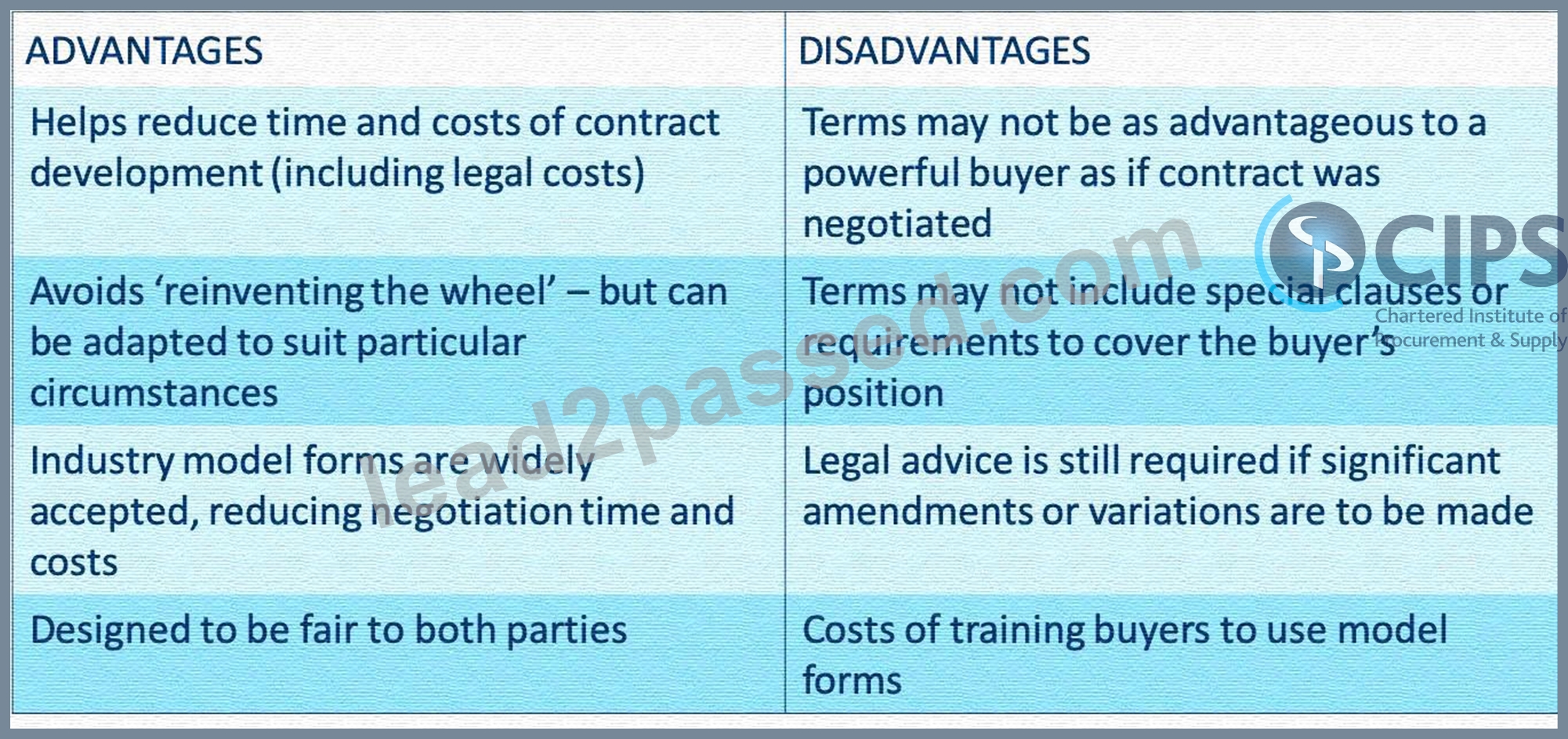
Reference:
- Procurement Study Buddy on Facebook
- CIPS study guide page 147
NEW QUESTION # 89
Which of the following regulates barriers to the provision of services between countries?
- A. GATS
- B. CISG
- C. ADA
- D. Incoterms
Answer: A
Explanation:
- The General Agreement on Trade in Services (GATS) is a treaty of the World Trade Organization (WTO) that entered into force in January 1995 as a result of the Uruguay Round negotiations. The treaty was created to extend the multilateral trading system to service sector, in the same way the General Agreement on Tariffs and Trade (GATT) provides such a system for merchandise trade.
- CISG is the Vienna Convention on Contracts for the International Sale of Goods. This is a voluntary treaty under United Nations Commission on International Trade Law (UNCITRAL). The purpose of the Vienna Convention is to set out a framework for international transactions based on a uniform approach. It establishes substantive rules that regulate the duties and obligations of both parties, including the delivery of goods, contract formation, and remedies for breach of contract.
- The Incoterms or International Commercial Terms are a series of pre-defined commercial terms published by the International Chamber of Commerce (ICC) relating to international commercial law. They are widely used in international commercial transactions or procurement processes and their use is encouraged by trade councils, courts and international lawyers. A series of three-letter trade terms related to common contractual sales practices, the Incoterms rules are intended primarily to clearly communicate the tasks, costs, and risks associated with the global or international transportation and delivery of goods. Incoterms inform sales contracts defining respective obligations, costs, and risks involved in the delivery of goods from the seller to the buyer, but they do not themselves conclude a contract, determine the price payable, currency or credit terms, govern contract law or define where title to goods transfers.
- ADA is Anti-Dumping Agreement (Implementation of Article VI of the GATT).
LO 1, AC 1.3
NEW QUESTION # 90
According to mailbox rule in some common law countries, at which point the offeree's acceptance will be effective?
- A. When the letter of acceptance is received by the offeror.
- B. When the letter of acceptance has been written.
- C. When the letter of acceptance has been correctly addressed, its postage paid, and posted.
- D. When the letter of acceptance is opened and its contents read by the offeree.
Answer: C
Explanation:
When parties do not negotiate face-to-face, a key Question: becomes when things like acceptances, rejections and revocations take effect. The general rule is that acceptances are effective on dispatch (when they are mailed). Everything else becomes effective when the offeror actually receives them. This idea is codified by the "mailbox rule" which states that acceptance is effective on dispatch, even before the offeror has received it. (The one minor exception to this rule involves option contracts for which acceptances are not effective until they are received by the offeror.) Reference:
- The Mailbox Rule
- CIPS study guide page 34
NEW QUESTION # 91
Which of the following are likely to be advantages of using request for quotation? Select TWO that apply:
- A. Short turnaround times
- B. Lower administration costs
- C. No specification required
- D. Helping the buying organisation assess both price and quality
- E. Encouraging suppliers to submit creative solutions
Answer: A,B
Explanation:
One of the advantages of using the RFQ method to procure pricing is that the company making the solicitation does not need to prepare any documentation, as requests are sent out privately. With less paperwork to prepare, turnaround times for quotes are reduced. Administration cost is also lower in compare with other procurement method like ITT or RFP. RFQ is usually used in low value purchase, where buyer knows the detailed specification and the price is the only variable that need to consider.
To use RFQ effectively, the buyer should attach the detailed specification and standard terms & conditions.
The RFQ should only be sent to verified suppliers.
Reference:
- What is an RFQ?
- CIPS study guide page 3-4
LO 1, AC 1.1
NEW QUESTION # 92
Which of the following clauses addresses fraud, bribery and corruption?
The Company has undertaken commercially reasonable efforts to eliminate Conflict Minerals from each Company Product and any products currently proposed to be manufactured by the Company or on its behalf in the future. "Conflict Minerals" means columbite-tantalite (coltan),cassiterite, gold, wolframite, or their derivatives, which originate in the Democratic Republic of the Congo or other country the exploitation and trade of which is determined by the United States to be financing conflict in the Democratic Republic of the Congo or other country.
- A. Nothing in this Agreement shall prevent a Party from utilizing the services of any subcontractor as it deems appropriate to perform its obligations under this Agreement; provided, however, that each Party shall require its subcontractors to comply with all applicable terms and conditions of this
- B. Agreement in providing such services and each Party shall remain primarily liable to the other Party for the performance of such subcontractor.
- C. Customer will be responsible for and shall ensure that while Service Provider employees, agents or contractors are on Customer's premises, all proper and legal health and safety precautions are in place and fully operational to protect such persons.
- D. Each Party hereby undertakes that, at the date of the entering into force of the Contract, itself, its directors, officers or employees have not offered, promised, given, authorized, solicited or accepted any undue pecuniary or other advantage of any kind in any way connected with the Contract and that it has taken reasonable measures to prevent subcontractors, agents or any other third parties, subject to its control or determining influence, from doing so.
Answer: D
Explanation:
This question is intended to let students know about how contractual clauses regarding ethical issues is constructed. The exam paper may not ask about this.
"Each Party hereby undertakes that, at the date of the entering into force of the Contract, itself, its directors, officers or employees have not offered, promised, given, authorized, solicited or accepted any undue pecuniary or other advantage of any kind in any way connected with the Contract and that it has taken reasonable measures to prevent subcontractors, agents or any other third parties, subject to its control or determining influence, from doing so.": This is a clause addressing fraud, bribery and corruption. It is created to prevent any undue act by contracting parties. You may find other anti-corruption clause samples in this document.
"Nothing in this Agreement shall prevent a Party from utilizing the services of any subcontractor as it deems appropriate to perform its obligations under this Agreement; provided, however, that each Party shall require its subcontractors to comply with all applicable terms and conditions of this Agreement in providing such services and each Party shall remain primarily liable to the other Party for the performance of such subcontractor.": This clause is used to control the subcontracting and subcontractors.
"Customer will be responsible for and shall ensure that while Service Provider employees, agents or contractors are on Customer's premises, all proper and legal health and safety precautions arein place and fully operational to protect such persons.": This clause is used to ensure health and safety standards.
"The Company has undertaken commercially reasonable efforts to eliminate Conflict Minerals from each Company Product and any products currently proposed to be manufactured by the Company or on its behalf in the future. "Conflict Minerals" means columbite-tantalite (coltan), cassiterite, gold, wolframite, or their derivatives, which originate in the Democratic Republic of the Congo or other country the exploitation and trade of which is determined by the United States to be financing conflict in the Democratic Republic of the Congo or other country.": This is a clause addressing conflict minerals.
Reference: CIPS study guide page 164-166
LO 3, AC 3.2
NEW QUESTION # 93
Rochdale Ltd is looking for a new IT system to automate some of its operations. In designing the specification, procurement manager supposes that it should be done solely by the IT department who have deep expertise on this matter. Is procurement manager's opinion appropriate?
- A. No, because designing complex specification could only be outsourced
- B. Yes, because designing complex specification would waste procurement manager's time
- C. No, because challenging the user's demand is the role of procurement
- D. Yes, because procurement professional has no expertise in IT sector
Answer: C
Explanation:
Procurement professionals have a role in challenging specifications. Technical experts can get things wrong and asking naive questions can be useful in bringing these to light. The challenging may include:
- Does the organisation really need these features/functions?
- With this specification, are there many available suppliers in the market?
- How many does the organisation really need?
etc
Reference: CIPS study guide page 9-10
LO 1, AC 1.1
NEW QUESTION # 94
John Powers is the managing director of ACC Trading Ltd, which provides components to the automotive industry. His company has been providing number plates to Elite Motors Ltd for many years. As John Powers and Peter Ellis, the MD of Elite, have been friends for a long time, there has never been a formal contract agreed between the companies. Following a downturn in the market, Elite Motors Ltd has now been placed in administration. ACC recently delivered 200 number plates but have not received payment. As the number plates have been fitted to some vehicles, the administrators are being very slow to return them. Which clause in a formal agreement would have helped John?
- A. Retention of Title (Romalpa)
- B. Liquidated Damages
- C. Force Majeure
- D. Penalty Clause
Answer: A
Explanation:
A Retention of Title clause allows the seller to retain ownership of goods until full payment is received. If included in a contract, this clause would have enabled ACC to claim ownership of the number plates and potentially recover them from Elite Motors Ltd, even in administration. It protects suppliers against buyer insolvency.
Reference:CIPS L4M3 Commercial Contracting Study Guide, Chapter 3, Section 3.2.1 - Retention of Title clauses.
NEW QUESTION # 95
Which of the following should include in the service level agreement that is an appendix of a contract?
1. How often the service is measured
2. Minimum qualification of supplier staffs
3. Remedies to resolve dispute
4. On time service delivery
- A. 2, 3 and 4 only
- B. 1, 2 and 3 only
- C. 1, 2 and 4 only
- D. 1, 3 and 4 only
Answer: C
Explanation:
When the SLA is a schedule or an appendix to the contract, it should clearly state the following:
1. KPIs: how they are to be measured, who measures them and how often
2. How the measurements convert into scores
3. Any other service level standards, which may be of lesser importance than the KPIs
4. Minimum acceptable standards or scores in each case
5. Range of scores both above and below the minimum acceptable
6. Any mitigating factors which might apply in the event of poor performance
7. Any time period permitted in which to remedy a situation or poor performance.
In this question, "2. Minimum qualification of supplier staffs" and "4. On time service delivery" are the KPIs, while "1. How often the service is measured" is the frequency in which the KPIs are measured.
The remedies available in the event of poor performance should be set out in the body of the contract, along with those for any other contractual breach. These clauses should be cross-referenced in the SLA.
Reference: CIPS study guide page 110-116
LO 2, AC 2.2
NEW QUESTION # 96
Which of the following are reasons why a purchaser wants to embed a subcontracting clause into the main contract? Select TWO that apply:
- A. To improve supply chain transparency
- B. To condemn whole liabilities to subcontractors
- C. To induce the conflicts between the main contractor and subcontractors
- D. To keep main contractor liable
- E. To reduce the main contract complexity
Answer: D
Explanation:
There are number of reasons why the purchaser will want to control the supplier's subcontracting:
- Supply chain transparency: Normally the purchaser has invested a lot of effort into selecting the right contractor. However, the main contractor's selection of subcontractor might not be in such careful manner, which may result in poor performance. Purchaser must know who subcontractors are. Controlling the subcontracting process can help the purchaser control the outcome.
- Contract terms: the purchaser's requirements must be reflected in the subcontracts. The subcontracting clauses may require the main contractor to do this.
- Liability: the main contractor may subcontract the whole or a part of its liabilities. Subcontracting clause may bind the contractor to be liable with the work, it cannot just blame the subcontractor for any faults.
Reference: CIPS study guide page 154-155
LO 3, AC 3.2
NEW QUESTION # 97
Since services are intangible, so KPIs for services must be qualitative in all circumstances. Is this statement correct?
- A. No, some KPIs for services are measurable by means of outcome, time and space performed
- B. No, KPIs for services must always be quantitative so that they can be measured easily
- C. Yes, the only measure mattered to supply of services is end-users' satisfaction
- D. Yes, quantitative KPIs are limited to timeliness of supply of goods, defective rates and in-full quantities, which are applied to monitor supplier of physical goods
Answer: A
Explanation:
KPIs are used to monitor supplier's performance. They can be qualitative or quantitative. Of course, service providers can be monitored by quantitative KPIs regarding the outcome achieved (such as uptime in IT contracts), timeliness of deliveries (such as in construction contracts)...
Reference:
LO 2, AC 2.2
NEW QUESTION # 98
......
Validate your Skills with Updated L4M3 Exam Questions & Answers and Test Engine: https://www.lead2passed.com/CIPS/L4M3-practice-exam-dumps.html
Reliable Study Materials & Testing Engine for L4M3 Exam Success!: https://drive.google.com/open?id=16NTEzIyKJCdDVw8mk_VzNwJiGGQpqmbz