Verified & Latest OGEA-101 Dump Q&As with Correct Answers
Latest OGEA-101 dumps - Instant Download PDF
NEW QUESTION # 44
Refer to the exhibit.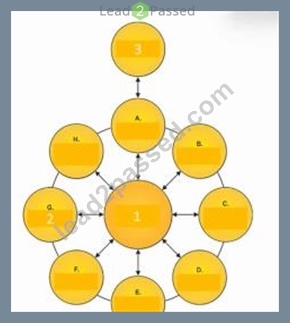
Consider the illustration of an architecture development cycle.
Select the correct phase names corresponding to the labels 1, 2 and 3?
- A. 1 Continuous Improvement - 2 Migration Planning - 3 Architecture Vision
- B. 1 Architecture Governance - 2 Implementation Governance - 3 Preliminary
- C. 1 Requirements Management - 2 Change Management - 3 Strategy
- D. 1 Requirements Management - 2 Implementation Governance - 3 Preliminary
Answer: C
NEW QUESTION # 45
Complete the following sentence. In the ADM, documents which are under development and have not undergone any formal review and approval process are called______ Documents which have been reviewed and approved are called ______
- A. "draft"- "finalized"
- B. "Version 0.1" - "Version 1.0"
- C. "draft" - "approved"
- D. "concept" - "deliverable"
Answer: C
Explanation:
According to the TOGAF Standard, 10th Edition, documents which are under development and have not undergone any formal review and approval process are called draft documents, while documents which have been reviewed and approved are called approved documents 1. Draft documents are typically marked with a version number of 0.x, indicating that they are incomplete or provisional. Approved documents are typically marked with a version number of 1.0 or higher, indicating that they have been finalized and authorized. The other options are not correct, as they are not the terms used by the TOGAF Standard to distinguish between documents under development and documents that have been reviewed and approved. The terms "finalized",
"concept", "deliverable", and "Version 0.1" and "Version 1.0" are not specific to the TOGAF Standard, and they may have different meanings or interpretations in different contexts. References: 1: TOGAF Standard,
10th Edition, Part II: Architecture Development Method, Chapter 7: Applying Iteration to the ADM, Section
7.2.3 Document Categorization.
NEW QUESTION # 46
Complete the sentence Business Transformation Readiness Assessment is_________________.
- A. widely used to validate an architecture that is being developed
- B. a joint effort between corporate staff lines of business and IT planners
- C. a way to put building blocks into context thereby supporting re-usable solutions
- D. to ensure the active support of powerful stakeholders
Answer: B
Explanation:
Business Transformation Readiness Assessment is a joint effort between corporate staff lines of business and IT planners to evaluate the readiness of the organization to undergo change. It involves assessing factors such as vision, commitment, capacity, capability, culture, and motivation that may influence the success of a business transformation initiative. Reference: The TOGAF Standard | The Open Group Website, Section 3.3.2 Business Transformation Readiness Assessment.
NEW QUESTION # 47
Which of the following statements about architecture partitioning are correct*?
1 Partitions are used to simplify the management of the Enterprise Architecture
2 Partitions are equivalent to architecture levels
3 Partitions enable different teams to work on different element of the architecture at the same time.
4 Partitions reflect the organization's structure
- A. 2 & 3
- B. 1 & 3
- C. 2 & 4
- D. 1 & 4
Answer: B
Explanation:
Statements 1 and 3 about architecture partitioning are correct. Architecture partitioning is the technique of dividing an architecture into smaller and more manageable parts that can be developed, maintained, and governed independently. Partitions are used to simplify the management of the Enterprise Architecture and to enable different teams to work on different elements of the architecture at the same time. Partitions are not equivalent to architecture levels, which are different degrees of abstraction or detail in an architecture. Partitions do not necessarily reflect the organization's structure, which may change over time or differ from the architecture's scope and boundaries. Reference: The TOGAF Standard | The Open Group Website, Section 2.5 Architecture Partitioning.
NEW QUESTION # 48
Consider the following statements.
1. All processes, decision-making, and mechanisms used will be established so as to minimize or avoid potential conflicts of interest.
2. More effective strategic decision-making will be made by C-Level executives and business leaders.
3. All actions implemented and their decision support will be available for inspection by authorized organization and provider parties.
4. Digital Transformation and operations will be more effective and efficient.
Which statements highlight the value and necessity for Architecture Governance to be adopted within organizations?
- A. 1 & 3
- B. 2 & 4
- C. 2& 3
- D. 1 & 4
Answer: A
Explanation:
Statements 1 and 3 highlight the value and necessity for Architecture Governance to be adopted within organizations. Architecture Governance is the practice and orientation by which Enterprise Architectures and other architectures are managed and controlled at an enterprise-wide level12. It ensures that architectural decisions are aligned with the organization's strategy, objectives, and standards. Architecture Governance also involves establishing and maintaining processes, decision-making, and mechanisms to avoid or minimize potential conflicts of interest, such as between different stakeholders, business units, or projects34. Moreover, Architecture Governance requires transparency and accountability for all actions implemented and their decision support, so that they can be inspected and evaluated by authorized parties, such as auditors, regulators, or customers5 . References:
*The TOGAF Standard, Version 9.2 - Architecture Governance - The Open Group
*Architecture Governance - The Open Group
*Tutorial: Governance in TOGAF's Architecture Development Method (ADM)
*Architecture Governance in TOGAF: Ensuring Effective Management and Compliance
*The TOGAF Standard, Version 9.2 - Definitions - The Open Group
*[Architecture Governance in TOGAF: Ensuring Alignment and Control]
NEW QUESTION # 49
Complete the sentence. The architecture domains that are considered by the TOGAF standard as subsets of an overall enterprise architecture are Business, Technology,
- A. Logical and Physical
- B. Capability and Segment
- C. Information and Data
- D. Application and Data
Answer: D
Explanation:
These domains provide a consistent way to describe and understand the architecture from different perspectives, such as business, information, and technology12. Each domain has its own set of concepts, models, views, and artifacts that define the structure and behavior of the architecture within that domain12.
The other options are incorrect because:
*Logical and Physical are not architecture domains, but rather levels of abstraction that can be applied to any domain. Logical architecture describes the functionality and behavior of the system, while physical architecture describes the implementation and deployment of the system3.
*Information and Data are not distinct architecture domains, but rather aspects of the same domain.
Information architecture describes the meaning and context of the data, while data architecture describes the structure and format of the data4.
*Capability and Segment are not architecture domains, but rather levels of granularity that can be applied to any domain. Capability architecture describes the current and desired states of a specific business capability, while segment architecture describes a subdivision of the enterprise that has a clear business focus5.
References: 1: The TOGAF Standard, Version 9.2 - Definitions 2: TOGAF Standard - Introduction - Definitions 3: [Logical vs Physical Architecture] 4: [Information Architecture vs Data Architecture] 5: [The TOGAF Standard, Version 9.2 - Applying the ADM Across the Architecture Landscape]
NEW QUESTION # 50
What ensures that a project transitioning into implementation also smoothly transitions into appropriate Architecture Governance?
- A. Implementation Governance Model
- B. Implementation Strategy
- C. Migration Plan
- D. Transition Plan
Answer: A
NEW QUESTION # 51
What can architects present to stakeholders to extract hidden agendas, principles, and requirements that could impact the final Target Architecture?
- A. Alternatives and Trade-offs
- B. Solutions and Applications
- C. Architecture Views and Architecture Viewpoints
- D. Business Scenarios and Business Models
Answer: C
Explanation:
* According to the TOGAF Standard, Version 9.2, an architecture view is a representation of a system from the perspective of a related set of concerns1. It consists of one or more architecture models that demonstrate how the system addresses the stakeholder concerns1.
* An architecture viewpoint is a specification of the conventions for constructing and using an architecture view to address specific stakeholder concerns1. It defines the perspective, scope, notation, and techniques for creating an architecture view of a system1.
* Architects can present architecture views and viewpoints to stakeholders to extract hidden agendas, principles, and requirements that could impact the final Target Architecture, because23:
* Architecture views and viewpoints help to communicate and visualize the architecture in a way that is meaningful and relevant to different stakeholders, addressing their specific interests and needs.
* Architecture views and viewpoints help to elicit and validate the stakeholder concerns and requirements, ensuring that they are aligned with the business goals and objectives, and that they are consistent and feasible within the architecture context.
* Architecture views and viewpoints help to identify and resolve any conflicts, gaps, or trade-offs among the stakeholder concerns and requirements, ensuring that they are balanced and prioritized in the architecture design and decision-making.
* Architecture views and viewpoints help to demonstrate and verify the value and benefits of the architecture to the stakeholders, ensuring that they are satisfied and committed to the architecture outcome and governance.
NEW QUESTION # 52
Exhibit
Consider the illustration showing an architecture development cycle Which description matches the phase of the ADM labeled as item 1?
- A. Conducts implementation planning for the architecture defined in previous phases
- B. Establishes procedures for managing change to the new architecture
- C. Provides architectural oversight for the implementation
- D. Operates the process of managing architecture requirements
Answer: D
Explanation:
* The illustration shows an architecture development cycle based on the TOGAF ADM (Architecture Development Method), which is a method for developing and managing an enterprise architecture1.
* The ADM consists of nine phases, each with a specific purpose and output. The phases are1:
* Preliminary Phase: To prepare and initiate the architecture development cycle, including defining the architecture framework, principles, and governance.
* Phase A: Architecture Vision: To define the scope, vision, and stakeholders of the architecture initiative, and to obtain approval to proceed.
* Phase B: Business Architecture: To describe the baseline and target business architecture, and to identify the gaps between them.
* Phase C: Information Systems Architectures: To describe the baseline and target data and application architectures, and to identify the gaps between them.
* Phase D: Technology Architecture: To describe the baseline and target technology architecture, and to identify the gaps between them.
* Phase E: Opportunities and Solutions: To identify and evaluate the opportunities and solutions for implementing the target architecture, and to define the work packages and transition architectures.
* Phase F: Migration Planning: To finalize the implementation and migration plan, and to ensure alignment with the enterprise portfolio and project management.
* Phase G: Implementation Governance: To provide architecture oversight and guidance for the implementation projects, and to manage any architecture change requests.
* Phase H: Architecture Change Management: To monitor the changes in the business and technology environment, and to assess the impact and performance of the architecture.
* In addition to these phases, there is a central process called Requirements Management, which is labeled as item 1 in the illustration. This process operates throughout the ADM cycle, and its purpose is to manage the architecture requirements throughout the architecture development, ensuring that they are aligned with the business requirements and the stakeholder concerns2.
* Therefore, the description that matches the phase of the ADM labeled as item 1 is C. Operates the process of managing architecture requirements.
NEW QUESTION # 53
Complete the sentence. The four purposes that typically frame the planning horizon, depth and breadth of an Architecture Project, and the contents of the EA Repository are Strategy, Portfolio,
- A. Segment, and End-to-end Target Architecture.
- B. Discreet, and Cohesive.
- C. Project, and Solution Delivery.
- D. Subordinate, and Superior Architecture.
Answer: A
Explanation:
The planning horizon, depth, and breadth of an Architecture Project, along with the contents of the EA Repository, are typically framed by Strategy, Portfolio,Segment, and End-to-end Target Architecture. The
'Segment' refers to a part of the organization, typically addressed in a Segment Architecture, while 'End-to- end Target Architecture' encompasses the complete view of the planned architecture across the entire organization.
NEW QUESTION # 54
Consider the following ADM phases objectives.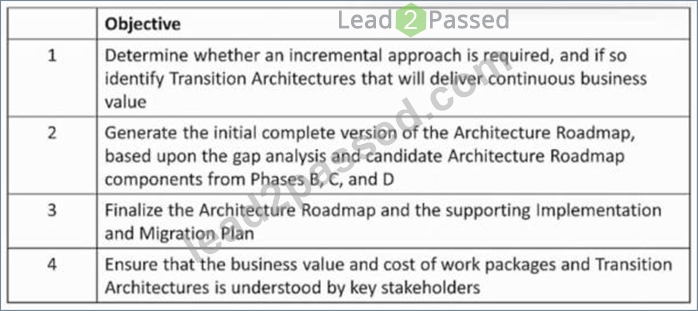
Which phase does each objective match?
- A. 1E-2E-3F-4F
- B. 1E-2F-3E-4F
- C. 1F-2E-3F-4G
- D. 1G-2E-3F-4F
Answer: D
NEW QUESTION # 55
In which phase(s) of the ADM would you deal with the actions resulting from a transformation readiness assessment?
- A. Phase A
- B. Phase G
- C. Phase E and F
- D. Phase F
Answer: C
Explanation:
According to the TOGAF Standard, 10th Edition, a transformation readiness assessment is a technique that evaluates the preparedness of the organization to undergo a change, and identifies the actions needed to increase the likelihood of a successful outcome. A transformation readiness assessment can be conducted in Phase E: Opportunities and Solutions, and the actions resulting from it can be dealt with in Phase F: Migration Planning 1. In Phase E, the transformation readiness assessment can help to identify the major implementation challenges and risks, and to define the critical success factors and key performance indicators for the architecture project. In Phase F, the actions resulting from the transformation readiness assessment can help to develop a detailed and realistic migration plan, and to address the gaps, issues, and dependencies that may affect the transition to the target architecture 1. Reference: 1: TOGAF Standard, 10th Edition, Part III: ADM Guidelines and Techniques, Chapter 29: Business Transformation Readiness Assessment.
NEW QUESTION # 56
Consider the following statements:
1. Each contracted party is required to act responsibly to the organization and its stakeholders.
2. All decisions taken, processes used, and their implementation will not be allowed to create unfair advantage to any one particular party.
3. Digital Transformation and operations will be more effective and efficient.
4. Strategic decision-making by C-Level executives and business leaders will be more effective.
Which statements highlight the value and necessity for Architecture Governance to be adopted within organizations?
- A. 2 & 3
- B. 3 & 4
- C. 1 & 2
- D. 1 & 4
Answer: C
Explanation:
Architecture governance is the practice of ensuring compliance with the enterprise architecture and its principles, standards, and goals. Architecture governance provides the means to establish, monitor, and control the architecture development and implementation processes, and to resolve any issues or conflicts that may arise. Architecture governance also ensures that all stakeholders are represented and involved in the decision-making process, and that their interests and concerns are balanced and aligned. Statements 1 and 2 highlight the value and necessity for architecture governance to be adopted within organizations, as they emphasize the importance of responsibility, accountability, fairness, and transparency in the architectural activities. Statements 3 and 4 are more related to the benefits and outcomes of having a good enterprise architecture, rather than the governance aspect.
Reference: : The TOGAF Standard, Version 9.2, Part VI: Architecture Capability Framework, Chapter 50: Architecture Governance : The TOGAF Standard, Version 9.2, Part III: ADM Guidelines and Techniques, Chapter 29: Architecture Governance
NEW QUESTION # 57
Which section of the TOGAF template for Architecture Principles should highlight the requirements for carrying out the principle?
- A. Implications
- B. Name
- C. Rationale
- D. Statement
Answer: A
Explanation:
The Implications section describes the impact of adhering to the principle on the organization, the processes, the information systems, and the technology23. It also identifies the changes, costs, and risks that may result from applying the principle23. The Implications section helps to communicate the benefits and consequences of the principle to the stakeholders and to guide the implementation and governance of the architecture23.
The other sections of the TOGAF template for Architecture Principles are1:
*Name: This section provides a short and memorable name for the principle that represents its essence and purpose23. The name should not mention any specific technology or solution23.
*Statement: This section provides a concise and formal definition of the principle that expresses the fundamental rule or constraint that the principle imposes23. The statement should be clear, unambiguous, and testable23.
*Rationale: This section provides the reasoning and justification for the principle, explaining why it is important and how it supports the business goals and drivers23. The rationale should also link the principle to the higher-level enterprise or IT principles that it elaborates on23.
NEW QUESTION # 58
Which of the following statements about architecture partitioning are correct*?
1 Partitions are used to simplify the management of the Enterprise Architecture
2 Partitions are equivalent to architecture levels
3 Partitions enable different teams to work on different element of the architecture at the same time.
4 Partitions reflect the organization's structure
- A. 2 & 3
- B. 1 & 3
- C. 2 & 4
- D. 1 & 4
Answer: B
Explanation:
Statements 1 and 3 about architecture partitioning are correct. Architecture partitioning is the technique of dividing an architecture into smaller and more manageable parts that can be developed, maintained, and governed independently. Partitions are used to simplify the management of the Enterprise Architecture and to enable different teams to work on different elements of the architecture at the same time. Partitions are not equivalent to architecture levels, which are different degrees of abstraction or detail in an architecture.
Partitions do not necessarily reflect the organization's structure, which may change over time or differ from the architecture's scope and boundaries. Reference: The TOGAF Standard | The Open Group Website, Section 2.5 Architecture Partitioning.
NEW QUESTION # 59
......
The Ultimate The Open Group OGEA-101 Dumps PDF Review: https://www.lead2passed.com/TheOpenGroup/OGEA-101-practice-exam-dumps.html
Updated Verified OGEA-101 Downloadable Printable Exam Dumps: https://drive.google.com/open?id=1Mm8Hzg3i8XNkrOOpz3HbtyR_TzgArvxz