2025 Free Databricks Databricks-Certified-Data-Engineer-Associate Exam Files Downloaded Instantly
Pass Databricks Databricks-Certified-Data-Engineer-Associate exam Dumps 100 Pass Guarantee With Latest Demo
The GAQM Databricks-Certified-Data-Engineer-Associate (Databricks Certified Data Engineer Associate) Exam is a certification exam designed for data engineers who are interested in validating their skills and knowledge in working with Databricks. Databricks is a cloud-based data processing and analytics platform that is widely used by organizations to manage and analyze large datasets. Databricks Certified Data Engineer Associate Exam certification exam is designed to test the candidate's ability to design, build and maintain data pipelines using Databricks.
NEW QUESTION # 53
A data engineer is working with two tables. Each of these tables is displayed below in its entirety.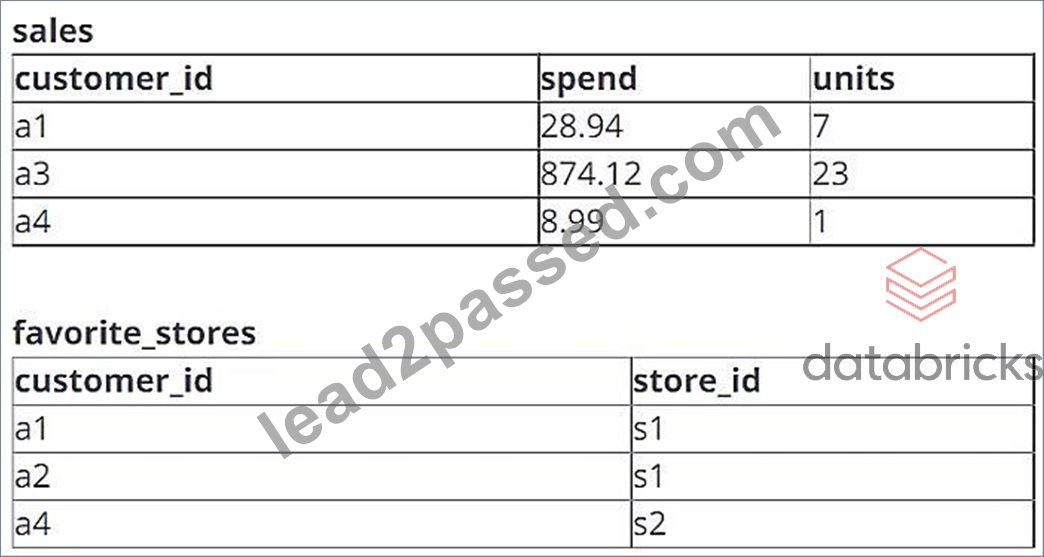
The data engineer runs the following query to join these tables together: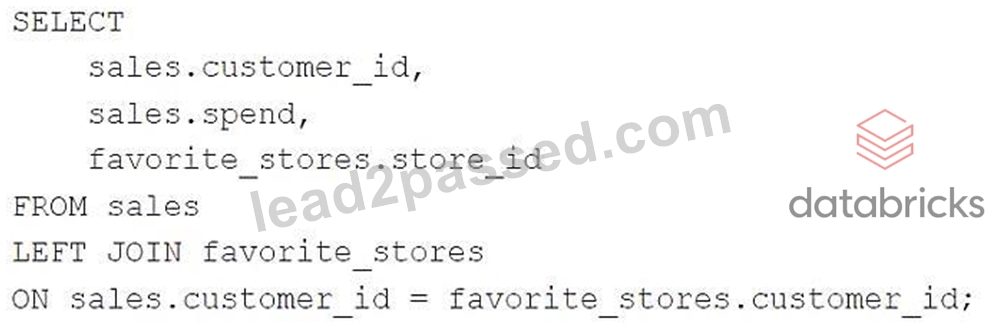
Which of the following will be returned by the above query?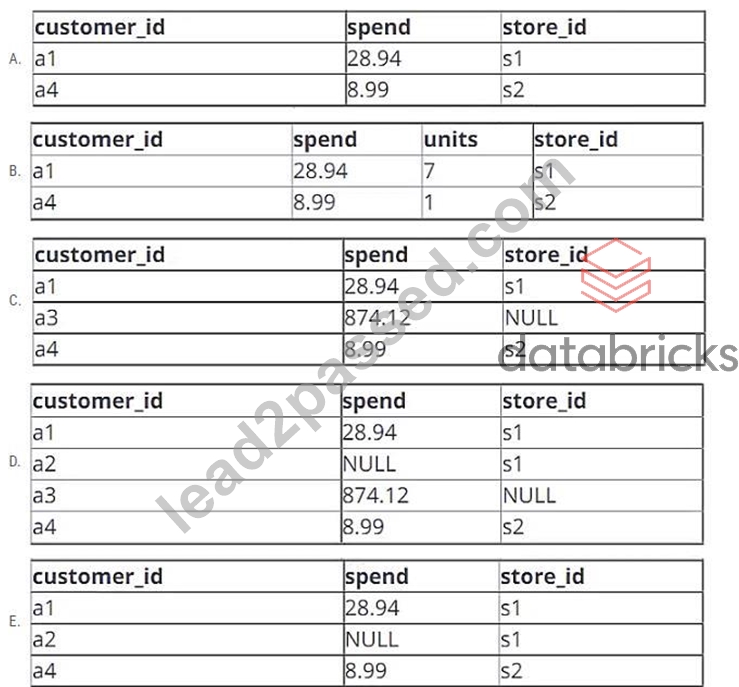
- A. Option B
- B. Option D
- C. Option E
- D. Option C
- E. Option A
Answer: D
NEW QUESTION # 54
A new data engineering team team. has been assigned to an ELT project. The new data engineering team will need full privileges on the database customers to fully manage the project.
Which of the following commands can be used to grant full permissions on the database to the new data engineering team?
- A. GRANT SELECT CREATE MODIFY USAGE PRIVILEGES ON DATABASE customers TO team;
- B. GRANT ALL PRIVILEGES ON DATABASE team TO customers;
- C. GRANT ALL PRIVILEGES ON DATABASE customers TO team;
- D. GRANT SELECT PRIVILEGES ON DATABASE customers TO teams;
- E. GRANT USAGE ON DATABASE customers TO team;
Answer: C
Explanation:
Explanation
To grant full privileges on the database "customers" to the new data engineering team, you can use the GRANT ALL PRIVILEGES command as shown in option E. This command provides the team with all possible privileges on the specified database, allowing them to fully manage it.
NEW QUESTION # 55
A data architect has determined that a table of the following format is necessary: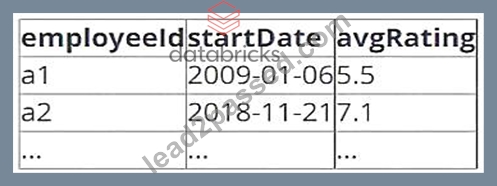
Which of the following code blocks uses SQL DDL commands to create an empty Delta table in the above format regardless of whether a table already exists with this name?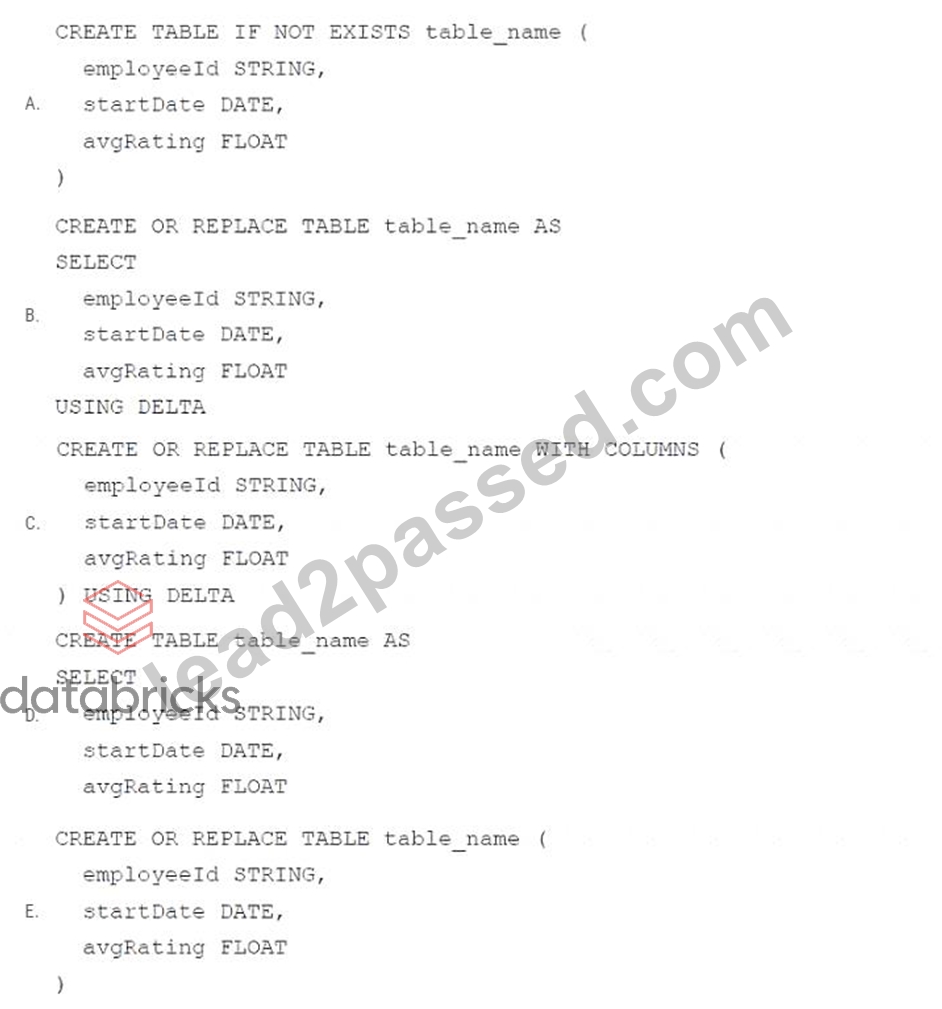
- A. Option B
- B. Option D
- C. Option E
- D. Option C
- E. Option A
Answer: C
Explanation:
References: Create a table using SQL | Databricks on AWS, Create a table using SQL - Azure Databricks, Delta Lake Quickstart - Azure Databricks
NEW QUESTION # 56
A data engineer needs to apply custom logic to identify employees with more than 5 years of experience in array column employees in table stores. The custom logic should create a new column exp_employees that is an array of all of the employees with more than 5 years of experience for each row. In order to apply this custom logic at scale, the data engineer wants to use the FILTER higher-order function.
Which of the following code blocks successfully completes this task?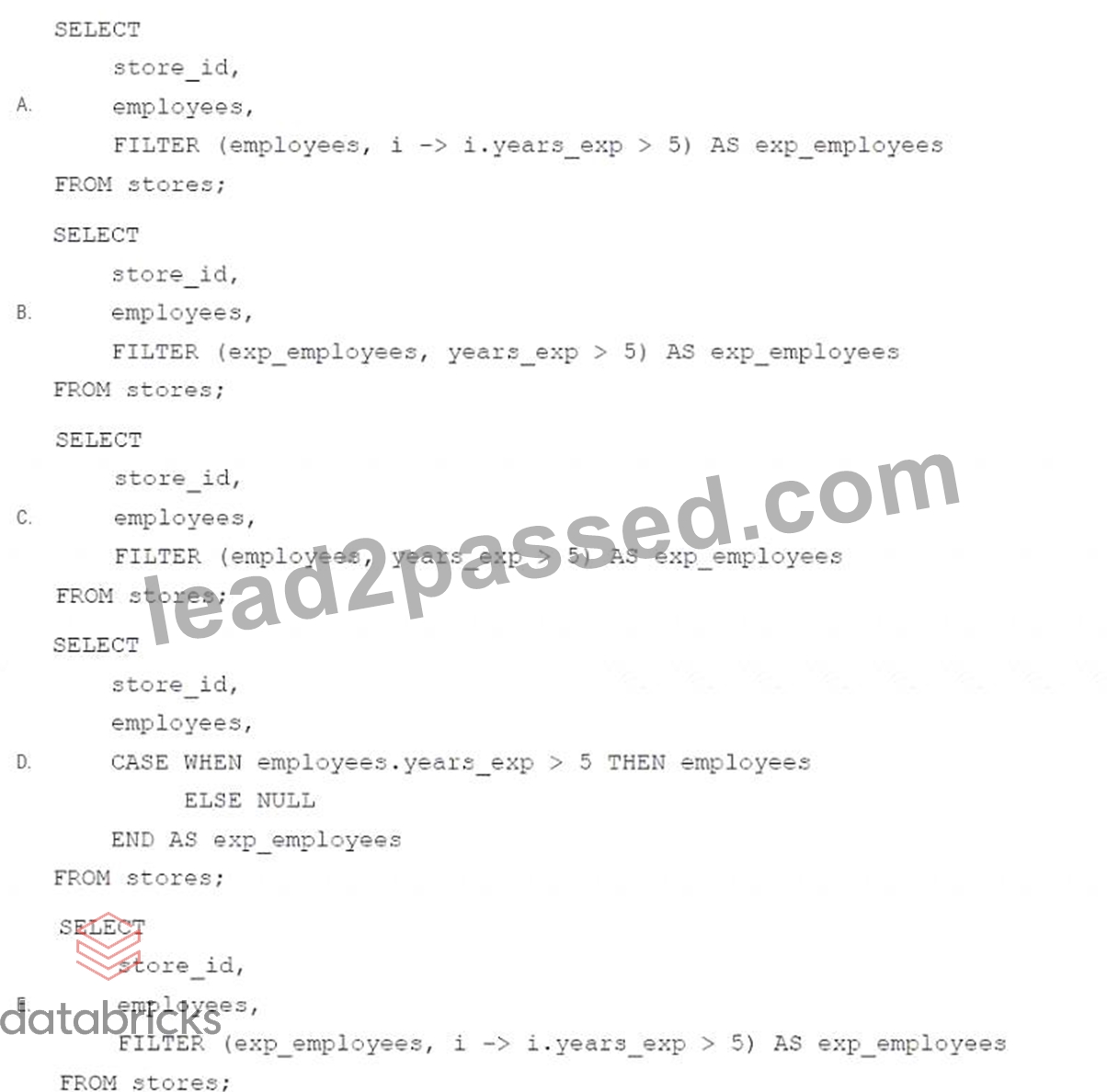
- A. Option B
- B. Option D
- C. Option E
- D. Option C
- E. Option A
Answer: E
Explanation:
Option A is the correct answer because it uses the FILTER higher-order function correctly to filter out employees with more than 5 years of experience from the array column "employees". It applies a lambda function i -> i.years_exp > 5 that checks if the years of experience of each employee in the array is greater than 5. If this condition is met, the employee is included in the new array column "exp_employees".
References: The use of higher-order functions like FILTER can be referenced from Databricks documentation on Higher-Order Functions.
NEW QUESTION # 57
A new data engineering team has been assigned to work on a project. The team will need access to database customers in order to see what tables already exist. The team has its own group team.
Which of the following commands can be used to grant the necessary permission on the entire database to the new team?
- A. GRANT USAGE ON CATALOG team TO customers;
- B. GRANT USAGE ON DATABASE customers TO team;
- C. GRANT VIEW ON CATALOG customers TO team;
- D. GRANT CREATE ON DATABASE customers TO team;
Answer: B
NEW QUESTION # 58
A data engineer wants to schedule their Databricks SQL dashboard to refresh once per day, but they only want the associated SQL endpoint to be running when it is necessary.
Which of the following approaches can the data engineer use to minimize the total running time of the SQL endpoint used in the refresh schedule of their dashboard?
- A. They can set up the dashboard's SQL endpoint to be serverless.
- B. They can ensure the dashboard's SQL endpoint is not one of the included query's SQL endpoint.
- C. They can ensure the dashboard's SQL endpoint matches each of the queries' SQL endpoints.
- D. They can reduce the cluster size of the SQL endpoint.
- E. They can turn on the Auto Stop feature for the SQL endpoint.
Answer: A
Explanation:
A serverless SQL endpoint is a compute resource that is automatically managed by Databricks and scales up or down based on the workload. A serverless SQL endpoint can be used to run queries and dashboards without requiring manual configuration or management. A serverless SQL endpoint is only active when it is needed and shuts down automatically when idle, minimizing the total running time and cost. A serverless SQL endpoint can be created and assigned to a dashboard using the Databricks SQL UI or the SQL Analytics API. References:
* Create a serverless SQL endpoint
* Assign a SQL endpoint to a dashboard
* SQL Analytics API
NEW QUESTION # 59
A data engineer has created a new database using the following command:
CREATE DATABASE IF NOT EXISTS customer360;
In which of the following locations will the customer360 database be located?
- A. dbfs:/user/hive/warehouse
- B. dbfs:/user/hive/customer360
- C. dbfs:/user/hive/database/customer360
- D. More information is needed to determine the correct response
Answer: A
Explanation:
dbfs:/user/hive/warehouse Thereby showing "dbfs:/user/hive/warehouse/customer360.db The location of the customer360 database depends on the value of the spark.sql.warehouse.dir configuration property, which specifies the default location for managed databases and tables. If the property is not set, the default value is dbfs:/user/hive/warehouse. Therefore, the customer360 database will be located in dbfs:/user/hive/warehouse/customer360.db. However, if the property is set to a different value, such as dbfs:/user/hive/database, then the customer360 database will be located in dbfs:/user/hive/database/customer360.db. Thus, more information is needed to determine the correct response.
Option A is not correct, as dbfs:/user/hive/database/customer360 is not the default location for managed databases and tables, unless the spark.sql.warehouse.dir property is explicitly set to dbfs:/user/hive/database.
Option B is not correct, as dbfs:/user/hive/warehouse is the default location for the root directory of managed databases and tables, not for a specific database. The database name should be appended with .db to the directory path, such as dbfs:/user/hive/warehouse/customer360.db.
Option C is not correct, as dbfs:/user/hive/customer360 is not a valid location for a managed database, as it does not follow the directory structure specified by the spark.sql.warehouse.dir property.
References:
* Databases and Tables
* [Databricks Data Engineer Professional Exam Guide]
NEW QUESTION # 60
Which of the following is a benefit of the Databricks Lakehouse Platform embracing open source technologies?
- A. Ability to scale storage
- B. Simplified governance
- C. Avoiding vendor lock-in
- D. Ability to scale workloads
- E. Cloud-specific integrations
Answer: C
Explanation:
One of the benefits of the Databricks Lakehouse Platform embracing open source technologies is that it avoids vendor lock-in. This means that customers can use the same open source tools and frameworks across different cloud providers, and migrate their data and workloads without being tied to a specific vendor. The Databricks Lakehouse Platform is built on open source projects such as Apache Spark™, Delta Lake, MLflow, and Redash, which are widely used and trusted by millions of developers. By supporting these open source technologies, the DatabricksLakehouse Platform enables customers to leverage the innovation and community of the open source ecosystem, and avoid the risk of being locked into proprietary or closed solutions. The other options are either not related to open source technologies (A, B, C, D), or not benefits of the Databricks Lakehouse Platform (A, B). References: Databricks Documentation - Built on open source, Databricks Documentation - What is the Lakehouse Platform?, Databricks Blog - Introducing the Databricks Lakehouse Platform.
NEW QUESTION # 61
Which of the following describes a scenario in which a data engineer will want to use a single-node cluster?
- A. When they are running automated reports to be refreshed as quickly as possible
- B. When they are concerned about the ability to automatically scale with larger data
- C. When they are manually running reports with a large amount of data
- D. When they are working interactively with a small amount of data
- E. When they are working with SQL within Databricks SQL
Answer: D
Explanation:
The scenario in which a data engineer will want to use a single-node cluster is when they are working interactively with a small amount of data. A single-node cluster is a cluster consisting of an Apache Spark driver and no Spark workers1. A single-node cluster supports Spark jobs and all Spark data sources, including Delta Lake1. A single-node cluster is helpful for single-node machine learning workloads that use Spark to load and save data, and for lightweight exploratory data analysis1. A single-node cluster can run Spark locally, spawn one executor thread per logical core in the cluster, and save all log output in the driver log1. A single-node cluster can be created by selecting the Single Node button when configuring a cluster1.
The other options are not suitable for using a single-node cluster. When running automated reports to be refreshed as quickly as possible, a data engineer will want to use a multi-node cluster that can scale up and down automatically based on the workload demand2. When working with SQL within Databricks SQL, a data engineer will want to use a SQL Endpoint that can execute SQL queries on a serverless pool or an existing cluster3. When concerned about the ability to automatically scale with larger data, a data engineer will want to use a multi-node cluster that can leverage the Databricks Lakehouse Platform and the Delta Engine to handle large-scale data processing efficiently and reliably4. When manually running reports with a large amount of data, a data engineer will want to use a multi-node cluster that can distribute the computation across multiple workers and leverage the Spark UI to monitor the performance and troubleshoot the issues.
References:
* 1: Single Node clusters | Databricks on AWS
* 2: Autoscaling | Databricks on AWS
* 3: SQL Endpoints | Databricks on AWS
* 4: Databricks Lakehouse Platform | Databricks on AWS
* : [Spark UI | Databricks on AWS]
NEW QUESTION # 62
An engineering manager uses a Databricks SQL query to monitor ingestion latency for each data source. The manager checks the results of the query every day, but they are manually rerunning the query each day and waiting for the results.
Which of the following approaches can the manager use to ensure the results of the query are updated each day?
- A. They can schedule the query to run every 1 day from the Jobs UI.
- B. They can schedule the query to refresh every 12 hours from the SQL endpoint's page in Databricks SQL.
- C. They can schedule the query to refresh every 1 day from the SQL endpoint's page in Databricks SQL.
- D. They can schedule the query to run every 12 hours from the Jobs UI.
- E. They can schedule the query to refresh every 1 day from the query's page in Databricks SQL.
Answer: E
Explanation:
Explanation
https://docs.databricks.com/en/sql/user/queries/schedule-query.html
NEW QUESTION # 63
A Delta Live Table pipeline includes two datasets defined using STREAMING LIVE TABLE. Three datasets are defined against Delta Lake table sources using LIVE TABLE.
The table is configured to run in Production mode using the Continuous Pipeline Mode.
Assuming previously unprocessed data exists and all definitions are valid, what is the expected outcome after clicking Start to update the pipeline?
- A. All datasets will be updated once and the pipeline will shut down. The compute resources will persist to allow for additional testing.
- B. All datasets will be updated at set intervals until the pipeline is shut down. The compute resources will persist to allow for additional testing.
- C. All datasets will be updated once and the pipeline will shut down. The compute resources will be terminated.
- D. All datasets will be updated once and the pipeline will persist without any processing. The compute resources will persist but go unused.
- E. All datasets will be updated at set intervals until the pipeline is shut down. The compute resources will be deployed for the update and terminated when the pipeline is stopped.
Answer: B
Explanation:
Explanation
In a Delta Live Table pipeline running in Continuous Pipeline Mode, when you click Start to update the pipeline, the following outcome is expected: All datasets defined using STREAMING LIVE TABLE and LIVE TABLE against Delta Lake table sources will be updated at set intervals. The compute resources will be deployed for the update process and will be active during the execution of the pipeline. The compute resources will be terminated when the pipeline is stopped or shut down. This mode allows for continuous and periodic updates to the datasets as new data arrives or changes in the underlying Delta Lake tables occur. The compute resources are provisioned and utilized during the update intervals to process the data and perform the necessary operations.
NEW QUESTION # 64
A data engineer has realized that they made a mistake when making a daily update to a table. They need to use Delta time travel to restore the table to a version that is 3 days old. However, when the data engineer attempts to time travel to the older version, they are unable to restore the data because the data files have been deleted.
Which of the following explains why the data files are no longer present?
- A. The VACUUM command was run on the table
- B. The DELETE HISTORY command was run on the table
- C. The TIME TRAVEL command was run on the table
- D. The OPTIMIZE command was nun on the table
- E. The HISTORY command was run on the table
Answer: A
Explanation:
The VACUUM command is used to remove files that are no longer referenced by a Delta table and are older than the retention threshold1. The default retention period is 7 days2, but it can be changed by setting the delta.logRetentionDuration and delta.deletedFileRetentionDuration configurations3. If the VACUUM command was run on the table with a retention period shorter than 3 days, then the data files that were needed to restore the table to a 3-day-old version would have been deleted. The other commands do not delete data files from the table. The TIME TRAVEL command is used to query a historical version of the table4. The DELETE HISTORY command is not a valid command in Delta Lake. The OPTIMIZE command is used to improve the performance of the table by compacting small files into larger ones5. The HISTORY command is used to retrieve information about the operations performed on the table. References: 1: VACUUM | Databricks on AWS 2: Work with Delta Lake table history | Databricks on AWS 3: [Delta Lake configuration | Databricks on AWS] 4: Work with Delta Lake table history - Azure Databricks 5: [OPTIMIZE | Databricks on AWS] : [HISTORY | Databricks on AWS]
NEW QUESTION # 65
A data engineering team has noticed that their Databricks SQL queries are running too slowly when they are submitted to a non-running SQL endpoint. The data engineering team wants this issue to be resolved.
Which of the following approaches can the team use to reduce the time it takes to return results in this scenario?
- A. They can increase the cluster size of the SQL endpoint.
- B. They can increase the maximum bound of the SQL endpoint's scaling range
- C. They can turn on the Serverless feature for the SQL endpoint.
- D. They can turn on the Serverless feature for the SQL endpoint and change the Spot Instance Policy to
"Reliability Optimized." - E. They can turn on the Auto Stop feature for the SQL endpoint.
Answer: C
Explanation:
Explanation
Databricks SQL endpoints can run in two modes: Serverless and Dedicated. Serverless mode allows you to run queries without managing clusters, while Dedicated mode allows you to run queries on a specific cluster.
Serverless mode is faster and more cost-effective for ad-hoc queries, especially when the SQL endpoint is not running. Dedicated mode is more suitable for predictable and consistent performance, especially for long-running queries. By turning on the Serverless feature for the SQL endpoint, the data engineering team can reduce the time it takes to start the SQL endpoint and return results. The other options are not relevant or effective for this scenario. References: Databricks SQL endpoints, New Performance Improvements in Databricks SQL, Slowness when fetching results in Databricks SQL
NEW QUESTION # 66
A data engineer has been given a new record of data:
id STRING = 'a1'
rank INTEGER = 6
rating FLOAT = 9.4
Which of the following SQL commands can be used to append the new record to an existing Delta table my_table?
- A. UPDATE VALUES ('a1', 6, 9.4) my_table
- B. INSERT INTO my_table VALUES ('a1', 6, 9.4)
- C. my_table UNION VALUES ('a1', 6, 9.4)
- D. UPDATE my_table VALUES ('a1', 6, 9.4)
- E. INSERT VALUES ( 'a1' , 6, 9.4) INTO my_table
Answer: B
Explanation:
To append a new record to an existing Delta table, you can use the INSERT INTO statement with the VALUES clause. This statement will insert one or more rows into the table with the specified values.
Option A is the only code block that follows this syntax correctly. Option B is incorrect, as it uses the UNION operator, which will return a new table that is the union of two tables, not append to an existing table. Option C is incorrect, as it uses the INSERT VALUES statement, which is not a valid SQL syntax.
Option D is incorrect, as it uses the UPDATE statement, which will modify existing rows in the table, not append new rows. Option E is incorrect, as it uses the UPDATE VALUES statement, which is also not a valid SQL syntax. References: Insert data into a table using SQL | Databricks on AWS, Insert data into a table using SQL - Azure Databricks, Delta Lake Quickstart - Azure Databricks
NEW QUESTION # 67
A data organization leader is upset about the data analysis team's reports being different from the data engineering team's reports. The leader believes the siloed nature of their organization's data engineering and data analysis architectures is to blame.
Which of the following describes how a data lakehouse could alleviate this issue?
- A. Both teams would respond more quickly to ad-hoc requests
- B. Both teams would be able to collaborate on projects in real-time
- C. Both teams would reorganize to report to the same department
- D. Both teams would use the same source of truth for their work
- E. Both teams would autoscale their work as data size evolves
Answer: D
Explanation:
Explanation
A data lakehouse is designed to unify the data engineering and data analysis architectures by integrating features of both data lakes and data warehouses. One of the key benefits of a data lakehouse is that it provides a common, centralized data repository (the "lake") that serves as a single source of truth for data storage and analysis. This allows both data engineering and data analysis teams to work with the same consistent data sets, reducing discrepancies and ensuring that the reports generated by both teams are based on the same underlying data.
NEW QUESTION # 68
Which of the following Git operations must be performed outside of Databricks Repos?
- A. Push
- B. Merge
- C. Commit
- D. Pull
- E. Clone
Answer: B
Explanation:
Databricks Repos is a visual Git client and API in Databricks that supports common Git operations such as commit, pull, push, branch management, and visual comparison of diffs when committing1. However, merge is not supported in the Git dialog2. You need to use the Repos UI or your Git provider to merge branches3. Merge is a way to combine the commit history from one branch into another branch1. During a merge, a merge conflict is encountered when Git cannot automatically combine code from one branch into another. Merge conflicts require manual resolution before a merge can be completed1. Reference: 4: Run Git operations on Databricks Repos4, 1: CI/CD techniques with Git and Databricks Repos1, 3: Collaborate in Repos3, 2: Databricks Repos - What it is and how we can use it2.
Databricks Repos is a visual Git client and API in Databricks that supports common Git operations such as commit, pull, push, merge, and branch management. However, to clone a remote Git repository to a Databricks repo, you must use the Databricks UI or API. You cannot clone a Git repo using the CLI through a cluster's web terminal, as the files won't display in the Databricks UI1. Reference: 1: Run Git operations on Databricks Repos | Databricks on AWS2
NEW QUESTION # 69
A data engineer needs to determine whether to use the built-in Databricks Notebooks versioning or version their project using Databricks Repos.
Which of the following is an advantage of using Databricks Repos over the Databricks Notebooks versioning?
- A. Databricks Repos automatically saves development progress
- B. Databricks Repos supports the use of multiple branches
- C. Databricks Repos is wholly housed within the Databricks Lakehouse Platform
- D. Databricks Repos allows users to revert to previous versions of a notebook
- E. Databricks Repos provides the ability to comment on specific changes
Answer: B
Explanation:
Databricks Repos is a visual Git client and API in Databricks that supports common Git operations such as cloning, committing, pushing, pulling, and branch management. Databricks Notebooks versioning is a legacy feature that allows users to link notebooks to GitHub repositories and perform basic Git operations. However, Databricks Notebooks versioning does not support the use of multiple branches for development work, which is an advantage of using Databricks Repos. With Databricks Repos, users can create and manage branches for different features, experiments, or bug fixes, and merge, rebase, or resolve conflicts between them. Databricks recommends using a separate branch for each notebook and following data science and engineering code development best practices using Git for version control, collaboration, and CI/CD. Reference: Git integration with Databricks Repos - Azure Databricks | Microsoft Learn, Git version control for notebooks (legacy) | Databricks on AWS, Databricks Repos Is Now Generally Available - New 'Files' Feature in ..., Databricks Repos - What it is and how we can use it | Adatis.
NEW QUESTION # 70
A data engineer has been using a Databricks SQL dashboard to monitor the cleanliness of the input data to a data analytics dashboard for a retail use case. The job has a Databricks SQL query that returns the number of store-level records where sales is equal to zero. The data engineer wants their entire team to be notified via a messaging webhook whenever this value is greater than 0.
Which of the following approaches can the data engineer use to notify their entire team via a messaging webhook whenever the number of stores with $0 in sales is greater than zero?
- A. They can set up an Alert with one-time notifications.
- B. They can set up an Alert without notifications.
- C. They can set up an Alert with a new webhook alert destination.
- D. They can set up an Alert with a new email alert destination.
- E. They can set up an Alert with a custom template.
Answer: C
Explanation:
A webhook alert destination is a notification destination that allows Databricks to send HTTP POST requests to a third-party endpoint when an alert is triggered. This enables the data engineer to integrate Databricks alerts with their preferred messaging or collaboration platform, such as Slack, Microsoft Teams, or PagerDuty. To set up a webhook alert destination, the data engineer needs to create and configure a webhook connector in their messaging platform, and then add the webhook URL to the Databricks notification destination. After that, the data engineer can create an alert for their Databricks SQL query, and select the webhook alert destination as the notification destination. The alert can be configured with a custom condition, such as when the number of stores with $0 in sales is greater than zero, and a custom message template, such as "Alert: {number_of_stores} stores have $0 in sales". The alert can also be configured with a recurrence interval, such as every hour, to check the query result periodically. When the alert condition is met, the data engineer and their team will receive a notification via the messaging webhook, with the custom message and a link to the Databricks SQL query. The other options are either not suitable for sending notifications via a messaging webhook (A, B, E), or not suitable for sending recurring notifications . Reference: Databricks Documentation - Manage notification destinations, Databricks Documentation - Create alerts for Databricks SQL queries, Databricks Documentation - Configure alert conditions and messages.
NEW QUESTION # 71
A data engineer needs to use a Delta table as part of a data pipeline, but they do not know if they have the appropriate permissions.
In which of the following locations can the data engineer review their permissions on the table?
- A. Jobs
- B. Data Explorer
- C. Databricks Filesystem
- D. Repos
- E. Dashboards
Answer: B
Explanation:
Data Explorer is a graphical interface that allows you to browse, create, and manage data objects such as databases, tables, and views in your workspace. You can also review and modify the permissions on these data objects using Data Explorer. To access Data Explorer, you can click on the Data icon in the sidebar, or use the
%sql magic command in a notebook. You can then select a database and a table, and click on the Permissions tab to view and edit the access control lists (ACLs) for the table. You can also use SQL commands such as SHOW GRANT and GRANT to query and modify the permissions on a Delta table. References:
* Data Explorer
* Access control for Delta tables
* SHOW GRANT
* [GRANT]
NEW QUESTION # 72
An engineering manager uses a Databricks SQL query to monitor ingestion latency for each data source. The manager checks the results of the query every day, but they are manually rerunning the query each day and waiting for the results.
Which of the following approaches can the manager use to ensure the results of the query are updated each day?
- A. They can schedule the query to run every 1 day from the Jobs UI.
- B. They can schedule the query to refresh every 12 hours from the SQL endpoint's page in Databricks SQL.
- C. They can schedule the query to refresh every 1 day from the SQL endpoint's page in Databricks SQL.
- D. They can schedule the query to run every 12 hours from the Jobs UI.
- E. They can schedule the query to refresh every 1 day from the query's page in Databricks SQL.
Answer: E
NEW QUESTION # 73
Which of the following describes when to use the CREATE STREAMING LIVE TABLE (formerly CREATE INCREMENTAL LIVE TABLE) syntax over the CREATE LIVE TABLE syntax when creating Delta Live Tables (DLT) tables using SQL?
- A. CREATE STREAMING LIVE TABLE should be used when data needs to be processed through complicated aggregations.
- B. CREATE STREAMING LIVE TABLE should be used when the subsequent step in the DLT pipeline is static.
- C. CREATE STREAMING LIVE TABLE should be used when the previous step in the DLT pipeline is static.
- D. CREATE STREAMING LIVE TABLE should be used when data needs to be processed incrementally.
- E. CREATE STREAMING LIVE TABLE is redundant for DLT and it does not need to be used.
Answer: D
Explanation:
Explanation
The CREATE STREAMING LIVE TABLE syntax is used when you want to create Delta Live Tables (DLT) tables that are designed for processing data incrementally. This is typically used when your data pipeline involves streaming or incremental data updates, and you want the table to stay up to date as new data arrives.
It allows you to define tables that can handle data changes incrementally without the need for full table refreshes.
NEW QUESTION # 74
In order for Structured Streaming to reliably track the exact progress of the processing so that it can handle any kind of failure by restarting and/or reprocessing, which of the following two approaches is used by Spark to record the offset range of the data being processed in each trigger?
- A. Checkpointing and Write-ahead Logs
- B. Write-ahead Logs and Idempotent Sinks
- C. Checkpointing and Idempotent Sinks
- D. Replayable Sources and Idempotent Sinks
- E. Structured Streaming cannot record the offset range of the data being processed in each trigger.
Answer: A
Explanation:
Structured Streaming uses checkpointing and write-ahead logs to record the offset range of the data being processed in each trigger. This ensures that the engine can reliably track the exact progress of the processing and handle any kind of failure by restarting and/or reprocessing. Checkpointing is the mechanism of saving the state of a streaming query to fault-tolerant storage (such as HDFS) so that it can be recovered after a failure.
Write-ahead logs are files that record the offset range of the data being processed in each trigger and are written to the checkpoint location before the processing starts. These logs are used to recover the query state and resume processing from the last processed offset range in case of a failure. References: Structured Streaming Programming Guide, Fault Tolerance Semantics
NEW QUESTION # 75
A data engineering team has noticed that their Databricks SQL queries are running too slowly when they are submitted to a non-running SQL endpoint. The data engineering team wants this issue to be resolved.
Which of the following approaches can the team use to reduce the time it takes to return results in this scenario?
- A. They can increase the cluster size of the SQL endpoint.
- B. They can increase the maximum bound of the SQL endpoint's scaling range
- C. They can turn on the Serverless feature for the SQL endpoint.
- D. They can turn on the Serverless feature for the SQL endpoint and change the Spot Instance Policy to
"Reliability Optimized." - E. They can turn on the Auto Stop feature for the SQL endpoint.
Answer: C
Explanation:
Option D is the correct answer because it enables the Serverless feature for the SQL endpoint, which allows the endpoint to automatically scale up and down based on the query load. This way, the endpoint can handle more concurrent queries and reduce the time it takes to return results. The Serverless feature also reduces the cold start time of the endpoint, which is the time it takes to start the cluster when a query is submitted to a non-running endpoint. The Serverless feature is available for both AWS and Azure Databricks platforms.
References: Databricks SQL Serverless, Serverless SQL endpoints, New Performance Improvements in Databricks SQL
NEW QUESTION # 76
......
Read Online Databricks-Certified-Data-Engineer-Associate Test Practice Test Questions Exam Dumps: https://www.lead2passed.com/Databricks/Databricks-Certified-Data-Engineer-Associate-practice-exam-dumps.html
The Databricks-Certified-Data-Engineer-Associate PDF Dumps Greatest for the Databricks Exam Study Guide!: https://drive.google.com/open?id=1VoDta5yin2tbkSvZHrgLfyJtJMF78NGp