Nov 12, 2024 PASS Databricks Databricks-Certified-Data-Engineer-Associate EXAM WITH UPDATED DUMPS
Databricks-Certified-Data-Engineer-Associate Questions PDF [2024] Use Valid New dump to Clear Exam
NEW QUESTION # 55
A data engineer has a Job that has a complex run schedule, and they want to transfer that schedule to other Jobs.
Rather than manually selecting each value in the scheduling form in Databricks, which of the following tools can the data engineer use to represent and submit the schedule programmatically?
- A. pyspark.sql.types.DateType
- B. Cron syntax
- C. datetime
- D. pyspark.sql.types.TimestampType
- E. There is no way to represent and submit this information programmatically
Answer: B
Explanation:
Cron syntax is a tool that can be used to represent and submit a complex run schedule programmatically. Cron syntax is a string of six fields that specify the frequency, date, and time of a job run. For example, the cron expression 0 0 12 * * ? means run the job at 12:00 PM every day. The data engineer can use the Databricks REST API to create or update a job with a cron schedule. The data engineer can also use the Databricks CLI to create or update a job with a cron schedule by using a JSON file that contains the cron expression. The other tools are either invalid or not suitable for representing and submitting a complex run schedule programmatically. Reference: Schedule a job, Jobs API, Databricks CLI, Cron expressions
NEW QUESTION # 56
A new data engineering team team has been assigned to an ELT project. The new data engineering team will need full privileges on the table sales to fully manage the project.
Which of the following commands can be used to grant full permissions on the database to the new data engineering team?
- A. GRANT SELECT ON TABLE sales TO team;
- B. GRANT SELECT CREATE MODIFY ON TABLE sales TO team;
- C. GRANT ALL PRIVILEGES ON TABLE team TO sales;
- D. GRANT USAGE ON TABLE sales TO team;
- E. GRANT ALL PRIVILEGES ON TABLE sales TO team;
Answer: E
NEW QUESTION # 57
A data engineer needs to determine whether to use the built-in Databricks Notebooks versioning or version their project using Databricks Repos.
Which of the following is an advantage of using Databricks Repos over the Databricks Notebooks versioning?
- A. Databricks Repos automatically saves development progress
- B. Databricks Repos supports the use of multiple branches
- C. Databricks Repos provides the ability to comment on specific changes
- D. Databricks Repos is wholly housed within the Databricks Lakehouse Platform
- E. Databricks Repos allows users to revert to previous versions of a notebook
Answer: B
Explanation:
Databricks Repos is a visual Git client and API in Databricks that supports common Git operations such as cloning, committing, pushing, pulling, and branch management. Databricks Notebooks versioning is a legacy feature that allows users to link notebooks to GitHub repositories and perform basic Git operations. However, Databricks Notebooks versioning does not support the use of multiple branches for development work, which is an advantage of using Databricks Repos. With Databricks Repos, users can create and manage branches for different features, experiments, or bug fixes, and merge, rebase, or resolve conflicts between them. Databricks recommends using a separate branch for each notebook and following data science and engineering code development best practices using Git for version control, collaboration, and CI/CD. Reference: Git integration with Databricks Repos - Azure Databricks | Microsoft Learn, Git version control for notebooks (legacy) | Databricks on AWS, Databricks Repos Is Now Generally Available - New 'Files' Feature in ..., Databricks Repos - What it is and how we can use it | Adatis.
NEW QUESTION # 58
A data engineer has configured a Structured Streaming job to read from a table, manipulate the data, and then perform a streaming write into a new table.
The cade block used by the data engineer is below:
If the data engineer only wants the query to execute a micro-batch to process data every 5 seconds, which of the following lines of code should the data engineer use to fill in the blank?
- A. trigger(once="5 seconds")
- B. trigger("5 seconds")
- C. trigger()
- D. trigger(processingTime="5 seconds")
- E. trigger(continuous="5 seconds")
Answer: D
Explanation:
The processingTime option specifies a time-based trigger interval for fixed interval micro-batches. This means that the query will execute a micro-batch to process data every 5 seconds, regardless of how much data is available. This option is suitable for near-real time processing workloads that require low latency and consistent processing frequency. The other options are either invalid syntax (A, C), default behavior (B), or experimental feature (E). Reference: Databricks Documentation - Configure Structured Streaming trigger intervals, Databricks Documentation - Trigger.
NEW QUESTION # 59
A data engineer has been given a new record of data:
id STRING = 'a1'
rank INTEGER = 6
rating FLOAT = 9.4
Which of the following SQL commands can be used to append the new record to an existing Delta table my_table?
- A. UPDATE my_table VALUES ('a1', 6, 9.4)
- B. UPDATE VALUES ('a1', 6, 9.4) my_table
- C. INSERT INTO my_table VALUES ('a1', 6, 9.4)
- D. my_table UNION VALUES ('a1', 6, 9.4)
- E. INSERT VALUES ( 'a1' , 6, 9.4) INTO my_table
Answer: C
Explanation:
To append a new record to an existing Delta table, you can use the INSERT INTO statement with the VALUES clause. This statement will insert one or more rows into the table with the specified values. Option A is the only code block that follows this syntax correctly. Option B is incorrect, as it uses the UNION operator, which will return a new table that is the union of two tables, not append to an existing table. Option C is incorrect, as it uses the INSERT VALUES statement, which is not a valid SQL syntax. Option D is incorrect, as it uses the UPDATE statement, which will modify existing rows in the table, not append new rows. Option E is incorrect, as it uses the UPDATE VALUES statement, which is also not a valid SQL syntax. Reference: Insert data into a table using SQL | Databricks on AWS, Insert data into a table using SQL - Azure Databricks, Delta Lake Quickstart - Azure Databricks
NEW QUESTION # 60
A new data engineering team has been assigned to work on a project. The team will need access to database customers in order to see what tables already exist. The team has its own group team.
Which of the following commands can be used to grant the necessary permission on the entire database to the new team?
- A. GRANT USAGE ON CATALOG team TO customers;
- B. GRANT CREATE ON DATABASE customers TO team;
- C. GRANT VIEW ON CATALOG customers TO team;
- D. GRANT USAGE ON DATABASE customers TO team;
Answer: D
NEW QUESTION # 61
A new data engineering team team. has been assigned to an ELT project. The new data engineering team will need full privileges on the database customers to fully manage the project.
Which of the following commands can be used to grant full permissions on the database to the new data engineering team?
- A. GRANT SELECT CREATE MODIFY USAGE PRIVILEGES ON DATABASE customers TO team;
- B. GRANT ALL PRIVILEGES ON DATABASE team TO customers;
- C. GRANT SELECT PRIVILEGES ON DATABASE customers TO teams;
- D. GRANT ALL PRIVILEGES ON DATABASE customers TO team;
- E. GRANT USAGE ON DATABASE customers TO team;
Answer: D
Explanation:
Explanation
To grant full privileges on the database "customers" to the new data engineering team, you can use the GRANT ALL PRIVILEGES command as shown in option E. This command provides the team with all possible privileges on the specified database, allowing them to fully manage it.
NEW QUESTION # 62
A data engineer has a Job that has a complex run schedule, and they want to transfer that schedule to other Jobs.
Rather than manually selecting each value in the scheduling form in Databricks, which of the following tools can the data engineer use to represent and submit the schedule programmatically?
- A. pyspark.sql.types.DateType
- B. Cron syntax
- C. datetime
- D. pyspark.sql.types.TimestampType
- E. There is no way to represent and submit this information programmatically
Answer: B
Explanation:
Cron syntax is a tool that can be used to represent and submit a complex run schedule programmatically. Cron syntax is a string of six fields that specify the frequency, date, and time of a job run. For example, the cron expression 0 0 12 * * ? means run the job at 12:00 PM every day. The data engineer can use the Databricks REST API to create or update a job with a cron schedule. The data engineer can also use the Databricks CLI to create or update a job with a cron schedule by using a JSON file that contains the cron expression. The other tools are either invalid or not suitable for representing and submitting a complex run schedule programmatically. References: Schedule a job, Jobs API, Databricks CLI, Cron expressions
NEW QUESTION # 63
A data engineering team has noticed that their Databricks SQL queries are running too slowly when they are submitted to a non-running SQL endpoint. The data engineering team wants this issue to be resolved.
Which of the following approaches can the team use to reduce the time it takes to return results in this scenario?
- A. They can turn on the Auto Stop feature for the SQL endpoint.
- B. They can turn on the Serverless feature for the SQL endpoint.
- C. They can increase the cluster size of the SQL endpoint.
- D. They can increase the maximum bound of the SQL endpoint's scaling range
- E. They can turn on the Serverless feature for the SQL endpoint and change the Spot Instance Policy to "Reliability Optimized."
Answer: B
Explanation:
Option D is the correct answer because it enables the Serverless feature for the SQL endpoint, which allows the endpoint to automatically scale up and down based on the query load. This way, the endpoint can handle more concurrent queries and reduce the time it takes to return results. The Serverless feature also reduces the cold start time of the endpoint, which is the time it takes to start the cluster when a query is submitted to a non-running endpoint. The Serverless feature is available for both AWS and Azure Databricks platforms.
NEW QUESTION # 64
A data engineer needs to create a table in Databricks using data from their organization's existing SQLite database.
They run the following command:
Which of the following lines of code fills in the above blank to successfully complete the task?
- A. org.apache.spark.sql.sqlite
- B. autoloader
- C. DELTA
- D. sqlite
- E. org.apache.spark.sql.jdbc
Answer: D
Explanation:
In the given command, a data engineer is trying to create a table in Databricks using data from an SQLite database. The correct option to fill in the blank is "sqlite" because it specifies the type of database being connected to in a JDBC connection string. The USING clause should be followed by the format of the data, and since we are connecting to an SQLite database, "sqlite" would be appropriate here. References:
* Create a table using JDBC
* JDBC connection string
* SQLite JDBC driver
NEW QUESTION # 65
A data engineer is attempting to drop a Spark SQL table my_table. The data engineer wants to delete all table metadata and data.
They run the following command:
DROP TABLE IF EXISTS my_table
While the object no longer appears when they run SHOW TABLES, the data files still exist.
Which of the following describes why the data files still exist and the metadata files were deleted?
- A. The table did not have a location
- B. The table was external
- C. The table's data was larger than 10 GB
- D. The table's data was smaller than 10 GB
- E. The table was managed
Answer: B
Explanation:
An external table is a table that is defined in the metastore and points to an existing location in the storage system. When you drop an external table, only the metadata is deleted from the metastore, but the data files are not deleted from the storage system. This is because external tables are meant to be shared by multiple applications and users, and dropping them should not affect the data availability. On the other hand, a managed table is a table that is defined in the metastore and also managed by the metastore. When you drop a managed table, both the metadata and the data files are deleted from the metastore and the storage system, respectively. This is because managed tables are meant to be exclusive to the application or user that created them, and dropping them should free up the storage space. Therefore, the correct answer is C, because the table was external and only the metadata was deleted when the table was dropped. Reference: Databricks Documentation - Managed and External Tables, Databricks Documentation - Drop Table
NEW QUESTION # 66
A Delta Live Table pipeline includes two datasets defined using STREAMING LIVE TABLE. Three datasets are defined against Delta Lake table sources using LIVE TABLE.
The table is configured to run in Production mode using the Continuous Pipeline Mode.
Assuming previously unprocessed data exists and all definitions are valid, what is the expected outcome after clicking Start to update the pipeline?
- A. All datasets will be updated once and the pipeline will shut down. The compute resources will be terminated.
- B. All datasets will be updated at set intervals until the pipeline is shut down. The compute resources will be deployed for the update and terminated when the pipeline is stopped.
- C. All datasets will be updated at set intervals until the pipeline is shut down. The compute resources will persist to allow for additional testing.
- D. All datasets will be updated once and the pipeline will persist without any processing. The compute resources will persist but go unused.
- E. All datasets will be updated once and the pipeline will shut down. The compute resources will persist to allow for additional testing.
Answer: B
Explanation:
Explanation
In a Delta Live Table pipeline running in Continuous Pipeline Mode, when you click Start to update the pipeline, the following outcome is expected: All datasets defined using STREAMING LIVE TABLE and LIVE TABLE against Delta Lake table sources will be updated at set intervals. The compute resources will be deployed for the update process and will be active during the execution of the pipeline. The compute resources will be terminated when the pipeline is stopped or shut down. This mode allows for continuous and periodic updates to the datasets as new data arrives or changes in the underlying Delta Lake tables occur. The compute resources are provisioned and utilized during the update intervals to process the data and perform the necessary operations.
NEW QUESTION # 67
Which of the following data lakehouse features results in improved data quality over a traditional data lake?
- A. A data lakehouse provides storage solutions for structured and unstructured data.
- B. A data lakehouse stores data in open formats.
- C. A data lakehouse enables machine learning and artificial Intelligence workloads.
- D. A data lakehouse supports ACID-compliant transactions.
- E. A data lakehouse allows the use of SQL queries to examine data.
Answer: D
Explanation:
Explanation
One of the key features of a data lakehouse that results in improved data quality over a traditional data lake is its support for ACID (Atomicity, Consistency, Isolation, Durability) transactions. ACID transactions provide data integrity and consistency guarantees, ensuring that operations on the data are reliable and that data is not left in an inconsistent state due to failures or concurrent access. In a traditional data lake, such transactional guarantees are often lacking, making it challenging to maintain data quality, especially in scenarios involving multiple data writes, updates, or complex transformations. A data lakehouse, by offering ACID compliance, helps maintain data quality by providing strong consistency and reliability, which is crucial for data pipelines and analytics.
NEW QUESTION # 68
A data engineer is using the following code block as part of a batch ingestion pipeline to read from a composable table:
Which of the following changes needs to be made so this code block will work when the transactions table is a stream source?
- A. Replace spark.read with spark.readStream
- B. Replace schema(schema) with option ("maxFilesPerTrigger", 1)
- C. Replace predict with a stream-friendly prediction function
- D. Replace "transactions" with the path to the location of the Delta table
- E. Replace format("delta") with format("stream")
Answer: A
Explanation:
Explanation
https://docs.databricks.com/en/structured-streaming/delta-lake.html
In the context of Databricks, when transitioning from batch processing to stream processing, one common change that needs to be made is replacing spark.read with spark.readStream. This modification is essential because spark.read is used for batch processing, while spark.readStream is used for stream processing. The rest of the code can often remain the same or require minimal changes. References: The information can be referenced from Databricks documentation on structured streaming: Structured Streaming Programming Guide.
NEW QUESTION # 69
A data engineering team has two tables. The first table march_transactions is a collection of all retail transactions in the month of March. The second table april_transactions is a collection of all retail transactions in the month of April. There are no duplicate records between the tables.
Which of the following commands should be run to create a new table all_transactions that contains all records from march_transactions and april_transactions without duplicate records?
- A. CREATE TABLE all_transactions AS
SELECT * FROM march_transactions
INNER JOIN SELECT * FROM april_transactions; - B. CREATE TABLE all_transactions AS
SELECT * FROM march_transactions
MERGE SELECT * FROM april_transactions; - C. CREATE TABLE all_transactions AS
SELECT * FROM march_transactions
UNION SELECT * FROM april_transactions; - D. CREATE TABLE all_transactions AS
SELECT * FROM march_transactions
INTERSECT SELECT * from april_transactions; - E. CREATE TABLE all_transactions AS
SELECT * FROM march_transactions
OUTER JOIN SELECT * FROM april_transactions;
Answer: C
NEW QUESTION # 70
A data engineer needs to apply custom logic to string column city in table stores for a specific use case. In order to apply this custom logic at scale, the data engineer wants to create a SQL user-defined function (UDF).
Which of the following code blocks creates this SQL UDF?
- A.

- B.

- C.

- D.
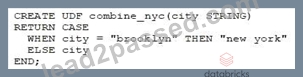
- E.

Answer: E
Explanation:
https://www.databricks.com/blog/2021/10/20/introducing-sql-user-defined-functions.html
NEW QUESTION # 71
A data engineer wants to create a data entity from a couple of tables. The data entity must be used by other data engineers in other sessions. It also must be saved to a physical location.
Which of the following data entities should the data engineer create?
- A. Function
- B. View
- C. Temporary view
- D. Table
- E. Database
Answer: D
Explanation:
Explanation
In the context described, creating a "Table" is the most suitable choice. Tables in SQL are data entities that exist independently of any session and are saved in a physical location. They can be accessed and manipulated by other data engineers in different sessions, which aligns with the requirements stated. A "Database" is a collection of tables, views, and other database objects. A "Function" is a stored procedure that performs an operation. A "View" is a virtual table based on the result-set of an SQL statement, but it is not stored physically. A "Temporary view" is a feature that allows you to store the result of a query as a view that disappears once your session with the database is closed.
NEW QUESTION # 72
A data engineer and data analyst are working together on a data pipeline. The data engineer is working on the raw, bronze, and silver layers of the pipeline using Python, and the data analyst is working on the gold layer of the pipeline using SQL. The raw source of the pipeline is a streaming input. They now want to migrate their pipeline to use Delta Live Tables.
Which of the following changes will need to be made to the pipeline when migrating to Delta Live Tables?
- A. The pipeline will need to stop using the medallion-based multi-hop architecture
- B. The pipeline will need to be written entirely in Python
- C. None of these changes will need to be made
- D. The pipeline will need to use a batch source in place of a streaming source
- E. The pipeline will need to be written entirely in SQL
Answer: C
Explanation:
Delta Live Tables is a declarative framework for building reliable, maintainable, and testable data processing pipelines. You define the transformations to perform on your data and Delta Live Tables manages task orchestration, cluster management, monitoring, data quality, and error handling. Delta Live Tables supports both SQL and Python as the languages for defining your datasets and expectations. Delta Live Tables also supports both streaming and batch sources, and can handle both append-only and upsert data patterns. Delta Live Tables follows the medallion lakehouse architecture, which consists of three layers of data: bronze, silver, and gold. Therefore, migrating to Delta Live Tables does not require any of the changes listed in the options B, C, D, or E. The data engineer and data analyst can use the same languages, sources, and architecture as before, and simply declare their datasets and expectations using Delta Live Tables syntax. References:
* What is Delta Live Tables?
* Transform data with Delta Live Tables
* What is the medallion lakehouse architecture?
NEW QUESTION # 73
A data engineer needs to determine whether to use the built-in Databricks Notebooks versioning or version their project using Databricks Repos.
Which of the following is an advantage of using Databricks Repos over the Databricks Notebooks versioning?
- A. Databricks Repos automatically saves development progress
- B. Databricks Repos supports the use of multiple branches
- C. Databricks Repos provides the ability to comment on specific changes
- D. Databricks Repos is wholly housed within the Databricks Lakehouse Platform
- E. Databricks Repos allows users to revert to previous versions of a notebook
Answer: B
Explanation:
Databricks Repos is a visual Git client and API in Databricks that supports common Git operations such as cloning, committing, pushing, pulling, and branch management. Databricks Notebooks versioning is a legacy feature that allows users to link notebooks to GitHub repositories and perform basic Git operations. However, Databricks Notebooks versioning does not support the use of multiple branches for development work, which is an advantage of using Databricks Repos. With Databricks Repos, users can create and manage branches for different features, experiments, or bug fixes, and merge, rebase, or resolve conflicts between them. Databricks recommends using a separate branch for each notebook and following data science and engineering code development best practices using Git for version control, collaboration, and CI/CD. Reference: Git integration with Databricks Repos - Azure Databricks | Microsoft Learn, Git version control for notebooks (legacy) | Databricks on AWS, Databricks Repos Is Now Generally Available - New 'Files' Feature in ..., Databricks Repos - What it is and how we can use it | Adatis.
NEW QUESTION # 74
A data analysis team has noticed that their Databricks SQL queries are running too slowly when connected to their always-on SQL endpoint. They claim that this issue is present when many members of the team are running small queries simultaneously. They ask the data engineering team for help. The data engineering team notices that each of the team's queries uses the same SQL endpoint.
Which of the following approaches can the data engineering team use to improve the latency of the team's queries?
- A. They can turn on the Auto Stop feature for the SQL endpoint.
- B. They can turn on the Serverless feature for the SQL endpoint.
- C. They can increase the cluster size of the SQL endpoint.
- D. They can increase the maximum bound of the SQL endpoint's scaling range.
- E. They can turn on the Serverless feature for the SQL endpoint and change the Spot Instance Policy to
"Reliability Optimized."
Answer: D
Explanation:
https://community.databricks.com/t5/data-engineering/sequential-vs-concurrency-optimization-questions-from-q
NEW QUESTION # 75
......
Databricks-Certified-Data-Engineer-Associate Study Guide Brilliant Databricks-Certified-Data-Engineer-Associate Exam Dumps PDF: https://www.lead2passed.com/Databricks/Databricks-Certified-Data-Engineer-Associate-practice-exam-dumps.html
Passing Databricks Databricks-Certified-Data-Engineer-Associate Exam Using 2024 Practice Tests: https://drive.google.com/open?id=1qY08BZizcNZuydcikxrHSS0my4FSg6Nd