Apr-2025 Free Databricks-Certified-Data-Engineer-Associate Test Questions Real Practice Test Questions
Databricks-Certified-Data-Engineer-Associate Dumps Updated Apr 26, 2025 WIith 102 Questions
Databricks Certified Data Engineer Associate certification exam is a computer-based exam that consists of 60 multiple-choice questions. Candidates are given two hours to complete the exam, and they must score at least 70% to pass. Databricks-Certified-Data-Engineer-Associate exam is available in multiple languages, including English, Spanish, French, German, and Japanese.
One of the unique features of the Databricks Certified Data Engineer Associate certification is that it is focused on Databricks, a cloud-based big data processing platform. Databricks is becoming increasingly popular among data professionals, and the certification is designed to test individuals' knowledge of this platform. This makes the certification especially valuable for individuals who work with Databricks or plan to work with it in the future.
NEW QUESTION # 22
A data engineer wants to create a relational object by pulling data from two tables. The relational object does not need to be used by other data engineers in other sessions. In order to save on storage costs, the data engineer wants to avoid copying and storing physical data.
Which of the following relational objects should the data engineer create?
- A. Database
- B. Temporary view
- C. Delta Table
- D. Spark SQL Table
- E. View
Answer: B
Explanation:
A temporary view is a relational object that is defined in the metastore and points to an existing DataFrame. It does not copy or store any physical data, but only saves the query that defines the view. The lifetime of a temporary view is tied to the SparkSession that was used to create it, so it does not persist across different sessions or applications. A temporary view is useful for accessing the same data multiple times within the same notebook or session, without incurring additional storage costs. The other options are either materialized (A, E), persistent (B, C), or not relational objects. References: Databricks Documentation - Temporary View, Databricks Community - How do temp views actually work?, Databricks Community - What's the difference between a Global view and a Temp view?, Big Data Programmers - Temporary View in Databricks.
NEW QUESTION # 23
Which of the following SQL keywords can be used to convert a table from a long format to a wide format?
- A. TRANSFORM
- B. SUM
- C. PIVOT
- D. WHERE
- E. CONVERT
Answer: C
Explanation:
The SQL keyword that can be used to convert a table from a long format to a wide format is PIVOT. The PIVOT clause is used to rotate the rows of a table into columns of a new table1. The PIVOT clause can aggregate the values of a column based on the distinct values of another column, and use those values as the column names of the new table1. The PIVOT clause can be useful for transforming data from a long format, where each row represents an observation with multiple attributes, to a wide format, where each row represents an observation with a single attribute and multiple values2. For example, the PIVOT clause can be used to convert a table that contains the sales of different products by different regions into a table that contains the sales of each product by each region as separate columns1.
The other options are not suitable for converting a table from a long format to a wide format. CONVERT is a function that can be used to change the data type of an expression3. WHERE is a clause that can be used to filter the rows of a table based on a condition4. TRANSFORM is a keyword that can be used to apply a user-defined function to a group of rows in a table5. SUM is a function that can be used to calculate the total of a numeric column.
References:
* 1: PIVOT | Databricks on AWS
* 2: Reshaping Data - Long vs Wide Format | Databricks on AWS
* 3: CONVERT | Databricks on AWS
* 4: WHERE | Databricks on AWS
* 5: TRANSFORM | Databricks on AWS
* : [SUM | Databricks on AWS]
NEW QUESTION # 24
Which of the following Git operations must be performed outside of Databricks Repos?
- A. Merge
- B. Push
- C. Commit
- D. Pull
- E. Clone
Answer: A
Explanation:
Databricks Repos is a visual Git client and API in Databricks that supports common Git operations such as commit, pull, push, branch management, and visual comparison of diffs when committing1. However, merge is not supported in the Git dialog2. You need to use the Repos UI or your Git provider to merge branches3. Merge is a way to combine the commit history from one branch into another branch1. During a merge, a merge conflict is encountered when Git cannot automatically combine code from one branch into another. Merge conflicts require manual resolution before a merge can be completed1. Reference: 4: Run Git operations on Databricks Repos4, 1: CI/CD techniques with Git and Databricks Repos1, 3: Collaborate in Repos3, 2: Databricks Repos - What it is and how we can use it2.
Databricks Repos is a visual Git client and API in Databricks that supports common Git operations such as commit, pull, push, merge, and branch management. However, to clone a remote Git repository to a Databricks repo, you must use the Databricks UI or API. You cannot clone a Git repo using the CLI through a cluster's web terminal, as the files won't display in the Databricks UI1. Reference: 1: Run Git operations on Databricks Repos | Databricks on AWS2
NEW QUESTION # 25
Which of the following commands will return the location of database customer360?
- A. DESCRIBE LOCATION customer360;
- B. DESCRIBE DATABASE customer360;
- C. DROP DATABASE customer360;
- D. USE DATABASE customer360;
- E. ALTER DATABASE customer360 SET DBPROPERTIES ('location' = '/user'};
Answer: B
Explanation:
Explanation
To retrieve the location of a database named "customer360" in a database management system like Hive or Databricks, you can use the DESCRIBE DATABASE command followed by the database name. This command will provide information about the database, including its location.
NEW QUESTION # 26
A data engineer has realized that they made a mistake when making a daily update to a table. They need to use Delta time travel to restore the table to a version that is 3 days old. However, when the data engineer attempts to time travel to the older version, they are unable to restore the data because the data files have been deleted.
Which of the following explains why the data files are no longer present?
- A. The OPTIMIZE command was nun on the table
- B. The DELETE HISTORY command was run on the table
- C. The TIME TRAVEL command was run on the table
- D. The HISTORY command was run on the table
- E. The VACUUM command was run on the table
Answer: E
Explanation:
The VACUUM command is used to remove files that are no longer referenced by a Delta table and are older than the retention threshold1. The default retention period is 7 days2, but it can be changed by setting the delta.logRetentionDuration and delta.deletedFileRetentionDuration configurations3. If the VACUUM command was run on the table with a retention period shorter than 3 days, then the data files that were needed to restore the table to a 3-day-old version would have been deleted. The other commands do not delete data files from the table. The TIME TRAVEL command is used to query a historical version of the table4. The DELETE HISTORY command is not a valid command in Delta Lake. The OPTIMIZE command is used to improve the performance of the table by compacting small files into larger ones5. The HISTORY command is used to retrieve information about the operations performed on the table. Reference: 1: VACUUM | Databricks on AWS 2: Work with Delta Lake table history | Databricks on AWS 3: [Delta Lake configuration | Databricks on AWS] 4: Work with Delta Lake table history - Azure Databricks 5: [OPTIMIZE | Databricks on AWS] : [HISTORY | Databricks on AWS]
NEW QUESTION # 27
Which of the following commands can be used to write data into a Delta table while avoiding the writing of duplicate records?
- A. APPEND
- B. MERGE
- C. INSERT
- D. DROP
- E. IGNORE
Answer: B
NEW QUESTION # 28
A data engineer has configured a Structured Streaming job to read from a table, manipulate the data, and then perform a streaming write into a new table.
The cade block used by the data engineer is below: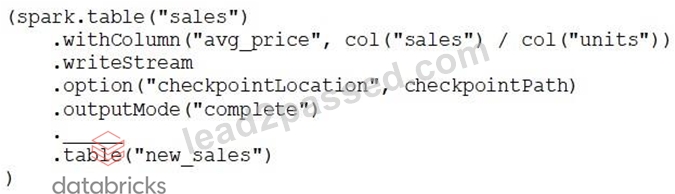
If the data engineer only wants the query to execute a micro-batch to process data every 5 seconds, which of the following lines of code should the data engineer use to fill in the blank?
- A. trigger()
- B. trigger(processingTime="5 seconds")
- C. trigger(continuous="5 seconds")
- D. trigger("5 seconds")
- E. trigger(once="5 seconds")
Answer: B
Explanation:
Explanation
# ProcessingTime trigger with two-seconds micro-batch interval
df.writeStream \
format("console") \
trigger(processingTime='2 seconds') \
start()
https://spark.apache.org/docs/latest/structured-streaming-programming-guide.html#triggers
NEW QUESTION # 29
A data engineer wants to schedule their Databricks SQL dashboard to refresh once per day, but they only want the associated SQL endpoint to be running when it is necessary.
Which of the following approaches can the data engineer use to minimize the total running time of the SQL endpoint used in the refresh schedule of their dashboard?
- A. They can turn on the Auto Stop feature for the SQL endpoint.
- B. They can reduce the cluster size of the SQL endpoint.
- C. They can ensure the dashboard's SQL endpoint matches each of the queries' SQL endpoints.
- D. They can ensure the dashboard's SQL endpoint is not one of the included query's SQL endpoint.
- E. They can set up the dashboard's SQL endpoint to be serverless.
Answer: E
Explanation:
A serverless SQL endpoint is a compute resource that is automatically managed by Databricks and scales up or down based on the workload. A serverless SQL endpoint can be used to run queries and dashboards without requiring manual configuration or management. A serverless SQL endpoint is only active when it is needed and shuts down automatically when idle, minimizing the total running time and cost. A serverless SQL endpoint can be created and assigned to a dashboard using the Databricks SQL UI or the SQL Analytics API. Reference:
Create a serverless SQL endpoint
Assign a SQL endpoint to a dashboard
SQL Analytics API
NEW QUESTION # 30
A data engineer needs to use a Delta table as part of a data pipeline, but they do not know if they have the appropriate permissions.
In which of the following locations can the data engineer review their permissions on the table?
- A. Jobs
- B. Repos
- C. Data Explorer
- D. Databricks Filesystem
- E. Dashboards
Answer: C
Explanation:
Data Explorer is a graphical interface that allows you to browse, create, and manage data objects such as databases, tables, and views in your workspace. You can also review and modify the permissions on these data objects using Data Explorer. To access Data Explorer, you can click on the Data icon in the sidebar, or use the %sql magic command in a notebook. You can then select a database and a table, and click on the Permissions tab to view and edit the access control lists (ACLs) for the table. You can also use SQL commands such as SHOW GRANT and GRANT to query and modify the permissions on a Delta table. Reference:
Data Explorer
Access control for Delta tables
SHOW GRANT
[GRANT]
NEW QUESTION # 31
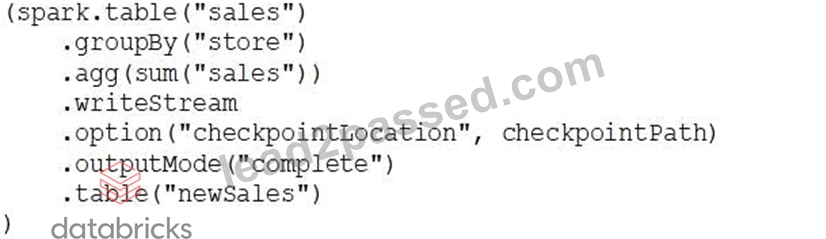
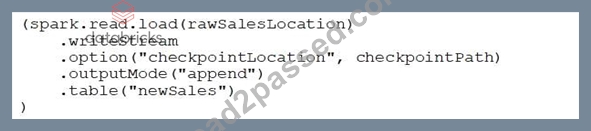
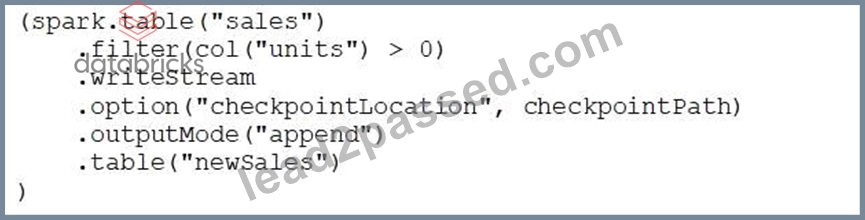
Which of the following Structured Streaming queries is performing a hop from a Silver table to a Gold table?
- A.
- B.
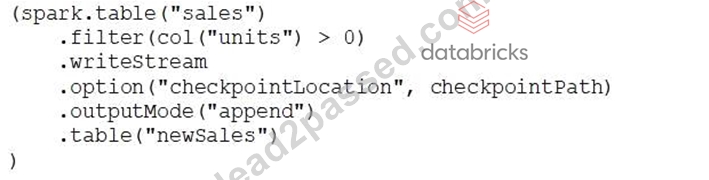
- C.
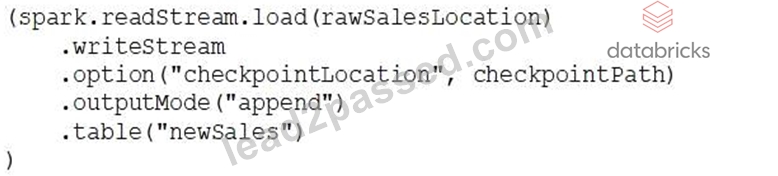
- D.
- E.

Answer: A
Explanation:
The best practice is to use "Complete" as output mode instead of "append" when working with aggregated tables. Since gold layer is work final aggregated tables, the only option with output mode as complete is option E.
NEW QUESTION # 32
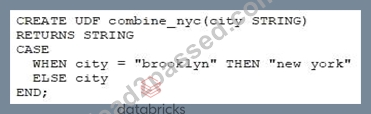
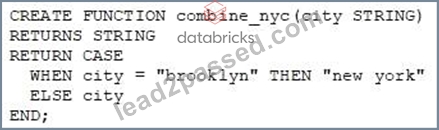
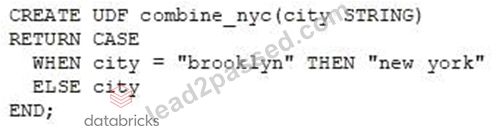
A data engineer needs to apply custom logic to string column city in table stores for a specific use case. In order to apply this custom logic at scale, the data engineer wants to create a SQL user-defined function (UDF).
Which of the following code blocks creates this SQL UDF?
- A.
- B.
- C.
- D.
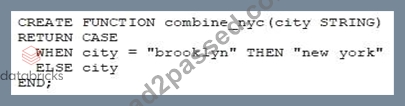
- E.
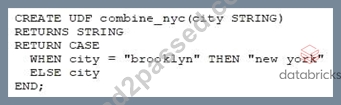
Answer: B
Explanation:
https://www.databricks.com/blog/2021/10/20/introducing-sql-user-defined-functions.html
NEW QUESTION # 33
A data engineer wants to create a new table containing the names of customers that live in France.
They have written the following command: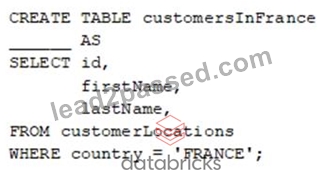
A senior data engineer mentions that it is organization policy to include a table property indicating that the new table includes personally identifiable information (PII).
Which of the following lines of code fills in the above blank to successfully complete the task?
- A. "COMMENT PII"
- B. PII
- C. COMMENT "Contains PII"
- D. TBLPROPERTIES PII
- E. There is no way to indicate whether a table contains PII.
Answer: C
Explanation:
In Databricks, when creating a table, you can add a comment to columns or the entire table to provide more information about the data it contains. In this case, since it's organization policy to indicate that the new table includes personally identifiable information (PII), option D is correct. The line of code would be added after defining the table structure and before closing with a semicolon. Reference: Data Engineer Associate Exam Guide, CREATE TABLE USING (Databricks SQL)
NEW QUESTION # 34
Which of the following data lakehouse features results in improved data quality over a traditional data lake?
- A. A data lakehouse provides storage solutions for structured and unstructured data.
- B. A data lakehouse stores data in open formats.
- C. A data lakehouse allows the use of SQL queries to examine data.
- D. A data lakehouse supports ACID-compliant transactions.
- E. A data lakehouse enables machine learning and artificial Intelligence workloads.
Answer: D
Explanation:
A data lakehouse is a data management architecture that combines the flexibility, cost-efficiency, and scale of data lakes with the data management and ACID transactions of data warehouses, enabling business intelligence (BI) and machine learning (ML) on all data12. One of the key features of a data lakehouse is that it supports ACID-compliant transactions, which means that it ensures data integrity, consistency, and isolation across concurrent read and write operations3. This feature results in improved data quality over a traditional data lake, which does not support transactions and may suffer from data corruption, duplication, or inconsistency due to concurrent or streaming data ingestion and processing . Reference: 1: What is a Data Lakehouse? - Databricks 2: What is a Data Lakehouse? Definition, features & benefits. - Qlik 3: ACID Transactions - Databricks : [Data Lake vs Data Warehouse: Key Differences] : [Data Lakehouse: The Future of Data Engineering]
NEW QUESTION # 35
A data analysis team has noticed that their Databricks SQL queries are running too slowly when connected to their always-on SQL endpoint. They claim that this issue is present when many members of the team are running small queries simultaneously. They ask the data engineering team for help. The data engineering team notices that each of the team's queries uses the same SQL endpoint.
Which of the following approaches can the data engineering team use to improve the latency of the team's queries?
- A. They can turn on the Auto Stop feature for the SQL endpoint.
- B. They can turn on the Serverless feature for the SQL endpoint.
- C. They can increase the cluster size of the SQL endpoint.
- D. They can turn on the Serverless feature for the SQL endpoint and change the Spot Instance Policy to "Reliability Optimized."
- E. They can increase the maximum bound of the SQL endpoint's scaling range.
Answer: E
Explanation:
https://community.databricks.com/t5/data-engineering/sequential-vs-concurrency-optimization-questions-from-query/td-p/36696
NEW QUESTION # 36
A data engineer has been using a Databricks SQL dashboard to monitor the cleanliness of the input data to an ELT job. The ELT job has its Databricks SQL query that returns the number of input records containing unexpected NULL values. The data engineer wants their entire team to be notified via a messaging webhook whenever this value reaches 100.
Which of the following approaches can the data engineer use to notify their entire team via a messaging webhook whenever the number of NULL values reaches 100?
- A. They can set up an Alert with one-time notifications.
- B. They can set up an Alert with a new webhook alert destination.
- C. They can set up an Alert without notifications.
- D. They can set up an Alert with a custom template.
- E. They can set up an Alert with a new email alert destination.
Answer: B
Explanation:
A webhook alert destination is a way to send notifications to external applications or services via HTTP requests. A data engineer can use a webhook alert destination to notify their entire team via a messaging webhook, such as Slack or Microsoft Teams, whenever the number of NULL values in the input data reaches
100. To set up a webhook alert destination, the data engineer needs to do the following steps:
* In the Databricks SQL workspace, navigate to the Settings gear icon and select SQL Admin Console.
* Click Alert Destinations and click Add New Alert Destination.
* Select Webhook and enter the webhook URL and the optional custom template for the notification message.
* Click Create to save the webhook alert destination.
* In the Databricks SQL editor, create or open the query that returns the number of input records containing unexpected NULL values.
* Click the Create Alert icon above the editor window and configure the alert criteria, such as the value column, the condition, and the threshold.
* In the Notification section, select the webhook alert destination that was created earlier and click Create Alert. References: What are Databricks SQL alerts?, Monitor alerts, Monitoring Your Business with Alerts, Using Automation Runbook Webhooks To Alert on Databricks Status Updates.
NEW QUESTION # 37
A data architect has determined that a table of the following format is necessary: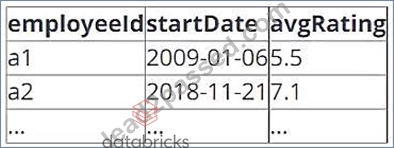
Which of the following code blocks uses SQL DDL commands to create an empty Delta table in the above format regardless of whether a table already exists with this name?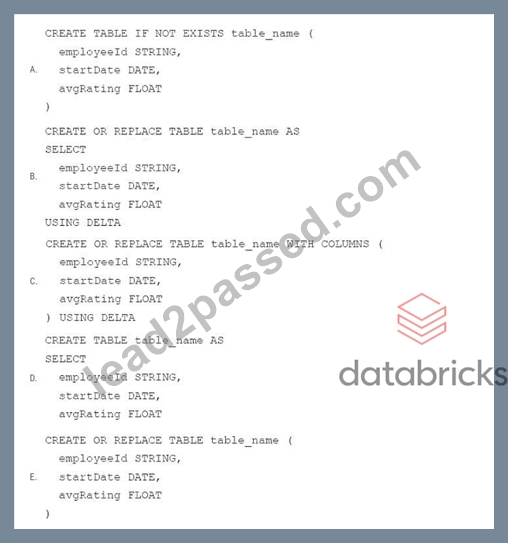
- A. Option A
- B. Option E
- C. Option C
- D. Option D
- E. Option B
Answer: B
NEW QUESTION # 38
A data engineer has three tables in a Delta Live Tables (DLT) pipeline. They have configured the pipeline to drop invalid records at each table. They notice that some data is being dropped due to quality concerns at some point in the DLT pipeline. They would like to determine at which table in their pipeline the data is being dropped.
Which of the following approaches can the data engineer take to identify the table that is dropping the records?
- A. They cannot determine which table is dropping the records.
- B. They can navigate to the DLT pipeline page, click on the "Error" button, and review the present errors.
- C. They can set up separate expectations for each table when developing their DLT pipeline.
- D. They can set up DLT to notify them via email when records are dropped.
- E. They can navigate to the DLT pipeline page, click on each table, and view the data quality statistics.
Answer: E
Explanation:
One of the features of DLT is that it provides data quality metrics for each dataset in the pipeline, such as the number of records that pass or fail expectations, the number of records that are dropped, and the number of records that are written to the target. These metrics can be accessed from the DLT pipeline page, where the data engineer can click on each table and view the data quality statistics for the latest update or any previous update. This way, they can identify which table is dropping the records and why. Reference:
Monitor Delta Live Tables pipelines
Manage data quality with Delta Live Tables
NEW QUESTION # 39
A data engineer is designing a data pipeline. The source system generates files in a shared directory that is also used by other processes. As a result, the files should be kept as is and will accumulate in the directory. The data engineer needs to identify which files are new since the previous run in the pipeline, and set up the pipeline to only ingest those new files with each run.
Which of the following tools can the data engineer use to solve this problem?
- A. Databricks SQL
- B. Unity Catalog
- C. Data Explorer
- D. Delta Lake
- E. Auto Loader
Answer: E
Explanation:
Auto Loader is a tool that can incrementally and efficiently process new data files as they arrive in cloud storage without any additional setup. Auto Loader provides a Structured Streaming source called cloudFiles, which automatically detects and processes new files in a given input directory path on the cloud file storage.
Auto Loader also tracks the ingestion progress and ensures exactly-once semantics when writing data into Delta Lake. Auto Loader can ingest various file formats, such as JSON, CSV, XML, PARQUET, AVRO, ORC, TEXT, and BINARYFILE. Auto Loader has support for both Python and SQL in Delta Live Tables, which are a declarative way to build production-quality data pipelines with Databricks. References: What is Auto Loader?, Get started with Databricks Auto Loader, Auto Loader in Delta Live Tables
NEW QUESTION # 40
Which of the following statements regarding the relationship between Silver tables and Bronze tables is always true?
- A. Silver tables contain less data than Bronze tables.
- B. Silver tables contain aggregates while Bronze data is unaggregated.
- C. Silver tables contain a less refined, less clean view of data than Bronze data.
- D. Silver tables contain more data than Bronze tables.
- E. Silver tables contain a more refined and cleaner view of data than Bronze tables.
Answer: D
Explanation:
Explanation
https://www.databricks.com/glossary/medallion-architecture
NEW QUESTION # 41
A data architect has determined that a table of the following format is necessary:
Which of the following code blocks uses SQL DDL commands to create an empty Delta table in the above format regardless of whether a table already exists with this name?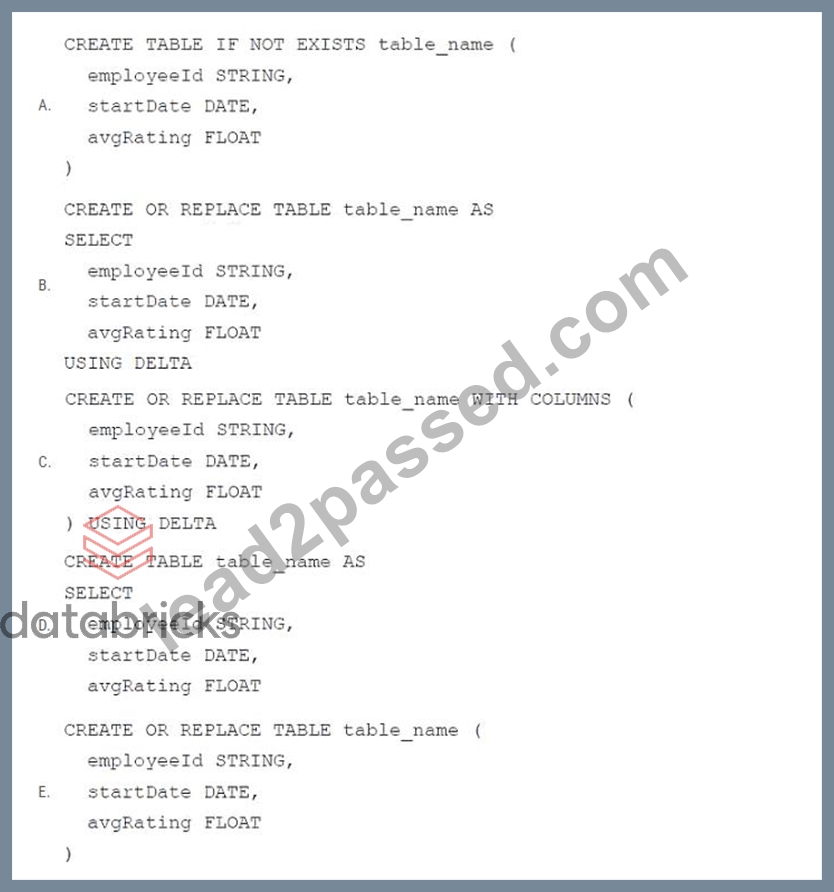
- A. Option A
- B. Option E
- C. Option C
- D. Option D
- E. Option B
Answer: B
NEW QUESTION # 42
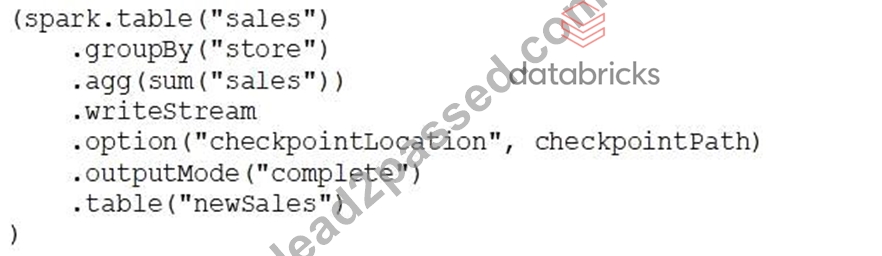
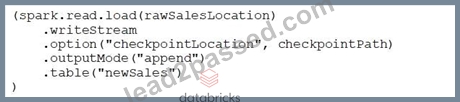
Which of the following Structured Streaming queries is performing a hop from a Silver table to a Gold table?
- A.

- B.
- C.
- D.
- E.

Answer: B
Explanation:
The best practice is to use "Complete" as output mode instead of "append" when working with aggregated tables. Since gold layer is work final aggregated tables, the only option with output mode as complete is option
NEW QUESTION # 43
In order for Structured Streaming to reliably track the exact progress of the processing so that it can handle any kind of failure by restarting and/or reprocessing, which of the following two approaches is used by Spark to record the offset range of the data being processed in each trigger?
- A. Checkpointing and Write-ahead Logs
- B. Write-ahead Logs and Idempotent Sinks
- C. Replayable Sources and Idempotent Sinks
- D. Checkpointing and Idempotent Sinks
- E. Structured Streaming cannot record the offset range of the data being processed in each trigger.
Answer: A
Explanation:
Structured Streaming uses checkpointing and write-ahead logs to record the offset range of the data being processed in each trigger. This ensures that the engine can reliably track the exact progress of the processing and handle any kind of failure by restarting and/or reprocessing. Checkpointing is the mechanism of saving the state of a streaming query to fault-tolerant storage (such as HDFS) so that it can be recovered after a failure.
Write-ahead logs are files that record the offset range of the data being processed in each trigger and are written to the checkpoint location before the processing starts. These logs are used to recover the query state and resume processing from the last processed offset range in case of a failure. References: Structured Streaming Programming Guide, Fault Tolerance Semantics
NEW QUESTION # 44
A data engineer and data analyst are working together on a data pipeline. The data engineer is working on the raw, bronze, and silver layers of the pipeline using Python, and the data analyst is working on the gold layer of the pipeline using SQL The raw source of the pipeline is a streaming input. They now want to migrate their pipeline to use Delta Live Tables.
Which change will need to be made to the pipeline when migrating to Delta Live Tables?
- A. The pipeline can have different notebook sources in SQL & Python.
- B. The pipeline will need to use a batch source in place of a streaming source.
- C. The pipeline will need to be written entirely in Python.
- D. The pipeline will need to be written entirely in SQL.
Answer: A
Explanation:
When migrating to Delta Live Tables (DLT) with a data pipeline that involves different programming languages across various data layers, the migration does not require unifying the pipeline into a single language. Delta Live Tables support multi-language pipelines, allowing data engineers and data analysts to work in their preferred languages, such as Python for data engineering tasks (raw, bronze, and silver layers) and SQL for data analytics tasks (gold layer). This capability is particularly beneficial in collaborative settings and leverages the strengths of each language for different stages of data processing.
Reference:
Databricks documentation on Delta Live Tables: Delta Live Tables Guide
NEW QUESTION # 45
......
Databricks Certified Data Engineer Associate certification provides candidates with a globally recognized credential that can help them stand out in a competitive job market. It is a valuable asset for professionals seeking career advancement opportunities in the data engineering field. Overall, the GAQM Databricks-Certified-Data-Engineer-Associate certification exam provides a comprehensive assessment of candidates' skills and knowledge in working with Databricks, making it an essential certification for data engineers, data architects, and developers.
View All Databricks-Certified-Data-Engineer-Associate Actual Free Exam Questions Updated: https://www.lead2passed.com/Databricks/Databricks-Certified-Data-Engineer-Associate-practice-exam-dumps.html
Pass Authentic Databricks Databricks-Certified-Data-Engineer-Associate with Free Practice Tests and Exam Dumps: https://drive.google.com/open?id=1b_suvT305xkNuNyzfiHYKq2GXVeMDwMm