ISQI CTAL-TM_Syll2012 Dumps - The Sure Way To Pass Exam
CTAL-TM_Syll2012 Exam Questions (Updated 2021) 100% Real Question Answers
NEW QUESTION 13
Reviews
You are the Test Manager of a project that adopts a V-model with four formal levels of testing: unit, integration, system and acceptance testing.
On this project reviews have been conducted for each development phase prior to testing, which is to say that reviews of requirements, functional specification, high-level design, low-level design and code have been performed prior to testing.
Assume that no requirements defects have been reported after the release of the product.
Which TWO of the following metrics do you need in order to evaluate the requirements reviews in terms of phase containment effectiveness?
- A. Number of defects found during the requirements review
- B. Total number of defects attributable to requirements found during unit, integration, system and acceptance testing
- C. Time to conduct the requirements review
- D. Total number of defects found during functional specification review, high-level design review, low-level design review, code review, unit testing, integration testing, system testing and acceptance testing
- E. Total number of defects attributable to requirements, found during functional specification review, high- level design review, low-level design review, code review, unit testing, integration testing, system testing and acceptance testing
Answer: A,E
NEW QUESTION 14
Improving the Testing Process
Which of the following statements about the TMMi test process improvement model is true?
- A. TMMi provides an approach for test process improvement such as the IDEAL (Initiating, Diagnosing, Establishing, Acting and Learning) model
- B. At TMMi level 1 testing is chaotic without a defined process, and it is often seen as the same as debugging
- C. In TMMi all the process areas at lower levels must be 75% complete by achieving specific and generic goals in order to claim the higher level
- D. TMMi has a staged architecture for process improvement with seven maturity levels
Answer: B
NEW QUESTION 15
People Skills - Team Composition
Assume you are managing the system testing execution phase of a project.
The system test execution period for that project is scheduled for eighteen weeks and the release date is scheduled at the end of system testing.
During the sixth week of system test execution, at the staff meeting, the project manager informs you that the project deadlines are changed and the release date that is only three weeks ahead.
This new release will not allow the completion of the system tests. Suppose also that you have followed a risk-driven test approach for this project.
Which of the following statements represents the worst way to lead your test team in the next three weeks?
Number of correct responses: 1
K2 1 credit
- A. Favor and encourage a proactive attitude where people ask for new tasks as soon as they finish their current tasks
- B. Convince all the people of your test team that each of them is an important and needed member, and that their contribution is fundamental to the success of the team
- C. Neglect your management activities and work side-by-side with your test team executing tests
- D. Considering the executed tests, you should reduce the test coverage back on the risk analysis and adjust downward the priority of the associated risk items
Answer: C
NEW QUESTION 16
Test Management
You are performing a quality risk analysis for a CSCI (Computer Software Configuration Item) used to implement a CBIT (Continuous Built-In Test) module of a safety-critical system.
During the quality risk analysis you are trying to identify the ways in which failures of the CBIT module can occur, for each of them trying to determine the potential causes and likely effects, and the risk level (calculated as the product of three factors: severity, occurrence and detection).
Which of the following risk analysis techniques are you working with?
- A. Failure Mode and Effect Analysis
- B. Cost of Exposure
- C. Wide Band Delphi
- D. A lightweight product risk analysis technique
Answer: A
Explanation:
Section: Test Management
NEW QUESTION 17
Test Management
You are the Test Manager of a new project aimed at developing a software system that must be certified at level B of the DO-178B standard. The project will follow a V-Model software development life cycle and it will have four formal levels of testing: component, integration, system and acceptance testing.
You must produce the test plan documentation for this project by providing an adequate coordination across the four levels of testing in order to assure auditability.
Which of the following answers would you expect to best describe how to organize the test plan?
Number of correct responses: 1
K3 2 credits
- A. Produce a master test plan describing the relationship between the four levels, and four separate detailed level test plans, one for each level
- B. Produce a single master test plan that covers in detail all four levels, describing the particular activities for all test levels
- C. Produce four separate detailed level test plans, one for each level, without a master test plan
- D. Produce a master test plan that covers three levels (component, integration, system test) and a separate acceptance test plan
Answer: A
NEW QUESTION 18
Test Management
In the next two months some new features will be constantly added to new releases of a project you are working on as Test Manager.
You have identified as one of the main project risks, that the requirements specification will still be incomplete when your team starts the test design and implementation phase.
Some requirements will most likely be completed too late to allow a proper test preparation.
You and your test team have already worked on several similar past projects in the same organization.
Which one of the following options would you expect to be the most effective at mitigating this risk?
- A. Even if there are only few details missing, escalate the risk to the project manager without preparing any tests
- B. Make reasonable assumptions about the missing details and design lightweight tests that can be easily updated during test execution
- C. Don't prepare any test and just run the regression test suite to check that the new features don't introduce regression
- D. Don't design any test until the test execution starts, then communicate that test execution is blocked due to incomplete requirements
Answer: B
Explanation:
Section: Test Management
NEW QUESTION 19
Test Management
You are estimating the effort for the integration testing activities of a new project. Consider the following factors, which can affect that estimation:
I. Availability of re-usable test systems and documentation from previous, similar projects II. Unexpected timing of components arrival III. Stability of the integration test team (no turnover) IV. Many and geographically distributed sub-teams Which of the following statements is true?
- A. I.and II. usually favor the accuracy of the estimation effort
- B. II. and IV. can negatively affect the estimation
- C. III. and IV. usually favor the accuracy of the estimation effort
- D. II. and III. can negatively affect the estimation
- E. II. and III. usually favor the accuracy of the estimation effort
- F. I.and II. can negatively affect the estimation III. and IV. usually favor the accuracy of the estimation effort
- G. III. and IV. can negatively affect the estimation
Answer: C
Explanation:
Section: Test Management
NEW QUESTION 20
Test Management
Assume you are managing the system testing phase of a project.
The system test execution period is scheduled to twenty weeks.
All tests are manual tests. You are following a risk-driven test approach.
During the last staff meeting the project manager tells you new deadlines that will not allow completion of all the system tests.
Which of the following would you expect to be the best way to respond to this situation?
- A. Automate all remaining tests
- B. No action is needed, test as much as possible in the remaining time period
- C. Remove testers from your test team, so that they can be assigned to other projects
- D. Prioritize executing the tests for the highest product risks and track these risks
Answer: D
NEW QUESTION 21
Consider an information system of a Pay-Tv company based on a SOA architecture.
The integrated system currently consists of three core systems:
-
a CRM (Customer Relationship Management) system
-
a BRM (Billing and Revenue Management) system
-
a CAS (Conditional Access System) system all of them communicating with SOA Middleware.
You have been asked to manage the testing activities for the integration of two additional off-theshelf systems from two different vendors: a SMS (Short Message Service) server and an IVR (Interactive Voice Response) system.
Assume that there is a high likelihood that the two off-the-shelf systems will be low-quality and that you have a clear proof that the testing performed by the two vendors on their systems has been unsystematic and unprofessional. This obviously leads to higher quality risk for the overall integrated system.
You are the Test Manager of this project. Your main goal is to plan for testing activities to mitigate this risk.
Which of the following answers best describes the test activities (assuming it is possible to perform all of them) you should plan for?
K4 3 credits
- A. You should directly plan for a single end-to-end test focused on end-to-end tests of the overall integrated system without an acceptance test of the two off-the-shelf systems
- B. You should plan for an informal and minimal acceptance test of the two off-the-shelf systems and then a single end-to-end test of the overall integrated system
- C. You should plan for two levels: a system integration test and an end-to-end test of the overall integrated system
- D. You should plan for adequate re-testing of both the systems followed by a system integration test and an end-to-end test of the overall integrated system
Answer: D
NEW QUESTION 22
Assume you are a Test Manager involved in system testing of a CRM application for a Pay-TV company. Currently the application is able to support a proper number of users assuring the required responsiveness. Since the business is expected to grow, you have been asked to evaluate the ability of the application to grow to support more users while maintaining the same responsiveness.
Which of the following tools would you expect to be the most useful at performing this evaluation?
K2 1 credit
- A. Static analysis tools
- B. Coverage tools
- C. Performance tools
- D. Test management tools
Answer: C
Explanation:
Topic 7, People Skills - Team Composition
NEW QUESTION 23
Test Management
Which one of the following metrics to be produced needs traceability between the test cases and each item in a proper test basis?
- A. Requirements coverage
- B. Cumulative number of reported defects versus cumulative number of resolved defects
- C. Trends in the lag time from defect reporting to resolution
- D. Mean time between failures for the system
Answer: A
Explanation:
Section: Test Management
NEW QUESTION 24
Test Management
Consider the following test strategies:
I. Consultative test strategy
II. Reactive test strategy
III. Analytical test strategy
IV. Process-compliant test strategy
Consider also the following examples of test activities:
1. Prioritize the test cases, based on the results of a FMEA analysis, to ensure early coverage of the most important areas and discovery of the most important defects during test execution
2. Execute usability testing driven by the guidance of a sample of users (external to the test team)
3. Perform exploratory testing sessions throughout the system test phase
4. On an Agile project, execute tests that cover the test conditions identified for each user story of a feature planned for an iteration
Which of the following correctly matches each test strategy with an appropriate example?
- A. I-2; II-3; III-4; IV-1
- B. I-1; II-2; III-3; IV-4
- C. I-3; II-2; III-1; IV-4
- D. I-2; II-3; III-1; IV-4
Answer: D
NEW QUESTION 25
Test Management
Assume you are currently working on a project developing a system where functional requirements are very well specified. Unfortunately non-functional requirements do almost not exist.
You are the Test Manager. You have to choose a technique for test selection that allows testing of non- functional characteristics, especially reliability.
Which of the following techniques for test selection do you expect being most useful in this scenario?
- A. Cause-effect graphing
- B. Test condition analysis
- C. A model-based technique based on the creation of operational profiles
- D. Ambiguity reviews
Answer: C
Explanation:
Section: Test Management
Explanation/Reference:
NEW QUESTION 26
Test Management
You are managing the system testing for a SOA based system. The integrated system consists of several subsystems:
- a SOA middleware
- a CRM (Customer Relationship Management) system
- a BRM (Billing and Revenue Management) system
- a SMS (Subscriber Management System) system
and you performed a risk analysis based on these subsystems.
At the end of the scheduled period for test execution you produce a first classical report based on the traditional metrics of testing. Test pass/fail status and bug status (open/resolved) That table provides you a distorted picture of the quality risk, because there is no indication of the risk level of the failed tests, the tests not run, or the open bugs. Thus, you produce the following table to solve this distortion issue: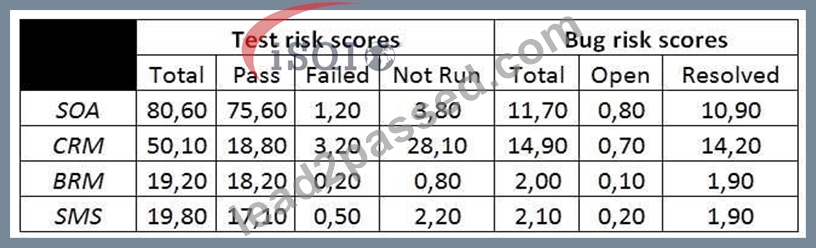
In the table above, where you have introduced the concept of risk weighting, the highest risk test or bug report has a score of 1, while the lowest risk test or bug report has a score of 0.04.
Which of the following subsystems, based on the risk scores of the table, is most risky?
- A. SMS
- B. CRM
- C. SOA
- D. BRM
Answer: B
Explanation:
Section: Test Management
Explanation/Reference:
NEW QUESTION 27
Test Management
You are managing the system testing for a SOA based system. The integrated system consists of several subsystems:
- a SOA middleware
- a CRM (Customer Relationship Management) system
- a BRM (Billing and Revenue Management) system
- a SMS (Subscriber Management System) system
and you performed a risk analysis based on these subsystems.
At the end of the scheduled period for test execution you produce a first classical report based on the traditional metrics of testing. Test pass/fail status and bug status (open/resolved) That table provides you a distorted picture of the quality risk, because there is no indication of the risk level of the failed tests, the tests not run, or the open bugs. Thus, you produce the following table to solve this distortion issue: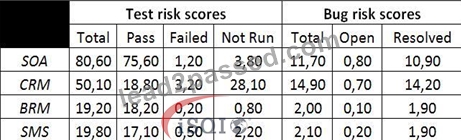
In the table above, where you have introduced the concept of risk weighting, the highest risk test or bug report has a score of 1, while the lowest risk test or bug report has a score of 0.04.
Which of the following subsystems, based on the risk scores of the table, is most risky?
Number of correct responses: 1
K4 3 credits
- A. SMS
- B. CRM
- C. SOA
- D. BRM
Answer: B
NEW QUESTION 28
Test Management
Assume you are managing the system testing phase of a project.
The system test execution period is scheduled to twenty weeks.
All tests are manual tests. You are following a risk-driven test approach.
During the last staff meeting the project manager tells you new deadlines that will not allow completion of all the system tests.
Which of the following would you expect to be the best way to respond to this situation?
- A. Automate all remaining tests
- B. No action is needed, test as much as possible in the remaining time period
- C. Remove testers from your test team, so that they can be assigned to other projects
- D. Prioritize executing the tests for the highest product risks and track these risks
Answer: D
Explanation:
Section: Test Management
NEW QUESTION 29
Which of the following is an example of the test closure activity indicated as "lessons learned"?
K2 1 credit
- A. Deliver an automated regression test suite, used during the system test phase of a software product released into production, to the team responsible for maintenance testing
- B. Participate in a meeting at the end of a project aimed at better managing the events and problems of future projects
- C. Archive all the test results of the acceptance testing phase
- D. Deliver a list of the open defects of a software product released into production to the service desk team
Answer: B
NEW QUESTION 30
......
Pass ISQI CTAL-TM_Syll2012 Exam Quickly With Lead2Passed: https://www.lead2passed.com/ISQI/CTAL-TM_Syll2012-practice-exam-dumps.html
Prepare CTAL-TM_Syll2012 Question Answers - CTAL-TM_Syll2012 Exam Dumps: https://drive.google.com/open?id=10V14TLTrPeqZUDtGblFmMRMV0XvM-nT1